
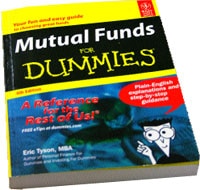
 With stock markets having created unprecedented wealth in the past few years investors are thinking of ways to invest wisely, spread risks and maximise opportunities to grow value. With increasing frequency, investors are looking to find attractive mutual funds that express their social, political, fashion, or even dietary choices. As always, mutual funds are high on nearly every investor’s list and so is the desire to pick up self-help investing books like this one. Mutual Fund for Dummies leaves one with a lot of queries answered but some that remain.
It’s strange that a dummies book does not get into a jargon breaking chapter or issues that are loaded with risks both real and imaginary; and should be heeded with discretion or, better still, not at all. But you still come across jargons that state “the statements that follow are forward-looking, backward-looking and occasionally sideways-glancing” but contain little valuable information.
But let’s start with some of the redeeming points in the book. Eric Tyson, with many titles under his belt, has a good grasp on the layout. The chapters are neatly captioned and arranged in a manner that lets a chapter flow and merge with the next. They have small bullets that recap its main points for the reader and Tyson probably assumed that the “dummy” would know the difference between determinants of risk and methods of risk reduction. The book also has simple explanations for constituents of mutual funds investments viz. bonds, cash, stocks and overseas investments, metals and real estate. Concepts such as annuities, limited partnership and insurance are also mentioned.HOW TO CHOOSE THE BEST MF FOR YOU |
| Do your research: Books, magazines, websites and prospectuses of potential funds are all good sources of information |
| Diversification is important: In a down market, spreading out your assets will offer some protection |
| Know your objectives, time frame and risk tolerance: This will help you plan out a sound strategy |
| Not all funds are created equal: Cost, the fund manager and portfolio turnover are all important considerations |
Perhaps the lacuna is that these important topics are almost breezed through, whereas a more elaborate explanation could have gone along way in educating the dummy. Plus the lack of illustrations could be a problem for the uninitiated. A real laugh riot is the first point on “Why we invest: To get a return (sic)!” Now that is a clear pointer that the target audience is not your average dummy but a person who would find it tough to locate the start switch in a tape recording machine.
“Avoid the advice of experts” — this is a piece of advice that I can readily agree with. Seems the experts are busier selling their expertise rather than doing what they should be doing with it in the first place — minting millions from the markets. Among the best portions of the book is the section that looks into the nitty gritties of loads and explaining to the lay investor how these make a difference to investing.
The explanation is done through some well thought out questions and the answers, which are extensive enough for any of us to understand what Tyson is getting at. Through 10 myths about loads, the author has gone through all the arguments and excuses fund houses and brokers use to explain why they charge a load (commission). This follows an illustrated example of expenses charged by funds.
The book moves through some of the important determinants of investments. This is done by bringing out the diverse strategies of investments that different individuals could opt for under different situations. Again the bullets at the head of the chapter lets one into what the section aims to do. The end game so to say. So the concepts have been clarified, the mechanics of investing illustrated. The only thing remaining is, as the author says, the rubber hitting the road. This is done quite simply and engagingly by illustrating real life examples. But I believe this should have been the most extensive chapter but unfortunately the chapter comes to an end just when things were settling down for the home run.
Where could we do with some more explanation? After reading the chapters on risk and its determinants one does not get a clear understanding of the difficult animal that risk is. We do realise that the animal walks on two feet and feeds on greed but that’s about it. A clearer and more elaborate illustration of this very complex concept would have been of immense help, not only to dummies but also the market pros. Then there is the problem of the book being too long and rambling — it is clearly not meant for a quick read (which I assume would be the attention span of most dummies). Instead it rambles on repetitively over seemingly infinite pages.
There are portions where the author could have breezed through but seemingly momentum caught up with him in the keyboard and he goes on and on. The over-exposure of bond funds and money market funds is a case in point. Usually all over the world these instruments are mostly availed by corporates and institutions while individuals have them as a small part of their portfolio.
The book is mostly geared for an American audience, so how do we relate? For us in India the examples of the Fidelities and Vanguards are without relevance. If the publisher had inserted some Indian examples the dummies here would have had an option to remove the cobwebs from their heads. Overall the book gets a six on 10 in my opinion. The dishes are vast and the table well-laid but a little something is amiss.













