

Every once in a while you pick up a book because the title intrigues you. So was it with Stock Options for Dummies. Not the “dummies” part (if you know how to read, you’ve heard about the Dummies series). It was the “stock options” bit.
Whether you’re working in a company that gives you these options or not, you’ve regularly come across a lot of brouhaha about them. Remember when the Budget came out and the finance minister ruffled a lot of employee feathers by deciding to tax employee stock options (Esops)? Well, that’s just one of the instances.
The question you may want to ask is whether this book is useful for just stock-options-holding employees or for everyone else. Surprisingly, it’s relevant to nearly all of us. Why? One, because it has a few good lessons for all investors. Such as the tip on recognising the difference between a “real” company and a “fad” one or the section on the principles of personal financial planning. And secondly, someday you might just find yourself seeking a job in a company that does give you this option.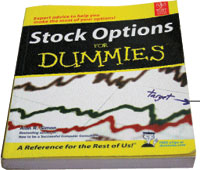
As the Boy Scouts motto goes: “Be prepared”. The first thing to remember is that the book talks about stock options and not stocks. As Alan Simon, the author, repeatedly points out, stock options are only your wealth on paper which you may or may not be able to exercise. These options may make you a neat bundle or leave you empty handed. On the other hand, stocks purchased in the stock market have real value.
The initial chapters are very important to understand whether going in for a stock option is a good idea for you or not. It’s a risk but is it one you can afford to take? Is it a good idea to stay in a company to redeem your vested options or can you afford to give them up? What happens if the company you work for and whose options you own doesn’t become public? When is the best time to join an organisation? In the early stages when you can get profitable stock options or later on when you know for certain that the company is doing well?KNOW YOUR STOCK OPTIONS |
| Golden handcuffs: Since stock options follow a vesting schedule, you stand to lose if you quit the job ahead of schedule |
| Know your wealth: Understand that stock options mean paper wealth only, so plan your other investments accordingly |
| Read the agreement: Pay attention to the minutest detail in your stock options legal agreement |
| Check the risk: You may get a good stock options offer in a start-up, but if the venture goes bust, you will end up with nothing |
The book does paint a rosy picture about new companies and how initial employees became millionaires by cashing in the stock options they received before the company became public. But, on the other hand, it also warns that you might end up with nothing if the company doesn’t go public or worse, goes underwater. The book’s main examples rely heavily on the tech boom of the 1990s and the subsequent dotcom bust in 2000.
In a way the book is also a guide for how to shape your career and which job to opt for. Should you go in for a company which will give you stock options but less salary or join another company which will offer you a good salary but no stock options? It does stress on the fact that if you’re a specialist you have a good chance of bargaining for both.
An important section to read is “Money!”. It has a chapter titled “Determining What Your Stock Options Are Really Worth” which is an eye opener for many employees who complacently think that if they own options in a good company they will retire rich. Think again. The section on the share of stock options in your overall portfolio is an interesting as well as informative read. You need to understand that stock options are only wealth on paper and they are highly illiquid. So plan the other investments in your financial portfolio accordingly. In other words, diversify.
Also pay attention to the segment on pre-initial public offering (IPO) and post-IPO stock options. All these chapters will help you understand the true value of what you own. Another must-read chapter is the one on deciphering the legal language of stock options agreement. In case you already own some options, crosscheck your legal agreement with the points mentioned.
There’s a detailed section on the taxes levied on the various types of stockoptions. It’s not quite relevant to the Indian reader since it relates to tax laws in the US. This is one shortcoming in the entire Dummies series being reprinted for India. The books will be much more useful and relevant if the publishers were to modify or add factual and legal information that is Indiaspecific. But do read the tips that have been highlighted in these sections. They are going to help make a few concepts clearer even though you can’t use them directly in the Indian context.
The “Changes and Special Circumstances” part in the book will equip you on how to plan your strategy about your stock options in case there are any corporate changes in your company or if you are planning to quit. The author has liberally used case studies to explain the finer points of each argument in the book. The language is simple and even the most technical aspects have been simplified so that even a financial dummy can comprehend the facts.
Important topics have been highlighted and relevant icons point to the must-read parts. If you already own stock options or are an aspiring job-seeker, read the book to be well prepared to understand what you will gain most from your job. Your stock options are an integral part of your cost-to-company and as relevant, or maybe even more so, than your salary.









