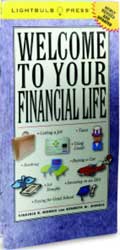
If personal finance has confounded you for the better part of your adult life and money management has left you gasping for financial wisdom, here is an easy route to fiscal nirvana. Allow Virginia B. Morris and Kenneth M. Morris to offer a Welcome to your Financial Life. The authors will ease you into the world of personal finance by simplifying complex concepts and will ensure that you put your newly acquired literacy to practical use.
Replete with graphical representations of the various financial products and services, the book is bound to help you lay a sound foundation in building a financial plan that is best suited to your specific needs.
If you are traumatised by the intricacies of balancing a chequebook, the chapter on credit is a must-read. Besides, the authors have listed out tips on how you can get out of a debt trap and set your finances on track. Easy steps guide you into gaining a better control of your finances and suggest ways to increase your income.
Similarly, the chapter on investing helps illustrate the concepts of risk and reward as well as asset allocation. There is a detailed section on mutual funds, with a special focus on index funds.
The chapter on financial planning points out the need for both shortand long-term preparation and the various ways to go about achieving your goals. Each life stage has a list of financial products that are important for that particular period. For instance, the authors describe when and how you should assess your life insurance needs as you age and have more dependants.
The book also cautions against common financial pitfalls and how you can avoid them. It’s an instructive, easy-tounderstand guide that provides all the information you’ll ever need to make smart financial decisions. It’s up to you to make the best of this advice by following it.
--
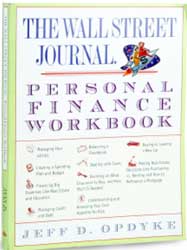
Whatever your income, lifestyle or financial concerns, The Wall Street Journal Personal Finance Workbook by Jeff D. Opdyke will help you make the most of every rupee you earn or save. Unlike most personal finance books, this manual doesn’t delve into the art and craft of investing. Instead, it expounds on how to get the most from your money. The very first chapter on budgeting sets the tone by talking about net worth, expenses, and savings in a weekly, monthly and yearly fashion.
The book is split into two, with the first section dealing with the development of a financial base. It helps you assess your financial needs and goals and shows how you can achieve them. For instance, the section on renting versus leasing, explains when it makes sense to opt for either. It also contains equations which will help you calculate how much loan you can afford.
The second half is on building your assets and focuses on two subjects— investing and retirement planning. Issues such as risk tolerance and rate of return are highlighted with graphical charts and tables that can be easily understood. Basic concepts such as power of compounding and averaging are explained concisely. The book is an indispensable hands-on guide for all those who want to enrich themselves, literally.
--
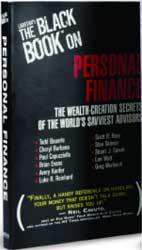
An anthology comprising 11 writeups, The Black Book on Personal Finance suggests steps that will help you improve your financial worth. Each author brings to the book his/her vast knowledge and experience to list out the lessons he/she considers indispensable.
The tome begins by shattering some wellentrenched investment myths and discusses the investing tools that work and those that don’t. It then delves into asset allocation and sector rotation. Making gradual progress, the book touches on complicated issues such as estate planning, financial planning for women, and even the ways entrepreneurs should look at building wealth—both personal and in their business.
Each chapter has insider notes that are shared by the respective author. The tips, illustrations and examples have been designed to make the book appealing to all readers. An interesting aspect is the spy motif on each spread which simplifies complex information.
The book also has a liberal dose of case studies in each chapter, which makes it easier for readers to understand varied financial subjects, ranging from taxes and insurance to loans.
Making for an interesting read are the chapters that counsel the readers to discount the advice of most selfanointed ‘experts’. The other chapters contain an 11-step investing process, tips on how to generate gains in any market condition, using life insurance premium financing to dramatically increase the cash flow and maximising bequests to beneficiaries.
This guide is a musthave for all those who aspire to have a comfortable financial life. It will ensure that you do.