
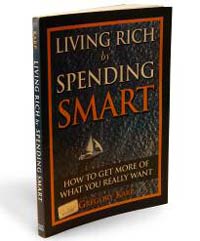
So you didn't think wearing spectacles could help you become rich? You're right-it can't. But lose a little of that vanity and wear them instead of contact lenses, thus spending a little less. If you save through such small ways, you'll have a much healthier bank balance. That's the perceived- and imparted-wisdom, according to Gregory Karp, award-winning personal finance columnist and author of Living Rich by Spending Smart.
Witty and incisive, both in his advice and writing, Karp doesn't preach from a high financial pulpit. But neither is he ambiguous about the remedies that he prescribes. He provides definite instances of exactly how his readers can cut costs.
This isn't an abstruse tome that targets investors or financial experts. It's as relevant for a housewife as for a student or a corporate executive, and just about anyone looking to enjoy life without maxing out his credit card. The reason Karp's advice is universal is that in a simple and succinct way he shows how adding the pennies can pile up the pounds pretty quickly.
Living rich by spending smart | |
|---|---|
| Price | Rs 275 |
| Pages | 200 |
| Author | Gregory Karp |
| Publisher | Pearson Power |
| Target audience | All spenders |
| Quick read tip | Choose the chapter that deals with your particular problem - the weakest point in your budget. |
| Language | Easy |
| Style | Illustrative |
| Visuals | Tables |
If he isn't particularly liberal about how much he wants you to spend, Karp is positively generous in the number of examples he gives to help save. For instance, check with your bank if you can avoid minimum balance rules, especially if you have multiple accounts or have taken a loan. You can invest the money rather than keep it idle in a savings account. Another option is to avoid credit card insurance. You're not liable for the fraudulent charges incurred on your stolen card, especially if you have filed an FIR. So what are you insuring against? The increments may be small, but they all add up. Karp details both sets of calculations: how small expenses pile up and clog your financial pipeline and how big results can come from small savings.
More importantly, Karp explains that the performance of the investment is beyond the investor's control, but the power of spending rests squarely with him. And that one doesn't have to be Scrooge, penny-pincher extraordinaire, or live in borderline poverty. A little prudence can go a long way, as per Karp's philosophy.
The first step, he says, is to perform 'forensics on your finances', that is, analyse your spending habits. The three worst offenders, according to him, are food, insurance and telecommunication.
Benchmarks for spending smart | |
|---|---|
| Outlay | Use 50% of post-tax income for musthaves, 30% for wants & put 20% in savings |
| Debt | Total debt payments should not exceed 36% of gross income. This includes loans |
| House | Loan payments should not exceed 30% of your gross monthly income |
| Car | Payments on car shouldn’t exceed 7% of gross income; less, if you have other debt. Net worth (what you own-what you owe): It should be age times pre-tax income by 10 |
| Life insurance | Term life cover should be 6-10 times the gross salary. Don’t buy cash-value insurance |
| Holiday & gifts | Spend no more than 1.5% of gross salary on festivals, travel, decorations and gifts |
| Net worth (what you own minus what you owe) | It should be age times pre-tax income by |
For every problem spending area, he provides not one, but a range of solutions: if your mobile phone bill is high-and whose isn't?-you can get rid of the monthly rental for downloading ring tones (transfer free from computer), get your close friends on to the same plan (avail of group discounts), or do away with the Internet phone access.
Go through the contents and then turn to the chapter that identifies your budget's weakest link. In some cases, personal preference does matter, such as buying second-hand clothes. But take the world, according to Karp, for what it is-a huge magnifying glass suspended over your expense list. Use it to see your expenses clearly: pare a little here, snip a little there. Trust Karp on this: it will all add up.
Still unsure? Money Today conducted a similar exercise in 29 issues.













