
 | |
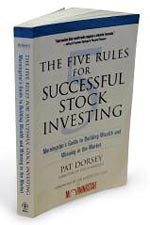
| The Five Rules For Successful Stock Investing | |
| Price | Rs 722 |
| Pages | 364 |
| Author | Pat Dorsey |
| Publisher | John Wiley & Sons |
| Target Audience | All investors |
| Language | Easy |
| Style | Academic |
| Visuals | Tables |
| Quick read tip: Read ‘Economic Moats’ to know how to recognise profitable companies that will continue to prosper | |
However, Dorsey doesn’t simply focus on ways to buy stocks. He also points out the mistakes that investors make and how they can avoid falling prey to emotional investment decisions. He highlights five rules— doing homework, economic moats, margin of safety, investing for long periods and knowing when to sell—which should be the benchmark for investing. Of these, the second rule is the most relevant, according to Dorsey.
Economic moat is the competitive advantage a company has over its peers. After running basic checks on cash flows and management quality, it’s the economic moat that’s the critical tool in zeroing in on the right stock. Most investors buy stocks based on the firm’s past performance. But any industry doling out good returns will attract competition, putting pressure on the profitability of the incumbents. So, investors need to learn to identify the economic moats that will help a company perform consistently over the years. Some of these are the company’s trusted brands, high switching costs and entry barriers.
The book illustrates various kinds of moats— wide moat (higher competitive advantage, which can last for a longer period); narrow moat (lower competitive advantage, which can last for a limited period); and no moat (no competitive advantage). “Estimating how long a moat will last is tough, but you need to at least give it some thought, even if you can’t come up with a precise answer,” notes Dorsey.
For example, a technological advantage can be shortlived as rapidly changing technologies could make today’s leaders tomorrow’s losers. “Cost leadership, brands, customer lock-ins, and competitor lockouts can each confer competitive advantage periods of varying lengths—there is no good rule of thumb,” he points out.
He also explains in detail the right time for an investor to sell a stock. According to Dorsey, if an investor has done his homework and bought a stock, his sell decisions should not be based on a steep fall in stock prices or on the market trends. He should sell only if he feels he has made a mistake in picking a particular stock or if the company’s fundamentals have deteriorated sharply after his investment. But it isn’t only the negative aspects that should prompt an investor to get rid of a stock. He should sell if the stock’s price rises too far above its intrinsic value or if there is another avenue where the money can be invested and which may give higher returns.
Apart from the rules, what makes this book attractive is the comprehensive coverage of investment analysis and techniques. From financial statements to valuation ratios, the author elaborates on each topic.
He has also explained the need to identify and avoid companies involved in dressing up their books. Dorsey tells investors to be wary of companies that report financial inconsistencies like divergent growth in cash flows and net income. Also, the companies with potential problems are the ones that make serial acquisitions or frequent writedowns, don’t pay their bills or whose CFO and auditors have quit.
If the Satyam fiasco highlights the extent to which a company’s management can windowdress accounts, the companies that chase inorganic growth through acquisitions are prone to negative surprises (Dr. Reddy’s Laboratories suffered financial strain because of a German acquisition).
Acquisitions increase the risk that the firm will report a nasty surprise some time in the future, “because acquisitive firms that want to beat their competitors to the punch often don’t spend as much time checking out their targets as they should,” notes Dorsey.
The book is a good package for investors who want to start with a clean slate. As the author points out, “Successful investing is simple, but it’s not easy.”
| Standing out in the crowd Strong selling points helped these companies to gain an edge over their competitors |
Dell: Lean operating structure and direct Internet-based sales allow it to score over its rivals. Wal-Mart: Preeminent low-cost provider. The firm flexes its muscles with suppliers in negotiating prices and passes on the savings to consumers. |













