
The best thing about the book is written in bold right on the front jacket: “The easy way to get started”. That clearly lets you know who it is mainly targeting—complete novices. Besides, who doesn’t like “easy”? We are, after all, living in an age where we like things neat and processed — instant coffee, twominute noodles and now condensed investment guides and primers.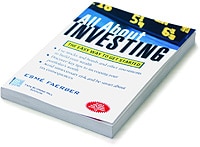
Indeed, this book takes you on a quick step-bystep journey through the entire investment process, one that delivers on its claim as a guide to “putting your money to work for you”. From how to track the stockmarket to how to determine the financial risk of a firm and how to use the Internet to find value and growth stocks, All About Investing provides you with a solid foundation necessary to make informed decisions.
The basic premise of the book is that the key to successful financial planning is to set aside more for saving and to invest it wisely using a long-time horizon. The most important reason to invest, according to the author, Esme Faerber, is to fund retirement because we are living longer. Whether you agree with her or not, you just cannot ignore the soundness of her five easy steps to building and maintaining an ideal portfolio of investments.
Beginning with listing your objectives, like buying a car in the next two years or funding a college education in 10 years’ time, and moving on to charting out an asset allocation plan and investment strategy, the author emphasises on the need to regularly evaluate your portfolio to factor in changing market and economic conditions as well as your own circumstances. The rest of the book is dedicated to detailing all the asset classes available.How to decide where to invest your funds |
| Determine your financial objectives with their time horizon and the amount required to fund them |
| Allocate your assets among different types of investment, be it bonds, stocks, real estate or collectibles |
| Develop an investment strategy that conforms to your objectives |
| Select your investments, according to your strategy, be it an active one or passive |
| Evaluate your portfolio from time to time to factor in changing circumstances |
Each chapter, be it the one on security markets and how stocks are traded or detailing the ABCs of bonds, is a neat bite-sized piece to read during a spare moment, like post dinner, waiting for an interview, or so forth.
Written in simple language, the book also throws in some easy math that will help you compute your own returns and more, and perhaps bring a gleam or two to your eyes—check out the box detailing how you can accumulate a million dollars by simply investing $66 a week at 8% per annum for 40 years (pg 4).
Given that it’s meant for new investors, the book dwells extensively on the risk factor. Apart from a 28-page chapter detailing all types of risk, from market risk to operating risk, subsequent chapters dealing with particular investment options, like bonds etc, too outline the respective risks involved. By the time you are through with the book, you would have gathered some basic tips in increasing returns without upping the risk factor.
However, in a bid to also interest sophisticated investors, or perhaps an investor who has “evolved” using this very book, the latter half of All About Investing tells you everything from how you can profit from using a combination of put and call options (the former gives the holder the right to sell stocks at an agreed price while the latter allows the holder to buy it) to analysing the futures markets.
Not that I don’t have any gripes about the book. To start with there is the style of writing—nononsense quickly becomes dry and boring and verbose. In fact, you might even mistake the book for a textbook given its presentation—detailed definitions for every single term you might conceivably stumble upon on the road to long-term financial security, boxes and charts offering cool tips (anybody wants to learn how to use Microsoft Excel to compute a bond’s yield to maturity?), in addition to flowcharts simplifying the whole deal. But then again, the author is a professor of business and accounting at Rosemont College, Pennsylvania.
Readers must not forget that a book dealing with personal finance cannot be a page turner or an entertaining read. Yet, there are ways to break the monotony of jargon and technicalities. And All About Investing contains no anecdotes, or little jokes or even quotes by Wall Street sharks to lighten the tone.
The other drawback is there is nothing really new here. It traverses areas that have already been covered by classics such as The Motley Fool’s Guide or The Only Investment Guide You’ll Ever Need. Do you really need another 300 pages to learn about the only asset that you can sell without actually owning it and without the risk of landing in jail, or what is Triple Witch Friday? What, you mean you don’t know?
Then what are you waiting for…hurry and grab this book. It’s excellent for long-term reference if nothing else.
The bottom line? The book is a decent buy for a new investor. If you’re interested in learning the basics of a real-world investment philosophy spelled out smoothly enough for the lay person to really understand it, buy this book. But, be warned, this is not a getrich-quick investment philosophy. It does not crystal gaze into the future to tell you which stocks will get you a home next door to Lakshmi Niwas Mittal’s palace in London’s posh Kensington Palace Gardens, also known as Millionaires’ Row.
It only tells you how you can make rational decisions to build your wealth without unnecessary risk. So use this book as a primer before you start pouring over the stock tables in any financial publication.













