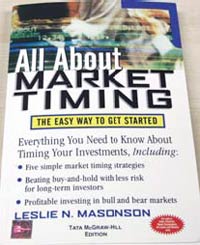
Price: Rs 325 Pages: 246 By: Leslie N. Masonson Published: Tata Mcgraw Hill Target audience: Informed investors Quick read tip: Jump to the chapter on moving averages to learn the basics of market technicals Language: Easy Style: Illustrative Visuals: Graphs |
Investing legend Warren Buffett once famously declared that ideally he would want to hold the shares in his portfolio “forever”. It takes a lot of courage—or perhaps some foolhardiness— to swim against the tide and debunk this “buy-and-hold” approach to stock investing. You are first up against the experts. Fund managers and financial planners never tire of pointing out that it is not the “timing of the market” but the “time in the market” that matters.
Then you are confronted by the stock market data for the past 25-30 years which forcefully states that the chances of losing money are inversely related to the tenure of the investment. That if you hold securities for, say 5 to 7 years, there is little chance of losing money, but if you hold the shares for 15 years, there is virtually no risk. And then, there is the practical difficulty of actually timing the market. You need to be Nostradamus to be able to buy and sell at the right time and the right price.
In All About Market Timing, Leslie N. Masonson valiantly demolishes the traditional long-term approach and argues that investors must learn to time the market to maximise their returns.
Masonson takes up the arguments in favour of longterm investing one by one and then presents a counter view, systematically shattering the “myth” that patience is the only way to create wealth from equities. The buy-and-hold strategy is not always wrong, he writes, but the fallacy is that it can be successfully applied to all stocks in a portfolio.
His theory is simple: bull markets will always be followed by bear markets. So, why stay invested and see the value of your investment go down when the bull cycle comes to an end? The savvy investor should be able to enter and exit just before the cycle changes.
Yes, it’s the same strategy that fund managers and investment analysts keep warning us about. But Masonson knows what he is talking about. Very early in the book, he hints at the scant respect he has for these “experts”. “I suspect that individuals who profess that market timing does not work are either not being totally honest with you or have not fully tested it for themselves,” he writes.
And he chooses to quote the redoubtable Peter Lynch in this context. When he was the fund manager of the Fidelity Magellan Fund, Lynch once remarked that “there are no market timers in the Forbes 400”. Masonson points out that the turnover of the fund managed by Lynch touched 300% in the years when he was at the helm. A fund’s turnover is a measure of the percentage change in its portfolio in a year. Clearly, Lynch was not practising what he was preaching.
Masonson buttresses his argument with real life examples, pointing out how timing the market can be more profitable. He also explains how to tell when to buy and sell a stock. The chapter on technical analysis explains how to read the buy and sell signals coming from the market.
Another chapter explains the 10 common indicators for reading the health of the market and ways to make the most of these indicators. The book suggests five strategies for timing the markets. Some of them (such as the fouryear presidential election cycle) may not exactly fit into the Indian situation, but the logic behind them is indisputable. Of course, technical indicators such as moving averages are universally accepted tools for predicting market movements.
Using simple language devoid of jargon, Masonson demonstrates how to use the five strategies to maximise gains when markets rise and avoid catastrophic losses when the bears take over. He back-tests the hypothesis to show how there were enough signs before every large fall or rise in the market.
Six things to know about market timing • Market timing is not about forecasting market direction • It only tells you when you should buy and when you should sell • It assumes that stock prices are not random and that the market is not efficient • Market timing should be mechanical and devoid of emotions • Market timers will underperform in a sustained bull market • Market timing is not magic and may not be 100% accurate all the time |
Savvy investors, who were able to see these signals and moved accordingly, reaped hefty profits—or simply avoided large losses. Masonson makes it clear that market timing is not about stock selection. Rather, it is about knowing when to enter and exit the market. The three main objectives of market timing are to preserve capital, avoid big losses by exiting at the right time and outperform the traditional buyand-hold approach on a risk-adjusted basis.
He also states that timing the market is not for everybody. Go for it only if you are not emotional about your investments and can follow the indicators with clinical discipline. It would hardly be helpful if the market sends a sell signal and you don’t have the heart to book losses.
Masonson identifies six qualities that a market timer must have: discipline, selfconfidence, independent thinking, realistic outlook, quick decisionmaking capability and emotional stability.
However, this book is not meant for the novice investor. Nor will it be of any value to a seasoned one. Rather, it will appeal to the middle rung of retail investors who have been there but haven’t done that. The heightened volatility in the stock markets will only add to that appeal.