
Prabhdev Singh
Golf is big on table manners. No other sport has as many unwritten rules of behaviour as this one, and they come into practice right from the time you set foot on the first tee. For example, the correct place to wait when somebody is teeing off is opposite that person. You wouldn’t park yourself in front for obvious reasons and neither would you stand on the right-hand side or behind the golfer. The more practical reason is that you don’t want to be clobbered by a club or a golf ball from close quarters.
Once you are off, the guy furthest from the green gets to play first and the same principle applies when you are on the putting surface till the time you hole out. Also, you must never step on the intended path of somebody’s putt as your shoes can damage the surface. Complete silence is called for when a golfer is ready to hit, which is why cell phones are considered a menace on golf courses. The Augusta National Golf Club has a zero tolerance policy towards mobile phones during the Masters. Being caught with one means instant eviction and blacklisting for life. You would wish more places would adopt such a stringent line of action. The clearing of throats and jangling of coins when somebody is swinging are equally likely to invite a string of profanity. Of course, there has always been some gamesmanship involved in competitive golf. Teaching professional Kel Llewellyn has this anecdote about fellow Aussie and golfing legend Peter Thomson. Apparently, Thomson wore white shoes during tournaments and he would wiggle his feet just within his playing partner’s vision as he would get ready to play.
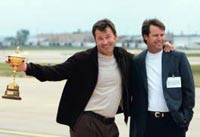
Spot the manners: Nick Faldo and Paul Azinger before the Ryder Cup this year
You might think of that as bit of harmless distraction but the Ryder Cup has taken gamesmanship to another level altogether. Fought once every two years, the golfing war between the US and Europe (originally Great Britain) evokes animalistic reactions in even the most sedentary golfers. Can you imagine Jim Furyk, who looks more like an orthopaedic surgeon with his bald pate and mild mannerisms, letting out bloodcurdling screams and pumping his fists after a long putt? The guy did give the Stars & Stripes the winning point at Valhalla (sounds almost Punjabi) recently after three straight drubbings, so I guess some chest-thumping is in order. The galleries have come to play a big role in the Ryder Cup to the point that they were touted as the “13th man” at Valhalla, Kentucky—each team consists of a dozen players. In that sense, there is some home course advantage and US captain Paul Azinger set the tone for the week when he said: “You can cheer when they (Europeans) miss.” Boo Weekley and J.B. Holmes, the pair of bull terriers in the American squad, played their role to perfection, hammering their European opponents into the ground and then playing symphony conductors to an already charged-up home crowd. “Boo” was the war cry at Valhalla and, at times, it did sound quite ridiculous.
There is nothing quite like the Ryder Cup in golf. Playing for country, team and honour seems to bring out new passion in these mildmannered men. They otherwise play a very individualistic, almost reclusive, sport, where the order of the day is usually the doffing of caps and polite handshakes after sinking a winning putt for, say, a million dollars.
—
Prabhdev Singh is Editor, Golf Digest India