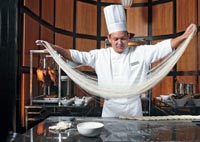
Chef Wu Zhang Qiu
Many years ago, in the quiet north of China, legendary noodle maker Jhang Sin Eil started to teach his best 18-yearold student the art of Lamian—hand-pulled or handswung noodles. It took two years for that student, the young Wu Zhang Qiu, to master the technique and now, 23 years later, Chef Wu is visiting Mumbai to exhibit the ancient art of Lamian. “The technique of preparing Lamian noodles dates back centuries,” says Wu, casually tossing the dough around in a plait-style. “Yet, somewhere along the way, the recipe was forgotten until 600 years ago when several regions in the north-west of China were struck by poverty, and the natives could no longer afford to buy readymade noodles. Today, the people of the north-western province of Xinjiang still make their noodles at home.”
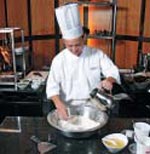
Chef Wu labouriously works up the Lamian noodle dough
For the last four years, Chef Wu has been running Bi Ye Mai Shi Zhong Xing—literally ‘Number 1 Food Court’—a restaurant in Johor Baharu, Malaysia. He insists that the art of Lamian is all about getting the arm movement right. First, Chef Wu has his students practise the swing with a piece of cloth, before they move to working with dough. Here’s how it works—the dough is held between the hands, stretched, tossed, pulled and swung repeatedly until it is evenly divided into thinner strands. This repeated movement makes the noodles soft and smooth. Chef Wu explains what makes the dough stretch as much as the length of a human body. He says: “Traditionally, the dough is prepared using egg white as well as Gaoxiaolamianji, a kind of salt powder, both of which add to the elasticity trait of the dough.”
Once the noodles are ready, they are boiled and strained like other readymade noodles and added to soup and served with vegetables and meat. Stretching the dough lets you actually make noodles the size you want—flat, spaghetti-thin or even as thin as strands of hair. “It requires several hours of practice. Three of my students have trained with me for over two years and are spreading the art of Lamian making by visiting restaurants the world over,” he says.
Lamian noodle dough
Before you can start swinging you need the right dough. Here’s how it’s made.
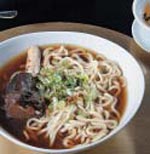
Voila! The noodles are added to the Lamian soup.
Flour (REFINED) 1 kg
Salt 10 gm
Corn cooking oil 20 gm
Water 500 ml
Gaoxiaolamianji powder 5 gm (Eggetarians could add four egg whites to the dough mix)
Serves: 1 kg dough serves 12-15 portions
Method: Add salt and Lamian powder to water and let it dissolve. Mix this water to refined flour to make dough soft. Knead the dough rigorously for 20 minutes, then add cooking oil to the dough and mix well. Start swinging!Start swinging!
Lamian chicken soup recipe A stock or soup that traditionally goes with the Lamian noodles.
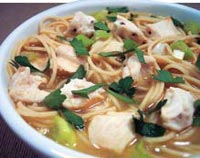
Lamian chicken soup
Water 10 ltrs
Chicken carcass 5 kg
Star anise 20 gm
Cinnamon stick 20 gm
Cloves 20 gm
Ginger 20 gm
Spring onion 20 gm
Dry red chillies 20 gm
Chinese red wine 20 ml
Rock sugar 30 gm
Dark soya sauce 20 ml
Chicken broth powder 20 gm
Salt 50 gm
Method: Blanch the carcass to remove dirt. Mix all the ingredients to the blanched carcass. Cover and steam for three hours. Then take Lamian noodles, boil them in the same way that readymade noodles are boiled. And strain. Add this soup along with desired vegetables.














