In the past year, the markets have managed a reasonably good imitation of Two-Face in Batman movies: in the second half of 2007, the indices were zooming upward out of sight, but in the first half of 2008 they plunged deep into the red. But we all know the law of the stock markets: with great returns comes great risk. That is the reason people with a relatively low appetite for risk prefer going the mutual fund way. The investors in equity funds suffered almost as much as those who invested directly in equities. Negative real returns coupled with a high inflation rate had investors and fund managers alike ducking for cover. In this scenario, investors are not entirely sure if they should sit tight and ride out the bumpy phase or bale out.
This is when investors begin to look at the old faithfuls—funds that have performed steadily and consistently regardless of market movements. These are the funds you will find in the second annual Money Today-Value Research ranking of India’s Best Mutual Funds. We have worked on the premise that a mutual fund should generate great returns, not great headlines. Our list of the 10 best funds across five categories features solid and consistent hitters that have performed well over the past 12 months and the past three years, and are poised for another growth spurt (Read “How Funds are Ranked”).
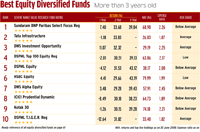
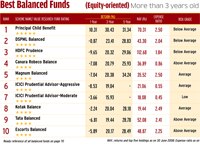
So, which funds made it to the top this year? The Sundaram BNP Paribas Select Focus fund tops the list as its focused approach resulted in good returns, even as several of its peers faltered. It looks like the Sundaram Mutual Fund has got its plans perfectly in place; The Sundaram Tax Saver tops the list of tax-saving schemes, and was, in fact, the only scheme that generated positive returns in the period we covered. Balanced funds also performed poorly, and the Principal’s Child Plan was the only one that announced positive returns.
Best Equity Diversified Funds |
Best Tax Planning Funds |
Best Balanced Funds |
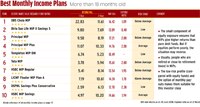
Best Monthly Income Plans |
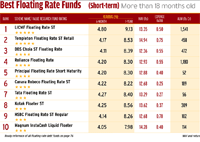
Best Floating Rate Funds |
The other factor to consider is the emergence of new fund houses and new schemes. In fact, even as you read this, there’s likely to be a fund house planning to launch a new scheme and thinking up new and innovative products. Of course, choice is good, but sometimes too much choice can only lead to confusion. Analysing and comparing mutual funds will become important for both existing investors and new investors. Regular columnist Dipen Sheth takes a look at the way in which the mutual fund industry has reacted to bear phases. We also take a look at a short list of all-weather funds, selected by Kumar based on a fine blend of objective and subjective analysis.
All this is very well, but what should you really do if this were a bear market and not a correction that’s taking longer than usual? Disgruntled investors might exit from their funds, while others watch and wait. We debate whether those who have exited have done so at the wrong time and for the wrong reasons. More to the point, we discuss whether there’s really a “right” time to buy a fund (see “Opportunity Loss”). Investing is a constant phenomenon. Fund managers are paid to manage funds actively and to follow the fund’s investment mandate. However, the onus is on you, the investor, to regularly invest and actively manage your investment portfolio. Besides this annual ranking of best mutual funds, every issue of Money Today lists out the best performing schemes of the fortnight across eight fund categories. Use that as your investment guide.
If you actively manage your portfolio, you will know that a downturn such as this could prove to be a goldmine. But to be able to pick the right schemes at the right time requires some knowledge. You should, at the very least, know your risk appetite and the ability to figure out what funds and schemes suit your needs and appetite for risk (see “Build your Fund Portfolio”). If you’re already invested, use the tips here to review your fund portfolio and consider rebalancing it, if needed.
So, what about your existing investments? There are investment opportunities in the form of old funds in your portfolio that you may want to exit, a new fund offer with a unique investment idea that is still not there in your portfolio. You also need to look at market cycles to understand which sector to enter and which to exit, at what time. For instance, the mid-cap story did not play in 2007, but once the market starts moving up, it is a sector that is likely to get the maximum boost from the overall market movement. Likewise, the real estate sector which was the darling until mid-2007, seems to be out of favour.
Yes, the profiles of funds are changing, but not more than the profile of investors. The early mutual fund investors were financially savvy, high-income urbanites. Today, however, a significant proportion is smalltown, low-income investors. For the first time, investors from outside the top eight cities have contributed considerably to the fund industry. A lot of credit goes to the small SIPs that fund houses introduced in 2006-7 which benefited investors who can contribute as little as Rs 50 a month and yet get the benefits of stock investing.
| 35 is the number of fund houses in the country | 16 per cent is the rise in AUM of mutual funds between June ’07 and June ’08 | Rs 5,660 crore collected by Reliance Natural Resources Fund is the biggest NFO |
—A Balasubramaniam, CIO, Birla Sun Life Mutual Fund
—Manish Bhandari, Fund manager, ING Investment Management
|
In order to give you the full picture and have an idea of where the industry is headed, we asked a host of experts from leading fund houses and institutions to share their views with us. They more than obliged. So we have a wide range of the industry’s most respected people discussing a wide range of subjects—from the global financial situation to when you should exit a fund. Among others, we have Arindam Ghosh of Mirae Asset Management, who foresees a boom year ahead for commodities and makes a strong case for investing in commoditieslinked companies. Then we have Fidelity International’s Ashu Suyash explaining the concept of wrapper funds and why they are so popular in mature markets such as the US and the UK. Krishnamurthy Vijayan of JP Morgan Asset Management Company discusses what proportion of an investor’s portfolio should be invested in debt and how much in equity, while HSBC AMC’s Dhiraj Sachdev moves away from the retail scene to paint a macro picture of the economy. And there’s Prasunjit Mukherjee of Plexus Management, who wonders if there’s a right time and a wrong time to eliminate a fund from your portfolio.
The core of this special issue, something that both Money Today and Value Research are proud of, is the exhaustive listing of 748 funds across 21 categories. Though 19-pages of data may seem too much too digest, the tables have been carefully designed to make for easy navigation (see “Get the most out of the tables”). Working on reader responses to our ranking last year, we have made the navigation easier and the investment style more meaningful with a new fund style monitor (see “Understand Fund Style”).
Having said all this, we leave you with one thought before you immerse yourself in facts and figures. Diversify. The secret to a successful portfolio is diversification, so make sure you don’t have too much exposure to one sector or fund with similar investment styles. Also, choose funds that have long track records of at least three to five years, longer if possible. And finally, remember that the simplest way to pick a fund is to see if its investment objective fits yours. Check its expenses and the risk category it falls in and, then look at its returns performance. If it matches your needs, go ahead and buy. If not, look at another scheme that could serve your needs better— there are several available, as you will see in the following stories.
| Why the past year’s top 10 fell behind | ||||
| Rank (2007) | Scheme name | 1-Year return | NAV (Rs) | Comment |
| 1 | HDFC Equity Fund | -13.394 | 143.17 | The fund avoided hot stocks early. This conservatism did not work when the market fell, HOLD FOR NOW |
| 2 | Reliance Vision Fund | -17.0027 | 172.07 | The fund stopped discovering new stocks which was driving its performance, HOLD FOR NOW |
| 3 | HDFC Index Fund-Sensex Plus Plan | -9.5402 | 144.97 | The fund has given good returns but is out of the rankings because others have done better, HOLD FOR NOW |
| 4 | ICICI Pru Advisor - Very Agressive Plan | -11.8791 | 24.3 6 | This is a fund-of-fund which suffered losses of the funds it invested in, ie, equity funds of ICICI Prudential, SELL |
| 5 | Magnum SFU - Contra Fund | -7.8866 | 38.66 | The fund has given good returns but is out of the rankings because others have done better, HOLD FOR NOW |
| 6 | FT India Life Stage Fund of Funds - 20 | -6.4901 | 23.10 | Another fund-of-fund which suffered losses of funds it invests in, ie, equity funds of Franklin Templeton, SELL |
| 7 | Sundaram BNP Paribas Select Midcap | -12.2357 | 87.31 | This is a mid-cap fund and suffered because mid-cap stocks did not do well in the past year, HOLD FOR NOW |
| 8 | HDFC Top 200 Fund | -4.0851 | 115.42 | None of the fund’s bets worked in the past year that pushed the returns down, HOLD FOR NOW |
| 9 | Reliance Growth Fund | - 1.8702 | 301.71 | The fund suffered because of lack of fresh investing ideas, HOLD FOR THE LONG TERM |
| 10 | Franklin India Prima Plus | -12.1095 | 137.12 | The fund suffered because of the lack of fresh investing ideas, HOLD FOR THE LONG TERM |
Value Research simplified last year’s methodology of selecting winners from the ever-enlarging universe of mutual funds.
The mutual fund industry has become more diverse and complicated since our last annual ranking of best mutual funds in August 2007. At least 191 new schemes have been launched in the past 12 months in widely divergent categories. There are schemes with new investment mandates and funds with innovative investment strategies, funds that invest in commodities and schemes that invest in overseas markets.
| The yardsticks used | |||
| Fund category | No of funds | Returns | Risks |
| Diversified equity funds | 111 | 3 years | A risk score was given to funds based on their risk of loss in the past 3 years. The higher the risk, the lower the score. The funds were also assigned a risk grade based on this risk of loss |
| ELSS | 20 | 3 years | |
| Balanced funds | 29 | 3 years | |
| MIPs | 38 | 18 months | Same method, except risk of loss was considered for 18 months |
| Floating rate funds | 19 | 18 months | No risk of loss was considered for this category |
| Equity and balanced funds that were at least 3 years old and MIPs and debt funds at least 18 months old were considered. This filter gave us a shortlist of 217 funds across five categories Source: Value Research | |||
The Money Today-Value Research ranking of best mutual funds cuts through the clutter to bring you the most promising picks. Returns (more specifically, percentage change in NAV) are the chief yardstick to judge a fund’s performance. But there are other factors that influence the performance of a scheme. As the experience of the past few months has shown, high returns come with high risks. So you also need to know how much risk a fund is undertaking. The ranking is a composite measure of both risks and returns.
The first step in the ranking process was to decide which funds to include. Even before we zeroed in on specific schemes, we had to select the fund types to pick the schemes from—after all, different types (categories) of funds serve different investment purposes. The five fund types that we chose to study for ranking are the ones in which retail investors have the most interest.
Measuring returns Unlike last year’s ranking, when we had assigned 60% weightage to a three-year performance and 40% weightage to a five-year performance to arrive at a composite score, this year we have looked at only a three-year performance of equity and balanced funds. This does away with the bias in favour of funds that are more than five years old. The expense ratio was excluded because it is reflected in the returns. For MIPs and floating rate funds too we have looked at a performance over 18 months only. This is because of the quality and average maturity of the instruments that these mutual fund schemes invest in.
Stocks are inherently volatile. So it doesn’t make sense to look at a short-term performance while evaluating an equity-oriented fund. Therefore, we considered funds that are at least three years old. For MIPs and debt funds, the cut-off was shorter at 18 months. How risk is measured
Value Research calculates a fund’s risk of loss by comparing its performance with a risk-free investment such as a 45-180-day term deposit with SBI. The risk of investing in a fund not only includes the possibility of losing money, but also the chance of earning less than you would on a guaranteed investment. To calculate the risk, monthly/weekly fund returns are compared with the monthly risk-free returns for equity and hybrid funds and weekly risk-free returns for debt funds. For all the months/weeks that the fund underperforms the risk-free return, the magnitude of underperformance is added.
This gives the average underperformance and how a fund performs vis-a-vis its category average. In case the category average is negative, the risk-free return is used as a benchmark. The relative performance of a fund is expressed as a risk score.