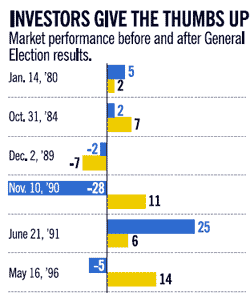
Monday, May 17, 2004: The BSE Sensex ends the day down 11.13 per cent, after hitting the lower circuit limit twice in the day. The outcome of the General Elections has clearly caught market players by surprise; instead of the NDA government coming to power, the UPA will form the government, with plenty of help from the Left parties.
Monday, May 18, 2009: The BSE Sensex closes 17.33 per cent higher, with the index hitting upper circuit limits twice in the day. The UPA will form the new government without the support of the Left parties. That’s beyond most investors’ wildest dreams.

But then there’s no better time than now to think big. Markets point that the time is ripe to start planning for a 9 per cent growth in the gross domestic product (GDP). And there’s plenty that can be done to get a move on. “The fiscal deficit can be controlled through disinvestment and by selling 3G licences,” says Krishnamurthy Vijayan, Executive Chairman, JPMorgan Asset Management in India. He estimates that these two measures alone can reduce the fiscal deficit by Rs 50,000-60,000 crore. Shankar Sharma, Vice Chairman and Joint Managing Director, First Global, too, expects disinvestment to rake in huge money for the government over the next couple of years. “Disinvestment alone can raise Rs 50,000 crore in the next two years,” says Sharma.
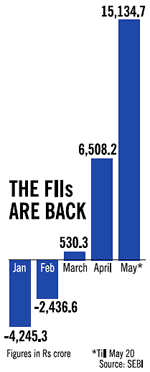

Since April, the Indian rupee has appreciated by 5.4 per cent against the US dollar. Many companies went into the red in the year ended March 2009 due to the provisions they had to make for currency fluctuations for the funds raised through foreign currency convertible bonds.
“That trend could now get reversed. Just after the election results, most of the broking houses that were negative on India have turned bullish. For instance, Christopher Wood, Strategist at Hong Kong-based brokerage and investment bank CLSA, has doubled India’s weightage to 14 per cent. “The result will be a surge of portfolio capital into the Indian stock market since many foreign investors had been wary of betting on India because of the sheer unpredictability of the electoral process,” says Woods in his latest Greed & Fear report. JP Morgan’s Vijayan says his firm was underweight on India before the elections and the country would be upgraded to neutral very soon.The key word to remember of course is “expect”. “We have built expectations and anything below (these expectations) will be treated negatively by the market,” says Motilal Oswal, Chairman, Motilal Oswal Financial Services. He feels the government should have a longterm plan to hit a GDP growth of 10 per cent. When an air of expectancy prevails, there’s no harm in dreaming big and hoping for the best.