It's smart, it's big and it's hot. The money that foreign institutional investors (FIIs) pour into Indian markets has been the driving force for every rally—as also every crash. The 2008 crisis was largely triggered by a sell-off by FIIs as they started unwinding from emerging markets. FIIs withdrew close to $12 billion (Rs 58,000 crore) from the Indian markets in 2008. The stocks in which their stake was high were the worst hit.
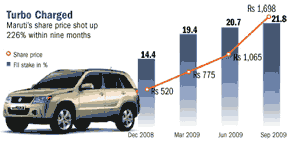
However, 2008 was an aberration, a black swan year that occurs once in a lifetime. FIIs are generally a savvy lot that buy into companies with solid fundamentals and good prospects. They study the company inside out before picking up its equity. An FII buying shares of a company is almost like a validation of its corporate governance and financial well-being. That's why the share prices of companies in which they buy a stake or increase their holding usually go up. We studied the BSE 500 universe and found 29 companies in which there was a consistent increase in the FII stake, and their share price between December 2008 and September 2009.When FIIs raised their stake in Maruti Suzuki from 14.39 per cent in December 2008 to 19.4 per cent in March 2009, the stock price jumped up from Rs 520 to Rs 775, an increase of almost 50 per cent. The correlation was even more pronounced in the case of Polaris Software, where the FII stake rose steadily from 2.3 per cent in December 2008 to 7.2 per cent in September 2009. Its share price went up from Rs 43 to Rs 151 during the same period. On the other hand, a reduction in the FII holding can put a stock in the doghouse. The share price of Koutons Retail fell from Rs 508 in December 2008 to Rs 330 in September 2009 after the FII holding in the company reduced from 20.22 per cent to 17.71 per cent.
The FII holding in a company is declared along with the quarterly results. One needs to look up the shareholding pattern of the company. Also, be on the alert for news about block deals by FIIs. Business TV channels, financial portals and pink newspapers flash such deals when they take place. A company is also supposed to inform the exchange about major changes in its shareholding.
As we said earlier, buying a share that FIIs have picked up is a sure-shot recipe for profit. But here's a word of caution: most FIIs are hedge funds. They won't take long to pack up and leave. This was what happened in 2008. If you can't keep up with their investment pattern, don't try to copy them.