

VOCATIONAL AND TRAINING |
Market size (Growth) |
| Vocational & Training: $1.4 billion (10%) |
| Test Preparation: $1.5 billion (15%) |
| E-learning: $.04 billion (40%) |
| IT Training: $1.8 billion (40%) |
Market size for 2008 |
Regulation |
| Unlike K-12 and higher education, profit-making is allowed. |
| Recognition: Only for ITIs and polytechnics. |
| Authority for registration: State Government. |
| Authority for affiliation: Directorate General of Employment and Training, National Council for Vocational Training or State Council for Vocational Training. |
Opportunities |
| Industries such as logistics, healthcare, construction, hospitality and automobiles need trained manpower. |
| New and viable business models in technology-enabled education. |
| 2.5 million getting vocation training annually against an estimated 85-90 million people needing it from 2008-13. |
Source: Technopak |
Recent Developments |
| Career Launcher readies university launch in 2010. |
| NIIT University rolls out in September 2009. |
| Everonn, a technology-enabled education player, has entered formal education; to set up colleges. |
| Matrix Partners India invested Rs 100 crore in IIT test prep company FIITJEE. |
| Career Point that started as a test prep outfit has recently raised Rs 50 crore in equity capital from Franklin Templeton Private Equity Strategy. |
In 1982 when Rajendra Pawar and Vijay K. Thadani started their first NIIT centre in Mumbai, education as a business proposition was a laughable idea and the computer a complex entity. But, in their search for the gold vein, Messrs Pawar and Thadani had spotted a glint here, a nugget there: IBM had introduced the personal computer in 1981, the Computer Society of India had said Indian industry was hamstrung by a lack of computer professionals, and India at that time had 6,00,000 unemployed graduates. The NIIT founders saw the mother lode: making industry and education talk.
Today, NIIT is one of the world’s leading education companies, centered on the premise of employability, which in turn has become a multi-billion-dollar business that has set the pulse of old and new entrepreneurs racing. “Earlier, the word private and education could not be said in the same sentence. Now, the opportunity around employability is huge. A hundred such NIITs can exist,” says Thadani, 57, CEO, NIIT Ltd.
The vocational and training business is a baby in the education business landscape, accounting for less than 10 per cent of the whole pie. But it is poised to grow the fastest, between 16 and 40 per cent a year, depending on the niche, according to Technopak. And what is the opportunity size? “India’s human capital is the biggest entrepreneurial opportunity on the planet,” says Manish Sabharwal, Member, National Council on Skill Development. Uma Ganesh, CEO of Global Talent Tract (GTT), which entered the market in 2009, has a value figure: Rs 40,000 crore just in India.
No wonder then, that everybody wants in: new entrepreneurs, established players in school and higher education, private equity investors and foreign players. The terrain covers everything from test preparation, training and assessment to curriculum, teacher’s training, technology delivery and products.
Among those already in: Navneet Publications, which is into stationery and e-learning, test preparation biggie FIITJEE and Mahesh Tutorials with its 50,000 students. Knocking at the door is higher education and schools major Manipal Education, armed with a tieup with City & Guilds of the UK. “With over three million Indians graduating every year, at least one million per year will need employable skills and that is where GTT intends to capture a major share,” says Ganesh.
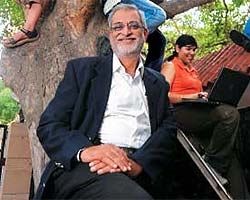 Vijay K. Thadani, CEO, NIIT |
NIIT |
| STARTED IN/AS: 1981, Delhi, an IT training solutions provider (first centre in 1982) NOW PRESENT IN: Schooling, higher education, vocational and skills training INITIAL INVESTMENT: Rs 12 lakh FIRST YEAR REVENUES: Rs 1 crore REVENUES NOW: Rs 1,148 crore (FY 2008- 2009) ENROLLMENTS IN FIRST BATCH: 99 CURRENT ENROLLMENTS: 5,00,000 at NIIT centres; 12 million across all verticals FOOTPRINT NOW: Over 1,25,00 education centres in India, over 200 IT centres in China and 170 across the world EXPANSION PLANS: NIIT University at Neemrana, Rajasthan, starts in Sept. ’09 FOCUS AREAS: Skills development and schools |
A to Z
Ganesh and scores of others are in a flurry of activity to exploit the terrain that NIIT first identified. Then, the going was not always smooth: NIIT began with 99 students and in the eighties had to actually support the education model with its software services business. Today, NIIT has become a start-to-finish outfit— schools, skills, corporate training and as you read this, its very own NIIT University in Neemrana, Rajasthan.
Start-to-finish is what Satya Narayanan R., 38, of Career Launcher, also wishes to be. The IIM-Bangalore alumni’s journey began in 1994 without any firm business model or capital. All he wanted was to be a teacherentrepreneur. His market: MBA aspirants. Career Launcher began with coaching for MBA entrance tests in 1995, then expanded into engineering, law and medical coaching.
Initially, however, the franchisee model that had worked for NIIT was an unmitigated disaster for Satya, till he realised that he needed business partners who were teachers first.
But when the business started to flatten by 2003, Satya started looking at the mainstream. “I would ask myself: how are we going to become a Rs 500-crore company? And the answer clearly lay outside test preparation,” says Satya.
By August 2005, Career Launcher had gotten into pre-school (Ananda) and K-12 (Indus World School). Scale happened. Two Indus World Schools were started in Indore and Hyderabad in 2006. Last year, Career Launcher had come full circle, setting up a B-school, the very thing for which it used to prepare students.
 Satya Narayanan R., Founder-Chairman, Career Launcher (in the centre) |
Career Launcher |
| STARTED IN/AS: 1995, Delhi,test preparation for B-schools NOW PRESENT IN: Schooling, higher education (B-school and university), vocational and skill training and test preparation INITIAL INVESTMENT: Rs 13,000 FIRST YEAR REVENUES: Rs 30,000 REVENUES NOW: Rs 150 crore (FY 2008- 2009) CURRENT ENROLLMENTS: 1,10,000 FOOTPRINT NOW: 225 locations across India, UAE and the US EXPANSION PLANS: University rollout next year; number of Bottom of Pyramid schools to go up to 100 by 2012 FOCUS AREAS: Higher education, vocational skills and K-12 with focus on low-cost education |
With the recession casting a shadow over the MBA market, Satya mapped out plans for a university. Career Launcher applied to the Rajasthan government last year and expects a green signal for its Indus World University. The university model is looking for volumes from skills. “Skills training will be the integral part of our university, just as entrepreneurship is the focus of our B-School,” he says.
That’s precisely what NIIT is targeting. Two businesses that started 14 years apart in training are branching out in a similar manner, and skillstraining remains the underlying focus.
And why not? A lot of industries like retail and healthcare have evolved in the last 4-5 years. “These will require a large work-force that needs to be trained,” says Amitabh Jhingan, Partner, Transaction Advisory Services, Ernst & Young. Moreover, unlike K-12 and higher education, vocational, test preparation and tutorials allow that dirty word, profit.
Venture capitalists have been quick to take note. “Vocational education will be one of the next spaces to witness tremendous growth,” says Pradeep Tagare, Director, Intel Capital.
Intel Capital’s $250-million (Rs 1,200-crore) India fund has invested $6.5 million (Rs 31 crore) in GTT in January 2009. In the US, the fund has a stake in Tutor.com, an upstart which now competes with TutorVista.
Learnings for the teachers
Yet for entrepreneurs, vocational education and training remains a difficult business. Old and new players alike face three common challenges: quality delivery, filling up classes and employer linkages. And only a massive upfront investment can help them tackle these challenges.
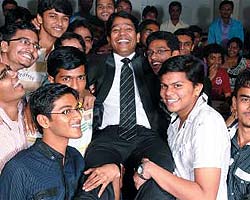 Mahesh Shetty, Founder-Chairman, Mahesh Tutorials (in the centre) |
Mahesh Tutorials |
| STARTED IN/AS: Mumbai, 1988, Coaching classes for higher secondary INITIAL INVESTMENT: Rs 6 lakh FIRST YEAR REVENUES: Broke even REVENUES NOW: Rs 100 crore CURRENT ENROLLMENTS: 50,000 FOOTPRINT NOW: 170 centres across India—one in Dubai EXPANSION PLANS: To begin IIT preparatory classes and to introduce technology as a teaching aid FOCUS AREAS: Test preparation |
“In vocational training, outcome is binary and easy to measure. Training has to lead to a job, an outcome,” says Sabharwal. Some of the successful models have successfully tackled one or more of these challenges.
Take, for instance, TutorVista, whose founder K. Ganesh got market volumes by offering unlimited online tutoring sessions to American students (K-12) at $100 (Rs 4,800) a month. The tutors are available roundthe-clock, all seven days, running classes from their homes in 95 towns/cities across India. TutorVista has about 10,000 student subscriptions, handled by 1,400 tutors.
Everonn, which started with 332 schools in Tamil Nadu as a public private partnership in technologyenabled education, is today expanding into formal learning. Says P. Kishore, Managing Director: “We expect payback for a B-school in 4-5 years, for engineering colleges in 60 months and for schools in 5-7 years.”
New entrepreneurs are quick to learn from their established peers. GTT is today building partnerships with universities and state governments. Its first B-school, Europe Asia Business School, has already opened its doors. “By end-2010 we expect to have a network of 25 GTT centres and at least four B-schools, operations in three countries outside India and become cash profitable,” says Uma Ganesh.
The sky, by all accounts, is the limit for Uma and others of her ilk.
With K.R. Balasubramanyam in Bangalore, Anamika Butalia in Mumbai and Nitya Varadarajan in Chennai.











