
In Ujjain, Madhya Pradesh, 44-year-old Sandeep Yagyik has put away Rs 3.5 lakh in mutual funds. Further south, K. Srinivasan, a cashier in a jewellery shop in Tiruchirapalli, invests around Rs 4,000 a month in systematic investment plans (SIPs). It’s a similar story across the country, whether it’s Allahabad, Bhubaneswar, Kozhikode or Faizabad. Investors in small towns have been bitten by the mutual-fund bug and seem to be loving it. Ashok Panda, a 39-year-old employee in a private firm in Bhubaneswar, speaks for most investors when he says, “I wanted to make investments in the stock market. However, the fear of scams made me wary. Equity mutual funds are different and I find them a good way to benefit from stock market gains.”
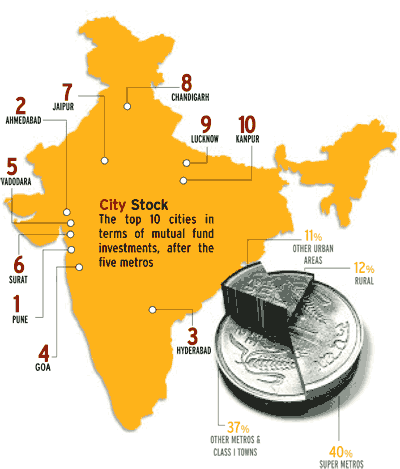
Till recently, investors in small towns were constrained by limited information and little access to mutual funds. They were forced to rely on traditional (and lowreturn) investments such as the post office small savings schemes, National Savings Certificates and insurance. Mutual fund houses also did not bother too much about these markets. The neglect of small towns is evident from the results of the Invest India Incomes and Savings survey carried out by IIMS Dataworks in 2007. According to this survey, over 90% of working Indians with incomes were unaware of the existence of mutual funds. Of the people who knew, over 30% could not recall a single mutual fund brand. The top five metros still account for 80% of the total investment in mutual funds.
But with high inflation eating into returns (even converting some into negative returns), and a few fixed-income returns being taxed, investors in non-metros are keen to explore new avenues. The mutual fund houses appear to have finally seen the writing on the wall. So far, they were content with investments from the metros and bigger cities and spent heavily in promoting their schemes in these areas alone. Now, with investors hungry for more, and with competition building up in the mutual fund space, fund houses are turning to small towns. The opportunity in these new markets is huge—out of an estimated 321 million people who make up the paid workforce aged 18-59 years, only 5.27 million people invest in mutual funds. Most of the potential new customers are expected to come from smaller towns.
Share of Mutual Fund Investments | ||
| Top 5 cities: 80% | Next 10 cities: 10% | Rest of India: 10% |
Ashok Panda, Bhubaneswar, Orissa  | K Srinivasan, Tiruchirapalli, Tamil Nadu | Sandeep Yagyik, Ujjain, Madhya Pradesh |
 Fund houses are promoting SIPs in small towns as the investors there are more used to instruments like recurring deposits. They are also advertising the fact that investments in mutual funds should not be seen merely as a tax-saving option, but as an investment avenue that will yield greater returns than traditional products. Banks and post offices—which have much better reach in smaller areas—are turning out to be a good way to reach out to customers. However, in most cases both these cater only to walk-in customers and do not play an advisory role, which is crucial for selling such products in these markets. So, companies are now also looking at better trained professionals to sell their schemes.













