
EMI & interest rates 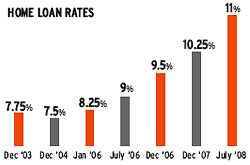 A 1% increase in interest rate raises the EMI by Rs 70 per Rs 1 lakh loan for 20 years If the EMI is kept constant, a 1% hike in interest rate increases the tenure of a 20-year loan by 24-42 months* *If the loan was taken 2-3 years ago |
| Click to see graphic: What brokers say |
The past three years have been a dream run for Delhi-based property agent Virendra Saxena. There was always a crowd of prospective buyers at his office. Saxena had his hands so full that he didn’t have time for those looking for rented accommodation. It didn’t make sense to spend time finding a house for them when all he would have earned was one month’s rent of Rs 10,000-15,000 as commission? It made more sense to broker a property deal worth Rs 50 lakh and pocket a cool Rs 1 lakh.
But times have changed and property buyers seem to have vanished. Now Saxena does not let any business slip past him—even if it is someone looking for rented accommodation. He drives prospective tenants to the houses on offer and is even willing to negotiate on the commission to seal the deal.
In a way, Saxena’s comedown sums up the situation facing the real estate sector. The sharp rise in inflation and its effect on interest rates has made many prospective buyers postpone their purchase decisions. Several projects launched in the past 6-8 months have not found any takers. Besides, banks are now cagey about funding real estate projects.
Builders are facing the heat from all sides. The rise in home loan interest rates means that real estate is no longer a good investment if you are buying it with borrowed money. If the price of the property increases by 12-15% in a year and you pay 11% to the lender, your net gain is marginal. So investor demand for real estate has virtually dried up. The fall in demand has not only affected the cash flow of realty firms but also hurt their bottom lines. Unitech, which has about 60% of its revenue coming from the residential segment, has reported that its consolidated profit for the fourth quarter of 2007-8 dropped by 50% due to poor demand. Brokers across the country are reporting a drop in demand from buyers and a renewed interest among prospective tenants.
All this points to what many people are desperately hoping for but the industry is afraid to admit: that property prices may be on their way down. “In the near term, we think affordability will be a bigger driver and a 20% correction in property prices will be needed by the year-end to revive volumes,” UBS Investment stated in a research note recently. “If the sentiment remains the same and mortgage rates go up, demand and property prices will come down,” says Anshuman Magazine, chairman and MD of CB Richard Ellis.
Already, the drop in demand is forcing builders to scale down their ambitions to realistic levels. “There is no point in constructing for 1,000 buyers when there are only 100 potential customers,” says Sanjeev Srivastava of Assotech. Some builders have put on hold their plans to launch new projects. Others are using technology to tide over the increase in labour costs.
However, don’t expect discount sales to open up soon. The past three years have seen a massive flow of investment in the real estate sector and most big builders will be able to hold prices at least in some locations. The correction will be more pronounced in the areas where prices had run up very fast due to unbridled speculation.
Will the high interest rates and spiralling inflation also affect rentals? That depends on local factors such as connectivity and proximity to commercial hubs. If the area is well connected and close to a major workplace, rentals would not be under pressure. But if the area is far-flung, rentals may fall.













