
Noida-based Amity Business School (ABS) has broken into the elite club of Top 10 B-schools in the country, doing a double nine of sorts: It’s #9 this year, having jumped nine places from #18 last year. But instead of gloating over ABS’s new status, Ashok Chauhan, Founder-Chairman, Amity University, talks about the road ahead. “We still have some way to go before we can catch up with the IIMs,” he says. “But give us another five years and we’ll be on par with the IIMs,” he adds determinedly.
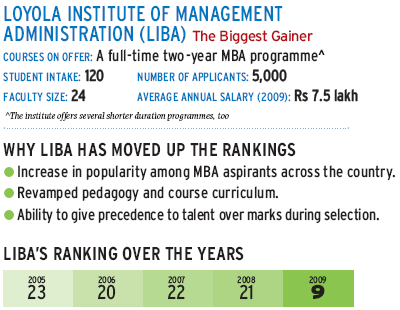
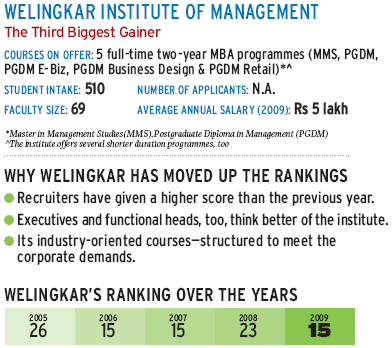
Whether Chauhan can walk the talk remains to be seen. But the biggest surprises in this year’s BT rankings have come from some of the secondrung B-schools. Along with ABS, Loyola Institute of Business Administration (LIBA) and Welingkar Institute of Management have registered the biggest jump in the rankings this time—LIBA has moved up 12 places to a joint #9 with ABS—scoring high on a host of parameters like infrastructure, pedagogy, course curriculum and extra co-curricular activities.
 Says Shiv Agrawal, CEO, ABC Consultants, a headhunting firm: “Some of the mid-tier B-schools are definitely providing quality education and their products have proved to be assets for recruiters.” BT caught up with the management and students of ABS, LIBA and Welingkar to learn about the thinking and practices in these institutions that are helping in giving their students an edge in an increasingly competitive market.
Personality Development
Personality development and grooming is a key thrust area for all the institutes. ABS, for instance, seeks to impart basic business etiquette from day one. Says Sanjay Srivastava, Head and Additional Director-General, ABS: “We focus on personality aspects like levels of extroversion and introversion, judgement and perception and have a holistic approach to personality development.” Here, every student is mentored by a faculty member, who monitors his or her progress over the two-year course, which is recorded in a personal dossier called the journal of success. Says Shivalika Gill, a second-year student at ABS: “There is a lot of focus on improving our communication skills. For instance, we have to make several presentations so that we become more articulate and confident and ready for the industry when the time comes.” Adds Srivastava: “For us, it’s important that each individual is a success story.”
At LIBA, the lack of skills like effective communication, creativity, leadership, team-building, and listening in candidates is spotted early and intensive training is given even before the course starts to rectify those problems. “Most students move to the “A” grade level easily with this,” says Father P. Christie, Director, LIBA.
Industry-oriented Courses
These institutions lay a great deal of emphasis on regularly exposing their students to the corporate world. At Welingkar, this is done through the “Friday Roundtable”. In this, 40-50 representatives of an industry are invited to the institute and groups of students make presentations on the problems peculiar to that industry and offer unique research and suggestions to deal with them. Says Dean Kanu Doshi: “In the past, companies have assigned Welingkar students to conduct in-depth research and work out solutions to crises.” Adds Devanshi Vaishnav, a second-year student: “Roundtable events give us an opportunity to work closely with the industry and are an invaluable hands-on work experience.”
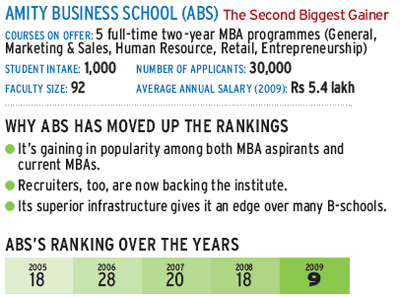 ABS, too, has forged close ties with the industry. It assigns a mentor from the industry (a senior-level executive from a leading company) to all its students at the beginning of the course. The mentor interacts regularly with the students. Interaction with industry also takes place through the “Corporate Forum” and “Alumni Forum”. Companies that are part of the Corporate Forum—these include big names such as Microsoft, Genpact and Dabur, among others—seek the assistance of ABS students in pilot projects. Says Srivastava: “Our alumni are well-placed today with leading corporates like HSBC, Microsoft and TCS and actively seek the assistance of our students on special projects.” These practices have been welcomed by the HR heads of companies. Says S.Y. Siddiqui, HR Head, Maruti Udyog: “Some of the mid-tier colleges, no doubt, give a lot of exposure to their students to the industry through various programmes and this helps them get ready for the industry at the end of the course.”
Pedagogy
A major differentiator for these institutes is their pedagogy and curriculum that give their students an edge. LIBA, for instance, has completely revamped its curriculum to suit the changing demand of the industry. In 2007, for seven months, its academic committee brainstormed every Wednesday to chalk out an innovative academic strategy. “What you see today is a result of our efforts then,” says Father Christie. The institute has established centres of excellence in areas where there was little or no competition—for instance, its Centre for Business Ethics and Corporate Governance and Centre for Behavioural Science. Since these centres are chaired by industry leaders, it results in a closer relationship with them, with an important bearing on final placements, says Father Christie.
Welingkar and Amity have regular visiting faculty from the industry. At Welingkar, the faculty consists mostly of people from the industry and very few pure academicians. ABS tries to give its students an edge by inviting management gurus from around the world as guest lecturers. Says Chauhan: “We have had over 50 management gurus from around the world lecture at our campus over the last five years, including the likes of Stephen Covey and Philip Kotler.” This has helped the institute keep abreast of trends abroad. Says Vinay Chopra, a first-year student at ABS: “This exercise helps the institute to regularly update its curriculum in sync with the industry needs.”
Moreover, ABS is planning to set up campuses in London and Singapore, which will offer one-year executive programmes to students from across the globe. Crucially, its Indian students will have the option, from next year, to complete one semester of their education in London. Says Chauhan: ‘This is important for two reasons. One, we are living in a global village now and multicultural experiences are important for management students. Then, students will also be able to build a wide network of friends. These contacts will serve them better in their professional career.”
ABS has also been a beneficiary of the heavy-duty advertising by its parent Amity University, which gives the B-school a top-of-the-mind recall.
Top-of-the-line Infrastructure
Modern infrastructure is a prerequisite for modern education, and these institutes make no exception to that rule. Both Amity and Welingkar campuses are Wi-Fi-enabled and equipped with libraries with online databases and video conferencing facilities. At Amity, all classroom lectures are videorecorded and can be accessed on the intranet anytime, while Welingkar has an auditorium with an audiovisual facility scalable to all classrooms. “In terms of infrastructure, many Bschools in India match the IIMs now,” says Raja S. Varadarajan, Executive VP and Chief of HR, Quatrro BPO Solutions.
 There are several reasons why companies are now flocking to the mid-tier institutes now. For one, many in the industry feel that the quality of the top rankers in these schools is comparable to that of the average student from the IIMs. Also, the IIM graduates command much higher salaries, which also deters many companies. Says Varadarajan: “Companies that are unable to recruit the toppers from the IIMs prefer to pick the best talent from the second-rung institutes. The cream of these institutes can match the standards of the IIMs.”
Then, there is another crucial reason why companies are looking beyond the IIMs. “Our students stay on an average at least one-and-a-half years longer with the companies that hire them compared to IIM grads,” says Jayaram K. Iyer, Associate Professor (Marketing), LIBA. Concurs Siddiqui: “Students from these colleges do tend to stay longer with a company. So, training and grooming these candidates pays off over the long term.”
However, while these institutes have made rapid strides recently, there is a significant roadblock in their forward march—lack of trained and competent faculty. Admits Chauhan: “Our biggest challenge, no doubt, is getting qualified teachers.” He says ABS is trying to woo the best talent by offering better pay scales than the IIMs besides incentives like opportunities to work on special projects and assignments with leading companies. Until Chauhan and his peers succeed in overcoming this handicap, IIMs will continue to have an edge over other B-schools for some years to come.
Additional reporting by Nitya Varadarajan & Anamika Butalia













