













The country's quick-commerce market, once defined by a simple race to open dark stores closer to consumers, is entering a new phase. The race is no longer just about who can deliver in 10 minutes, open the most number of stores or capture the largest share of orders. The era of growth at all costs is beginning to give way to a more unforgiving question—who can turn scale into a business that makes money, and how many such businesses can India sustain?
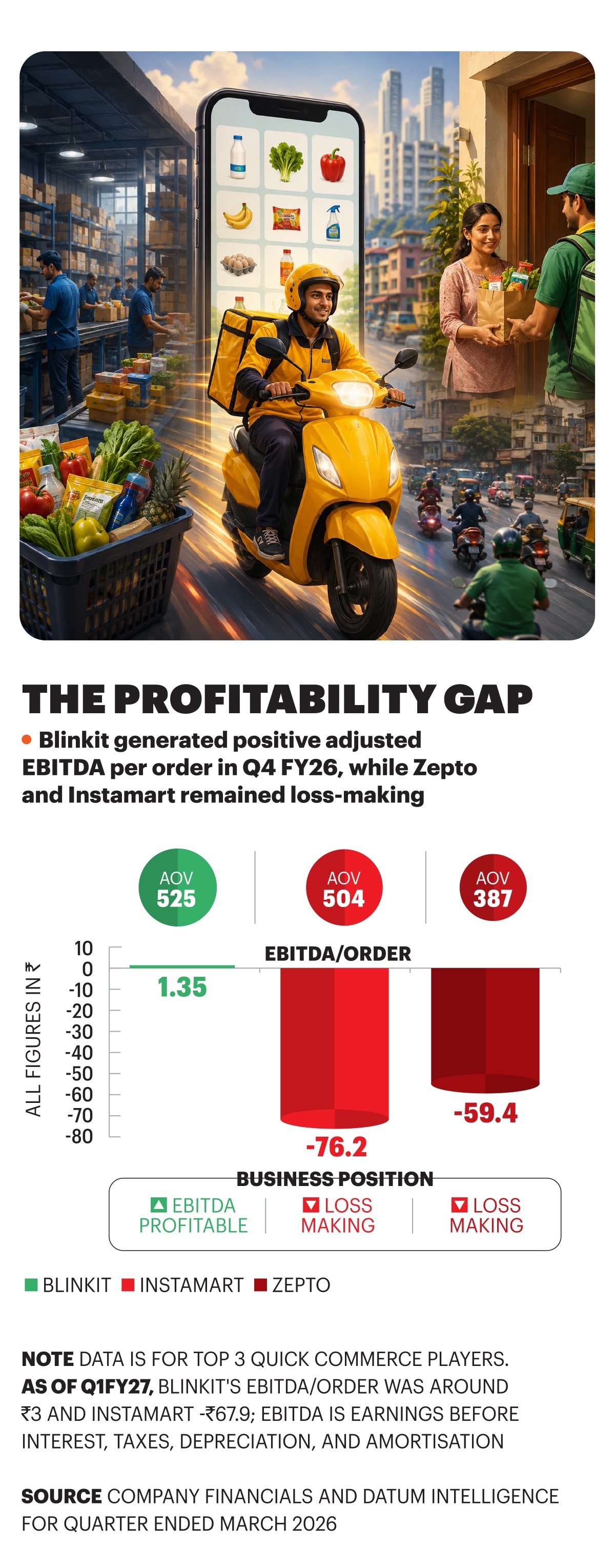
As of Q1FY27, Blinkit is the only major player to become EBITDA positive. EBITDA stands for earnings before interest, taxes, depreciation, and amortisation. Its adjusted EBITDA margin stood at 0.6%, while EBITDA per order was approximately Rs 3. Instamart, despite improving its economics, was losing around Rs 68 per order, while Zepto’s EBITDA loss was nearly Rs 60 per order as of Q4FY26. According to Swiggy’s inputs for Instamart, there has been improvement of +Rs 29 per order for adjusted EBITDA/order, so the loss per order has reduced considerably in last one year and its contribution (per order) has also improved the most in the industry.
The gap is a reminder that the quick-commerce race cannot be judged simply by order volumes, gross merchandise value (GMV) or dark-store counts. The real test is what remains after the cost of fulfilling those orders.There is also another story playing out in the sector and there are clear signs of a reset.
Changing dynamics
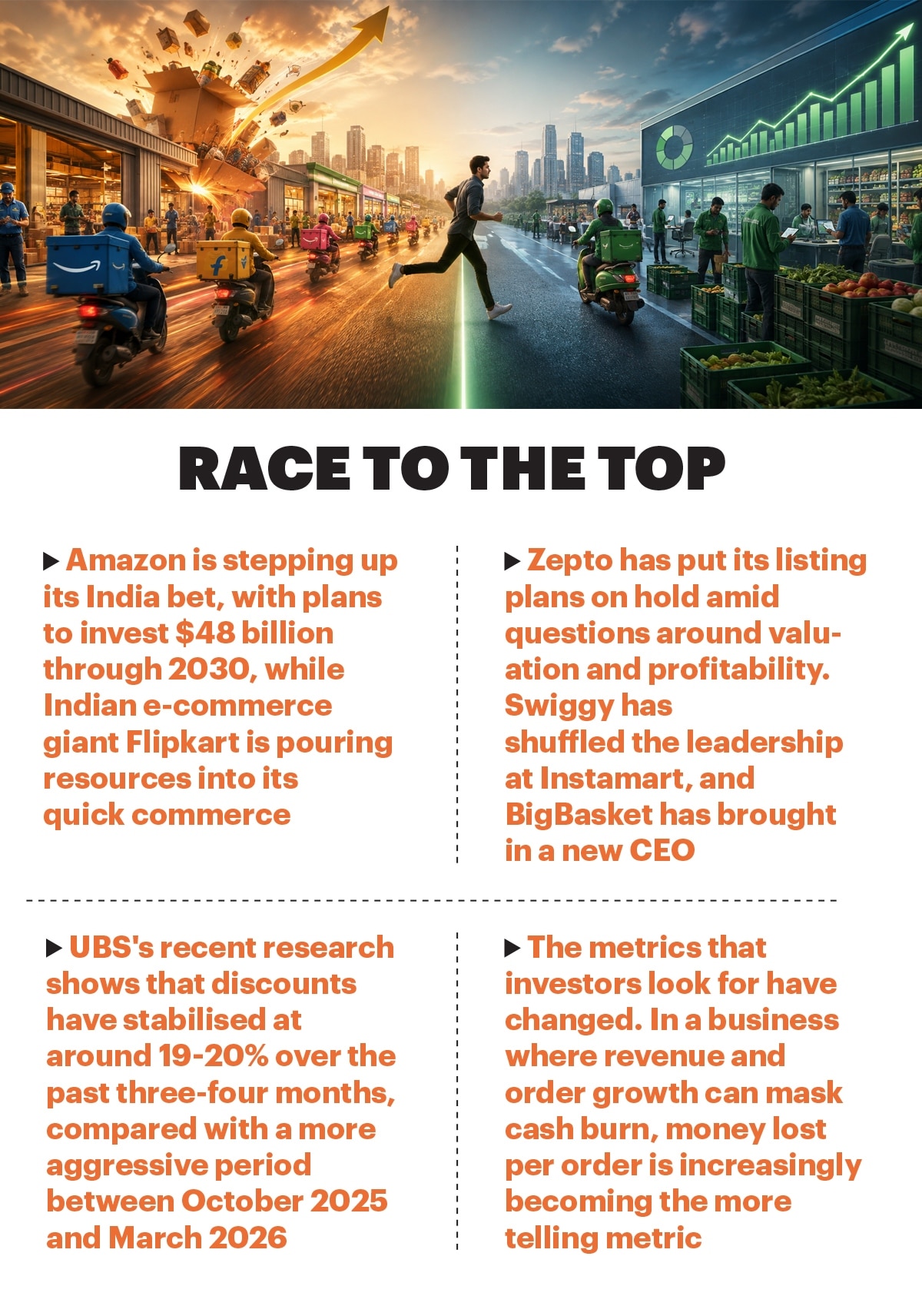
Global e-commerce major Amazon is stepping up its India bet, with plans to invest $48 billion through 2030, while Indian e-commerce giant Flipkart is pouring resources into its quick commerce offering, Minutes. The message from the two e-commerce giants is that quick commerce is no longer a niche dominated by a handful of specialists. It is becoming central to the battle for India’s urban consumer.
Zepto has put its initial public offering (IPO) on hold amid questions around valuation and profitability. Swiggy has reshuffled the leadership at Instamart, while BigBasket has brought in a new CEO as the Tata Group’s digital businesses undergo a broader transition.
Blinkit, the market leader, which reported a revenue of around Rs 38,000 crore in FY26, is moving beyond the dark-store strategy that defined the first phase of the industry and focusing on increasing productivity of the network already built. And, Blinkit is the first major player to demonstrate that the model can generate profits at scale.
This is the industry’s first big reality check. For years, quick commerce was synonymous with cash burn. Discounts, free deliveries and aggressive customer acquisition helped create the habit, but made the economics difficult to defend.
Beginning of change
Swiss multinational investment bank and financial services company UBS’s recent research shows discounts have stabilised around 19-20% over the past three-four months compared with the more aggressive period between October 2025 and March 2026, when they were at 24-27%.
Lower discounts, however, do not automatically translate into profits. BigBasket’s numbers illustrate a different challenge. In FY26, it spent roughly Rs 1.37 to generate Rs 1 revenue, losing Rs 37 for every Rs 100 revenue generated.
For a category built around low-margin grocery, that is a difficult equation to sustain. This is where Blinkit’s lead, though modest, becomes important. Its advantage is not simply the size of its order book or dark store network but its tighter grip on costs. It has built its position around a wide assortment, dense dark-store network, and an appeal among relatively premium consumers. Experts say a typical dark store needs at least 1,100-1,200 orders per day to break even, though this varies city-to-city and location-to-location due to real estate costs.
“It’s not only AOV (average order value). It’s also the operational efficiency and the discipline that you need to bring in. The ability to command a premium on the same SKUs (stock keeping units) versus the other platform directly flows into the bottom line, and then you make it operationally perfect in terms of delivery timelines, store efficiencies, etc,” says Apoorve Goyal, Managing Director, India Investments at Prosus, one of Swiggy’s largest investors.
As per experts, Blinkit can command a price premium even on identical SKUs, around 15% more expensive than offline retail, 10% higher than Instamart and 5% higher than Zepto. That pricing power also allows it to sell adjacent categories, further improving its economics.
Deloitte’s Anand Ramanathan, Consumer Industry Leader and Partner at Deloitte South Asia, says the other critical piece is operational discipline. “It is focused on a path to profitability, looking at where they will knock down cost and add efficiencies,” he adds.
What has also changed is the metrics investors watch out for. In a business where revenue and order growth can mask heavy cash burn, money lost per order is increasingly becoming the more telling metric, says Satish Meena, founder, Datum Intelligence, a market analytics firm. Blinkit’s ability to move that number into the positive territory gives it an advantage that its rivals are trying to replicate.
The profit math
There is an irony at the heart of India’s quick-commerce shake-up. While the companies are fighting harder than ever, the market itself is nowhere near saturated. Navin Killa, Head of Asian Telecoms, Media and Internet Research at UBS Global Research, believes the size of the opportunity explains the influx of competition.
When quick commerce began taking off in 2021, investors and analysts saw it as a $15-20 billion market, he says. At that size, it may have been logical to leave the market to the three pure-play companies. But as the platforms expanded beyond grocery and demonstrated that the opportunity could be much larger, other companies entered the fray.
Google and Deloitte expect India’s quick-commerce market to reach $250 billion by 2030 and as of April this year, the industry was estimated to be at $50 billion. And the opportunity extends far beyond the current quick-commerce basket.
India’s online grocery market was worth around $12 billion in 2025, according to Ken Research, and is projected to reach $103 billion by 2030. Overall grocery has the potential to touch the $1 trillion mark by 2030. Yet online grocery accounts for only 1-2% of urban grocery consumption. That means the industry’s biggest advantage may also be its biggest challenge considering that there is an enormous market still waiting to move online.
Goyal from Prosus believes the opportunity remains largely untapped. In urban centres, he says, online grocery—including quick commerce and other online models—accounts for only 1-2% of the grocery market. A large section of consumers continues to buy groceries the traditional way.
From a market perspective, therefore, the industry has only scratched the surface. But Goyal’s more important point is what comes next. “The question is not whether the market can grow; it is whether the economics that work in mature urban dark stores can be replicated across a much larger network,” he says.
Six players, six different paths
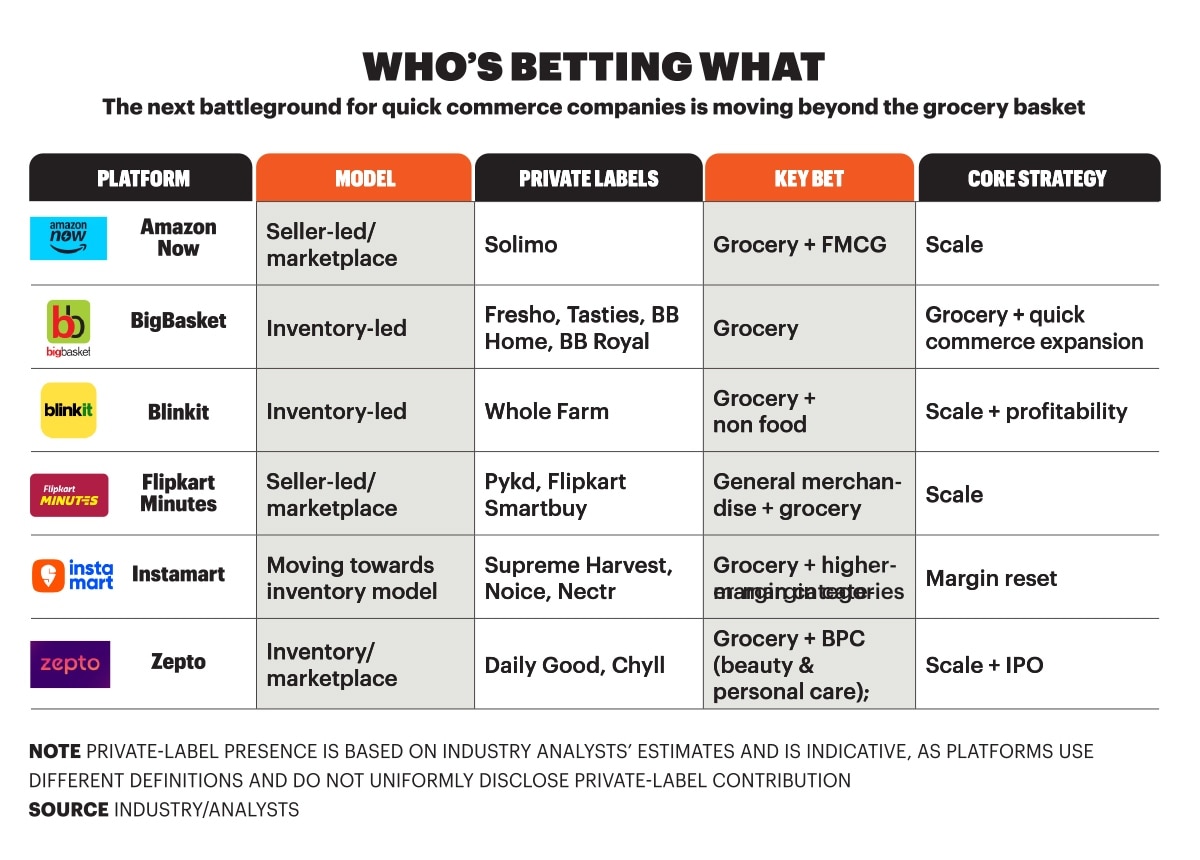
The market may be enormous, but the companies chasing it are entering the next phase with different starting points, and different problems.
Instamart is recalibrating after a period of aggressive expansion, while Prosus is signalling that the business is unlikely to return to a growth-at-all-costs strategy.
“Instamart had the capital, but it could not scale fast enough, and that is where it lost market share to Zepto. Now its stated objective is to take back Zepto’s share in the next two to three quarters. But the bigger question is whether it can do that while improving its unit economics. The pressure to grow and the pressure to become profitable are now coming together,” says Meena.
Zepto has focused on value-conscious consumers while continuing to push scale. But it has also put its IPO plans on hold amid questions around valuation and profitability. Flipkart Minutes and Amazon Now are still trying to persuade consumers to switch from incumbent platforms. That makes customer acquisition critical and expensive.
Kunal Gupta, Senior Vice President & Head of Flipkart Minutes Business, says the platform brings the wider Flipkart ecosystem—its technology, supply chain, customer base and assortment—into quick commerce. Gupta argues that Minutes’ advantage is not simply its store network but the ability to combine Flipkart’s customer base, supply chain, technology and assortment with a growing quick-commerce footprint.
“Minutes has scaled to 1,000 micro-fulfilment centres across more than 130 cities and 8,000-plus pincodes in under two years, with order volumes growing fivefold over the past year,” he says. It is leveraging the broader Flipkart customer ecosystem rather than relying solely on fresh customer acquisition.
Amazon Now has a unique advantage: deep pockets and a massive ecosystem. But deep pockets do not automatically solve the customer-acquisition problem.
BigBasket has perhaps the most complicated task. A company that once commanded an estimated 70-80% of India’s online grocery market now has to establish where it fits in a quick-commerce market that has fundamentally changed the rules of online grocery. It has also brought in a new CEO as the Tata Group’s digital businesses undergo a broader transition. JioMart, too, has entered the race, though its path in quick commerce remains less clearly defined.
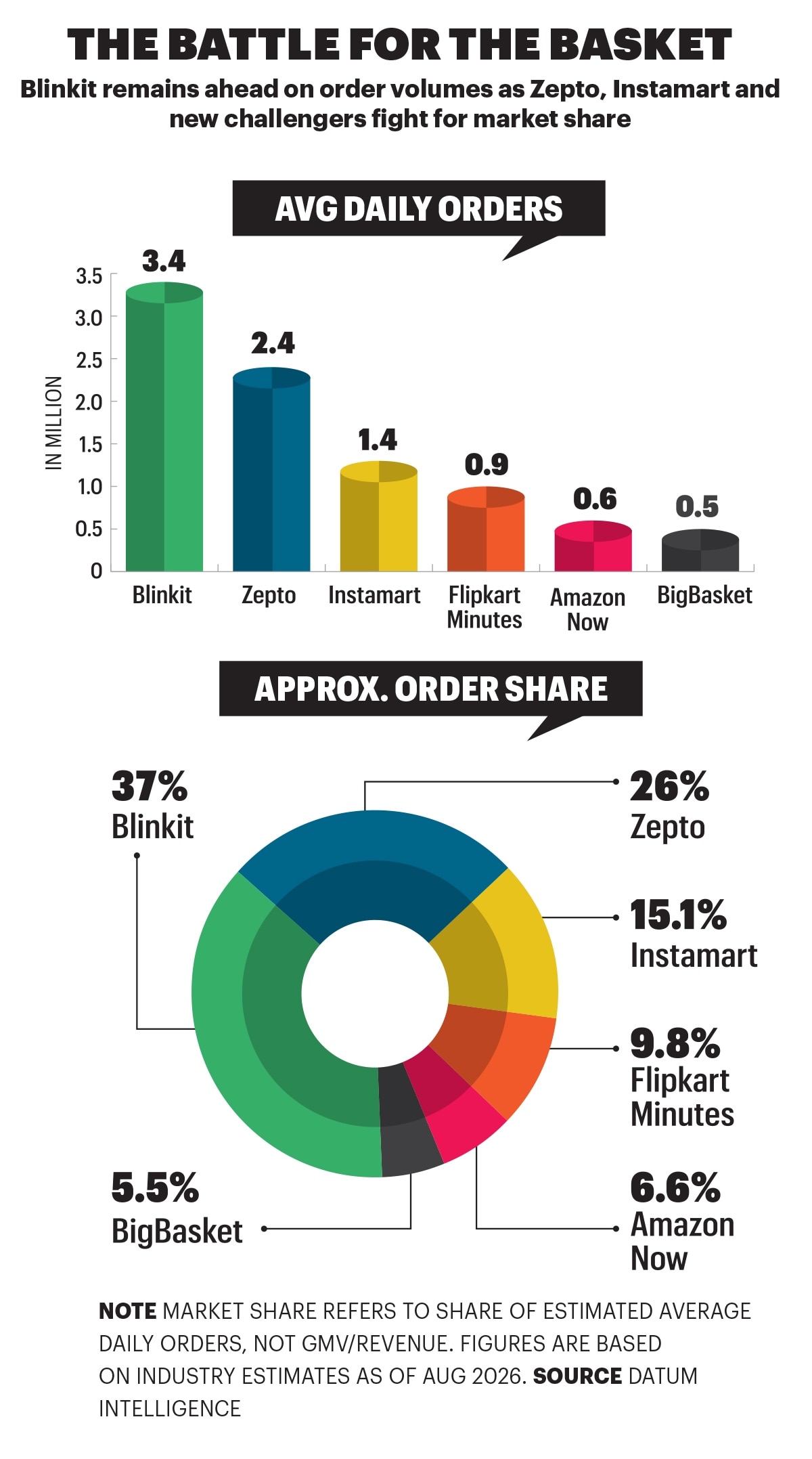
According to Badri Narayanan Gopalakrishnan, founder Infisum, a research consultancy firm, Blinkit, Instamart and Zepto together account for around 90% of the quick-commerce market, leaving the remaining three players—Flipkart Minutes, Amazon Now, BigBasket—to compete for the balance, with each currently in the single digits.
Moving beyond grocery
Grocery is a high-frequency category, but it is not a high-margin one. Milk, bread, vegetables, fruits and staples may bring consumers to the platform regularly, but they leave relatively little room to absorb the cost of dark stores, delivery and customer acquisition.
That is why the next battleground is moving beyond the grocery basket.
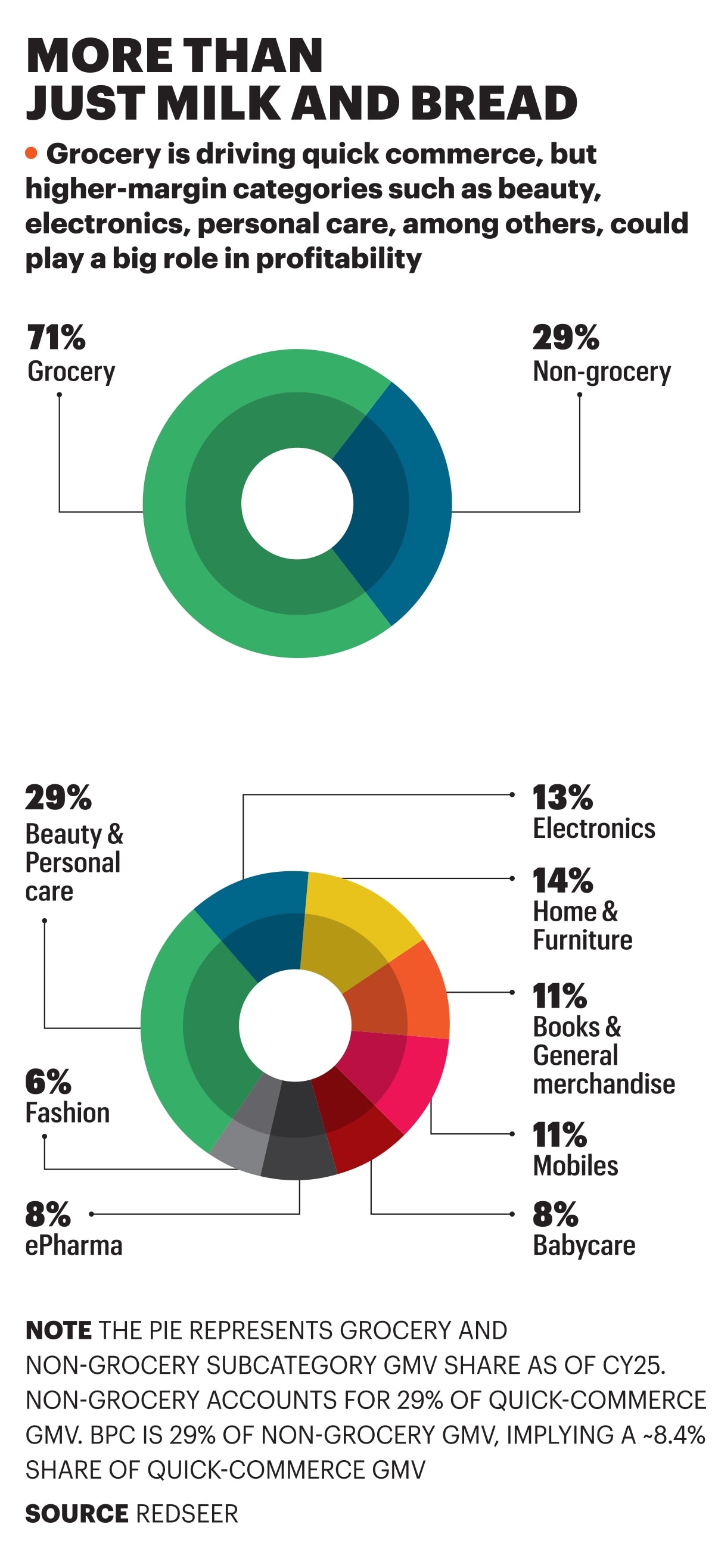
According to Redseer estimates, grocery still accounts for 71% of quick-commerce GMV. The remaining 29% comes from non-grocery categories, with beauty and personal care alone accounting for more than 8% of total quick-commerce GMV.
For platforms, these categories are attractive because they can potentially deliver better margins, larger baskets and more opportunities for private labels. The strategy is that while grocery brings the frequency, higher-margin categories improve the economics.
That is also where private labels enter the equation. Private labels can provide platforms something their traditional fast-moving consumer goods (FMCG) assortment cannot—greater control over pricing, margins, and, importantly, customer relationships.
Instamart, for instance, has been building a portfolio across brands such as Supreme Harvest and Nectr, while Noice has gone a step further, spanning categories from paneer and bread to ice creams and smoothies. Blinkit has Whole Farm, while Zepto has Daily Good. Minutes and Amazon Now are also moving into the space, including through sellers.
But the private-label opportunity is not just about earning more on each product. It could also give platforms a reason for consumers to keep coming back. “I think Swiggy is starting to do that in a very interesting way with Noice. It gives you two things: customer acquisition as well as retention. People start coming to the platform for a particular SKU. So, I may have to buy five things, but if one of them is a Noice product, I’m likely to buy the other four from Instamart as well,” says Goyal.
The economics are straightforward. “For a retailer, private labels are only going to be an upside. It means better margins. But for an FMCG player with 40% gross margins and above, it is very difficult. All this new product development and launch will kind of make them bleed,” Ramanathan says.
For beauty and personal care and other high-intent categories, brands see quick commerce not merely as another route to market, but as a channel that can generate incremental consumption.
Vikas Bagaria, founder and CEO of Pee Safe, says the economics of the channel have worked for the company.
“Quick commerce has evolved from being an additional distribution channel to becoming a strong product-channel fit for our business. We have found quick commerce to be a profitable channel for us, and in many cases, the profitability is better than marketplaces.”
That creates another layer to the private-label battle. Platforms want brands because they bring assortment, traffic and advertising revenue; at the same time, they increasingly want to build brands of their own. And brands, too, are becoming more selective about how much they are willing to spend to win visibility on these platforms.
For larger FMCG companies, launching differentiated products and acquiring new-age brands that cater to emerging consumer needs is becoming another way to strengthen their presence on quick commerce.
At ITC, digitally enabled sales, together with Modern Trade, now account for 34% of its FMCG portfolio, says Shuvadip Banerjee, Chief Digital Marketing Officer, ITC Ltd. Over the past year, ITC Foods has introduced both fresh and packaged products on quick commerce, alongside a range of differentiated SKUs and digital-first brands.
“We have also acquired many new-age start-up brands over the last few years, such as Yoga Bar, Prasuma and 24 Mantra that cater to unique consumer needs and are present on q-comm channels. We believe there is ample headroom for both new-age and established brands to co-exist as the quick commerce ecosystem and consumer choices continue to evolve.”
The battle for the deeper India
The next test of the model will be whether the economics that work in India’s largest cities can travel beyond them.
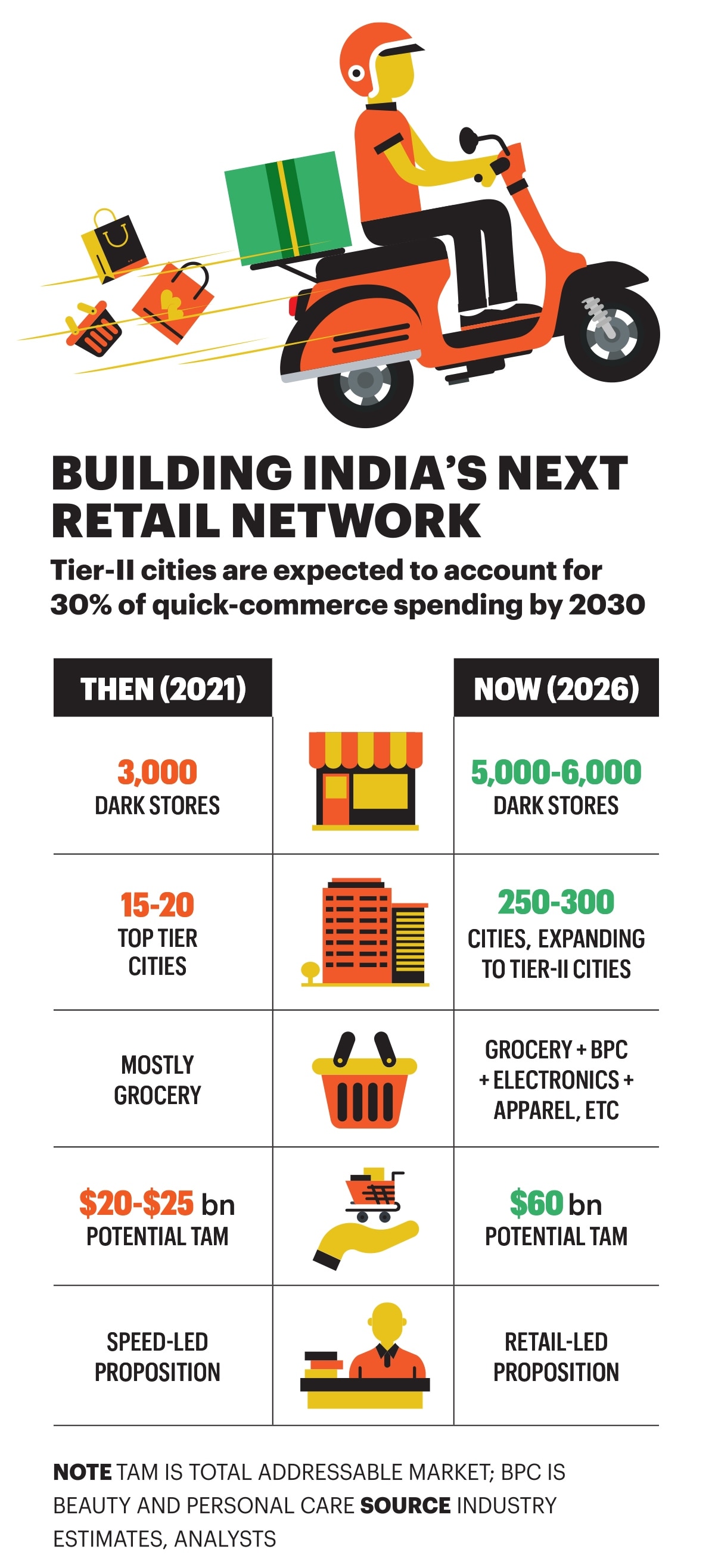
As per a Deloitte-FICCI report, Tier-II and Tier-III cities now account for over 60% of all e-commerce transactions in India. Quick commerce is already spreading beyond the metros, and Deloitte expects Tier-II cities to account for 30% of quick-commerce spending by 2030. But the economics of that expansion are likely to look very different.
Gupta from Flipkart Minutes says the platform’s Tier-II and Tier-III business has grown 42X over the past year as it expanded into more than 90 new cities. The company says value, assortment and availability become particularly important in these markets, where larger baskets and convenience are emerging as key drivers.
Ramanathan sees the growth of food delivery infrastructure and greater scale in private labels as factors that could make smaller cities more viable. “As food delivery grows in Tier-II, quick commerce will also grow because a lot of the infrastructure learnings are a function of how food delivery grows,” he says.
But he cautions that Tier-II will remain an investment for some time. “For e-commerce platforms, their existing scale, customer base, and supplier relationships help. But that last mile of having a dark store close to the customer, keeping exactly the right product in that dark store and managing hyperlocal demand, those are tricks that are very specific to quick commerce and will have to be learned,” says Killa.
In smaller towns, one dark store could serve an entire town, with 30-minute deliveries replacing the 10-15-minute promise.
But there is a catch: a market that can support quick commerce may not support several competing platforms.
Blinkit is already present in 300 cities with over 2,400 dark stores. Instamart is present in 128 cities with 1,181 dark stores, while Zepto stays ahead with 61 cities and 1,225 dark stores. Gupta says Minutes is on track to reach around 1,500 micro-fulfilment centres across more than 150 cities “very soon”.
The deep pockets of e-commerce giants give them the ability to spend. However, their biggest disadvantage would be customer habit.
Meena argues that Amazon and Flipkart are entering a market where consumers have already developed strong preferences for incumbent apps. “Deep pockets alone cannot beat established platforms. In quick commerce, customer stickiness and habit matter more,” he says.
Gupta says that repeat purchases for Minutes have risen more than 20% in the past one year as it seeks to leverage the broader Flipkart customer ecosystem rather than rely solely on fresh customer acquisition.
Killa sees another possible outcome. Amazon and Flipkart could expand the market by moving more traditional retail and e-commerce demand online. But their entry could also put pressure on incumbents’ growth and profitability.
While the market may be getting bigger and the economics may be getting better, competition could keep making profitable scale harder to achieve.
Consumer behaviour is changing with rising smartphone and internet adoption, and quick commerce is increasingly influencing what—and how—Indians shop. There is, therefore, a credible argument that India can accommodate more than the three players that dominated the first phase.
The winners of the next phase will not necessarily be the companies with the most stores, the fastest delivery times or even the largest order volumes. They will be the ones that can convert density into productivity, grocery frequency into higher-margin baskets, and scale into sustainable cash generation.
@Palakagarwal64


