













In 1949, XLRI (Xavier Labour Relations Institute) Jamshedpur, founded by Jesuit missionaries, became the first institute in India to start a programme on labour relations. The mandate was to train Tata Steel’s labour unions.
“The aspect that makes XLRI stand out is that we are the forerunners in starting a management institute in Independent India,” says Father Sebastian George, the Director of XLRI.
At a time when management education was still taking shape, corporate sustainability and ethics were part of XLRI’s curriculum.
“XLRI develops this mindset to work for the greater good,” says George.
Although XLRI Jamshedpur currently offers PGDM programmes, it has already applied to become a deemed-to-be university.
George says the institute has received a letter of intent from the ministry and wants to expand with more campuses. The plan includes opening another campus in Jamshedpur. “We have acquired one campus in Neral, Karjat (Maharashtra). As soon as we get the status of a university, we will begin our programmes there as well,” he says, adding that the university status is expected within a year.
Aside from Jamshedpur, XLRI has ventured into NCR with a campus in Haryana’s Jhajjar. It also plans to set up an AI-focused campus in Andhra Pradesh’s Amaravati. “We want the Amaravati campus to be known for AI,” says George.
With the university tag, XLRI will be able to offer MBA instead of PGDM. “Earlier, PGDM was well-accepted because IIMs were giving PGDMs. There was a lot of commonality among all institutions. Now, IIMs have started giving degrees. We are thinking that giving only PGDM may not help students in their further studies,” says the XLRI director.
“Once we get the university status, the fellow programme would become PhD and PGDM would become MBA,” he adds.
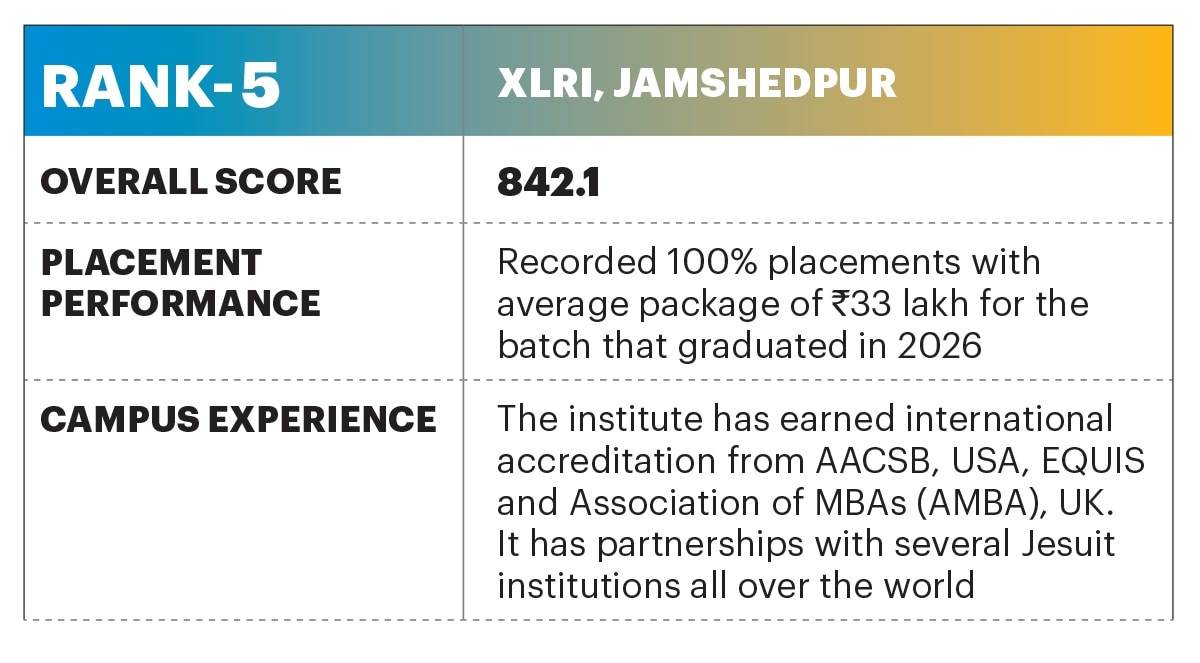
XLRI is among a few institutions that have been accredited with the triple crown: AMBA (Association of MBAs), AACSB (Association to Advance Collegiate Schools of Business) and EQUIS (EFMD Quality Improvement System). It has also ranked fifth in the BT-MDRA Best B-schools Survey 2026-27, with an overall score of 842.1.
According to George, XLRI wants to establish five schools and have at least 10 programmes once it receives university status.
The XLRI director is confident that a two-year management programme will continue to be relevant in India over the next decade.
“In Europe and the US, the one-year programme is becoming more relevant. But as far as India is concerned, a two-year programme is still relevant. But we don’t know what happens 10 years down the line. That’s anybody’s guess,” he adds.
Unlike IIMs, XLRI evaluates applicants through its own exam, XAT. Over 1,00,000 applicants appear each year.
“While CAT evaluates three components taught by coaching centres, XAT also looks at decision making, which requires raw intelligence,” says George.
The average package for the batch that graduated in 2026 stood at Rs 34 lakh for Business Management (BM) and Rs 33 lakh for Human Resource Management (HRM).
In HRM, 180 students pass out each year. In BM, about 240 students graduate from the Jamshedpur campus.
The institute also takes about 40 research scholars every year. While most of the institute’s 90 faculty members are from IIMs, George says attracting star faculty is difficult.
Most students get placed with consulting firms followed by the banking and financial sector.
@karandhar11


