













India is undergoing a quiet but far-reaching transformation in how wealth is made and by whom. The country is on track to mint its youngest generation of billionaires, many still in their twenties, marking a decisive break from how Indian wealth has traditionally been built. The contrast is clear. The median age of an Indian billionaire is around 67, while for self-made billionaires, it is early 30s. Further down the pipeline, an even younger set of soon-to-be billionaires is emerging, poised to reshape the country’s wealth demographics altogether.
Zepto’s co-founders, Aadit Palicha and Kaivalya Vohra, illustrate this shift best. At 23, they already rank among India’s youngest rupee-billionaires, with net worths of Rs 5,380 crore and Rs 4,480 crore respectively, according to the M3M Hurun India Rich List 2025, translating into roughly $650 million and $540 million, respectively.
With Zepto’s valuation now past $3.6 billion ahead of its IPO, a strong listing could push their individual holdings beyond the $1 billion mark, making them India’s youngest-ever dollar billionaires.
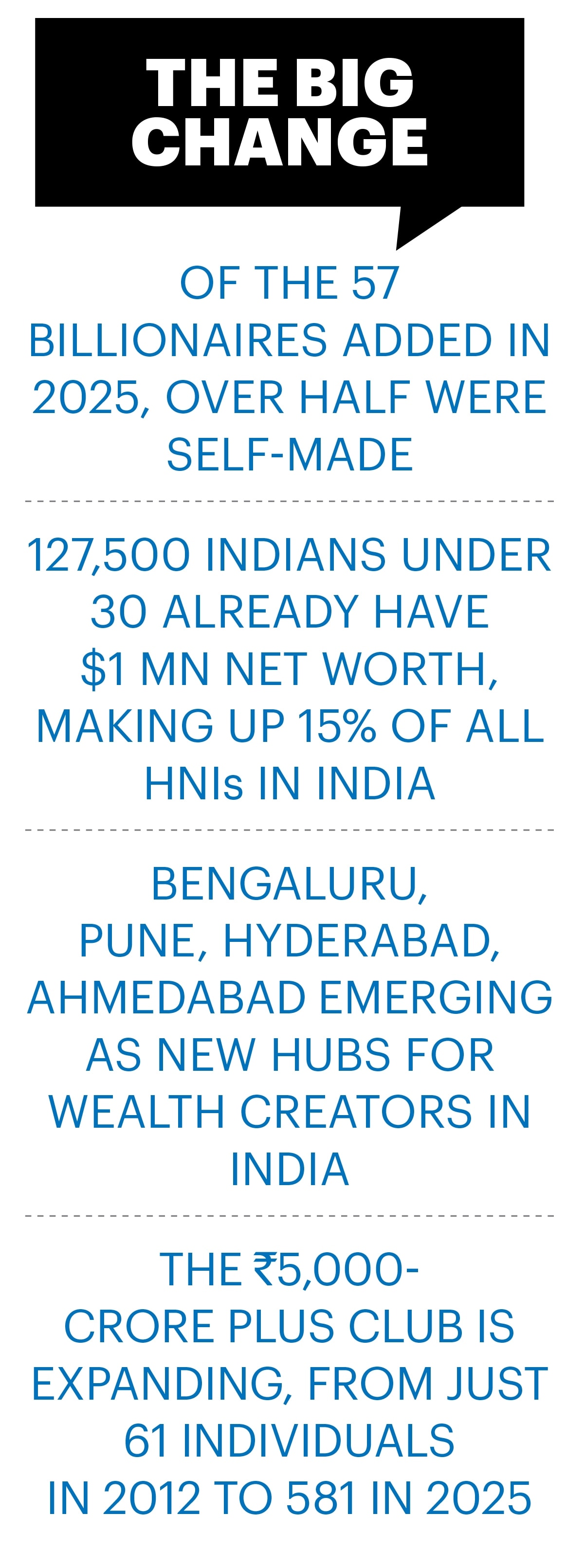
As per the Hurun Rich List 2025, India added 57 new billionaires over the year, and more than half were self-made. That’s still some way behind China (90% self-made) and the US (72%), but the trajectory is clear. India’s pipeline of first-generation wealth is only getting deeper and younger.
A Widening Base
The base is expanding as fast as its top tier. India currently has over 8,50,000 high-net-worth individuals (HNIs), a number expected to nearly double to 1.65 million by 2027, as per an Anarock report. Those under 30 are 15% of that. This means roughly 1,27,500 people under 30 have a net worth of $1 million or more.
This share is projected to climb further. The under-30s are expected to account for a quarter of India’s millionaires by 2030. At this pace, it may only be a matter of years before India’s billionaire cohort starts to skew towards the young and self-made, a shift that is playing out faster than most would have predicted even five years ago.
Beyond Mumbai & tech The geography of Indian wealth is shifting alongside its age. For decades, the road to serious money ran through a handful of cities. Mumbai dominated the overall billionaire list while Bengaluru and Delhi drove much of the newer, self-made wealth.
While legacy wealth remains heavily concentrated in Mumbai and Delhi, the new pipeline is increasingly emerging from Bengaluru, Pune, Hyderabad, and Ahmedabad, fuelled by tech talent clusters and regional manufacturing booms.
Many of these rising wealth creators haven't yet crossed the billion-dollar mark, but are closing in fast, and they come from strikingly different worlds.
Few stories capture this shift better than Lalit Keshre’s. His journey runs from a small farming village in Madhya Pradesh to co-founding and running Groww, now India’s largest stockbroking and investment platform. Under his leadership, Groww has evolved from a mutual fund aggregator launched in 2016 into a publicly listed fintech company, scaling revenue 77x in four years and crossing market capitalisation of Rs 1.36 lakh crore in 2026.
Then there’s Rakesh Chopdar, whose journey began in 2008 with a small manufacturing unit in Hyderabad. His company, Azad Engineering, is now valued at over Rs 15,000 crore and counts Boeing and Rolls-Royce among clients, a rare Indian success story in high-precision aerospace manufacturing, an industry with brutal entry barriers and where Indian firms have historically struggled to compete.
In real estate, Arun MN Casagrand shows how a professionalised, process-driven approach can still build outsized wealth in an industry long associated with opacity and old money. He left a marketing job at Wipro to start Casagrand in Chennai in 2004 with just five professionals, scaling operations to Coimbatore, Bengaluru, and Hyderabad, and delivering over 100 projects along the way, turning a small regional start-up into one of South India's leading residential developers.
However, not every name on this list is a founder. Akash Bhansali represents a different route to the top: with patient, concentrated public-market investing, he has built his fortune backing fundamentally strong businesses across industrials, chemicals, and infrastructure, including Gujarat Fluorochemicals, Sudarshan Chemical, and One97 Communications. He has proven that disciplined, long-term value investing can still create billionaire-scale wealth in India, without founding a company at all.
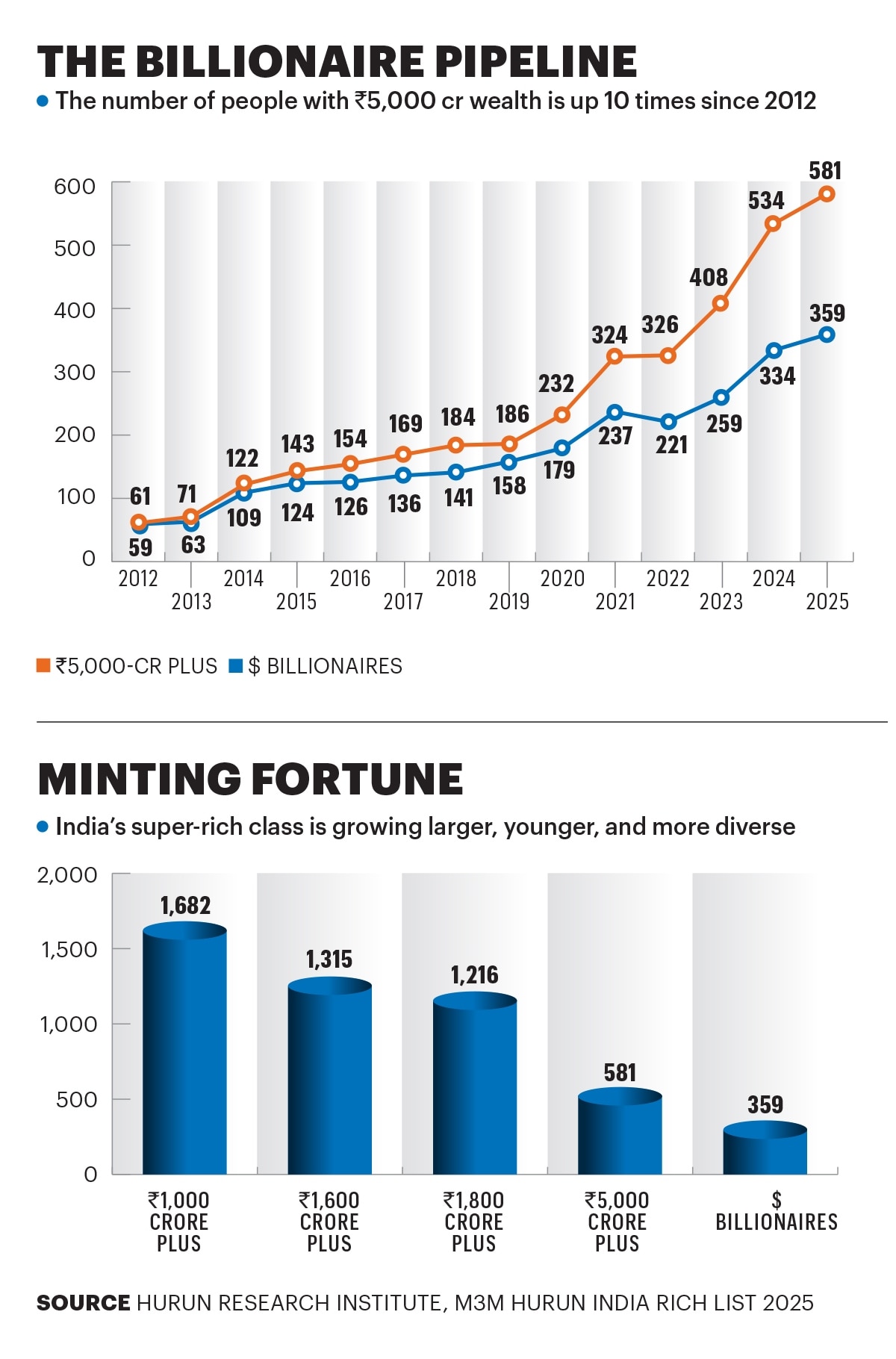
The Hurun Rich List data from 2012 to 2025 reveals just how dramatically this acceleration is playing out at the very top of India's wealth pyramid, specifically among individuals worth Rs 5,000 crore or more. This cohort has grown nearly tenfold: from 61 in 2012 to 581 in 2025. What stands out isn’t just the scale, but the pace of compounding. It took nine years, from 2012 to 2021, for the group to grow from 61 to 324 members, roughly 5.3 times growth. But it took just four more years, from 2021 to 2025, for that number to nearly double again to 581. That's a clear signal that ultra-high-net-worth wealth creation in India is accelerating structurally.
In comparison, the count of dollar billionaires rose from 59 in 2012 to 359 in 2025, a significant growth, but slower in absolute terms than the Rs 5,000 crore-plus cohort. The gap underscores that India’s super-rich class is growing larger, younger, and more diverse in sector and geography.
What makes this moment particularly significant is the pipeline just behind it. A large and growing set of profitable tech and consumer unicorns are preparing for public listings. IPOs have become the primary mechanism for converting paper net worth into realised billionaire status.
Zepto’s founders are simply the most visible example of a much larger cohort waiting for their moment on the exchange. When that wave of listings plays out over the next few years, India’s official billionaire count and its median age could look very different from what it does today.
@nindakbaba


