












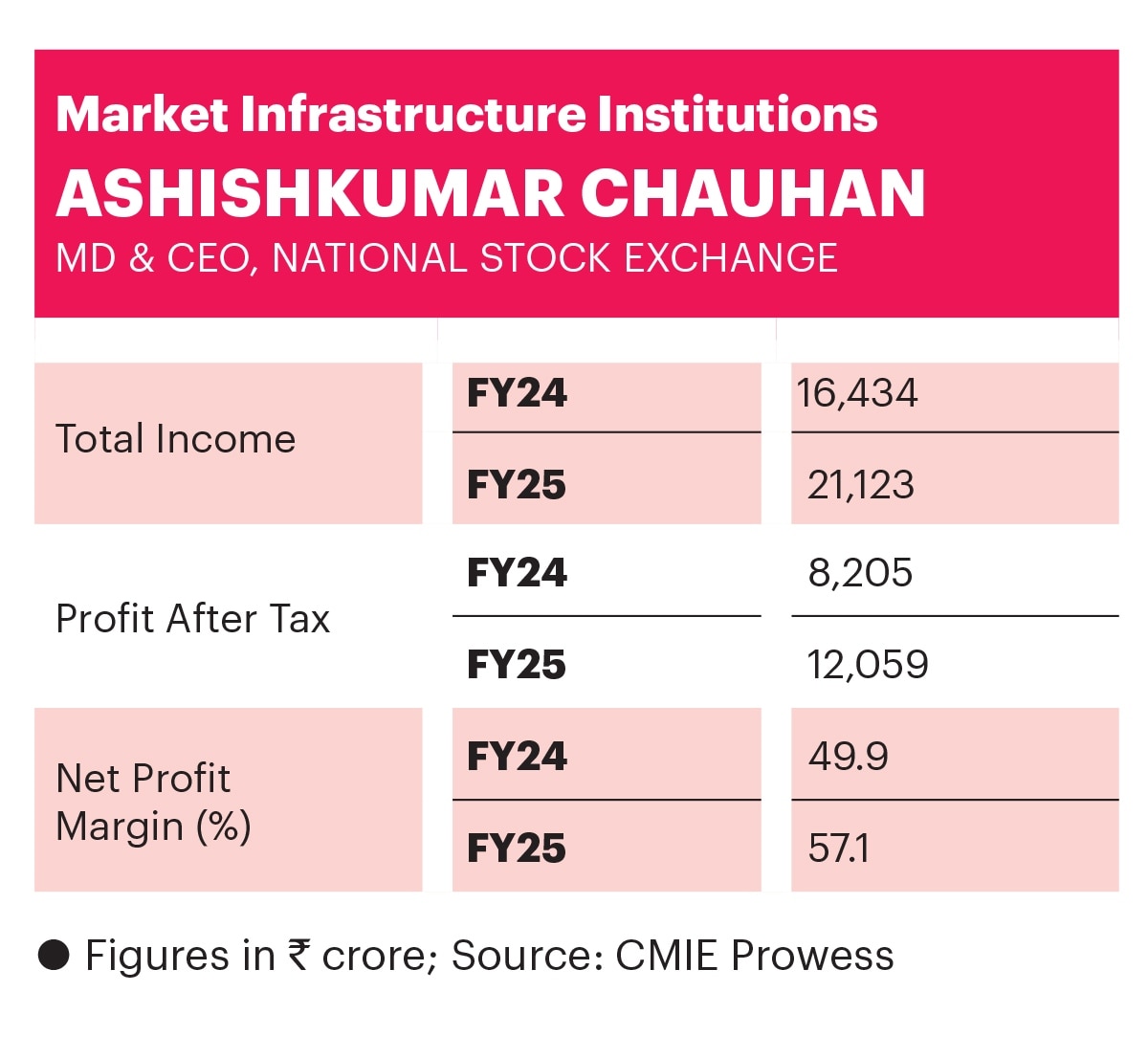

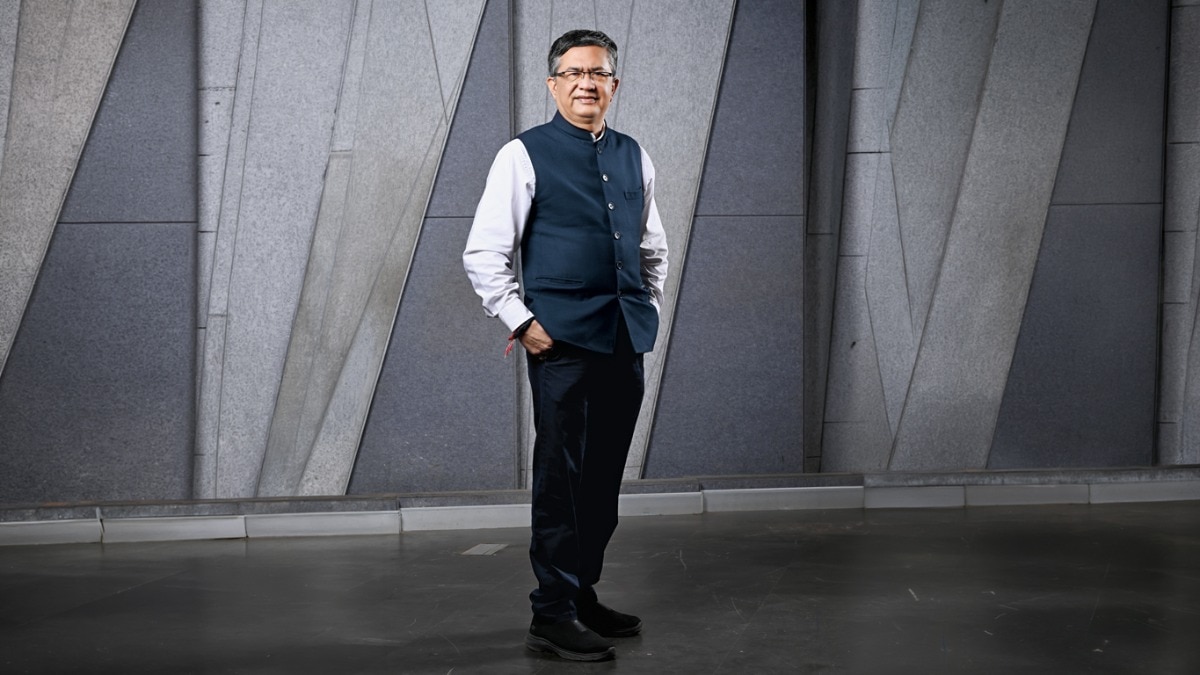
When Ashishkumar Chauhan returned to the National Stock Exchange (NSE) after over two decades, he did not just come back as its MD & CEO. He arrived with an idea and a symbol. At the NSE’s Mumbai headquarters stands a towering bull sculpture. Many are familiar with the iconic bull at BSE where Chauhan worked for 13 years before joining NSE in 2022. But NSE’s bull carries a deeper message with sculptures of investors, workers, and citizens walking alongside it.
“It reflects something Indian, that markets exist alongside society, not separate from it. Today, it has become part of samaj, the society itself,” says Chauhan.
There are 128 million unique investors registered on NSE. “Today, 25% of the households have exposure to equities. What was once seen as a niche activity is gradually becoming a mainstream part of everyday financial life,” says Chauhan.
As India moves towards its long-term vision of Viksit Bharat by 2047, the exchange’s ambition is clear: deepen trust in markets, widen participation, and ensure that capital markets help power entrepreneurship and wealth creation.
Chauhan’s return to the country’s largest exchange is a full-circle moment. In the early 1990s, he spent eight years at NSE as part of the core founding team that built the foundations of India’s modern capital markets—introducing screen-based trading, a nationwide satellite trading network, the Nifty index, derivatives trading, and several other market innovations.
Three decades later, India has emerged as the fourth-largest equity market in the world (based on market capitalisation) following the US, China (including Hong Kong) and Japan. NSE commands a lion’s share. Its business model has also evolved beyond equity trading to include SME markets, bonds, derivatives and exchange-traded funds.
In many ways, NSE now functions as a critical piece of India’s digital public infrastructure. This has earned Chauhan recognition as Best CEO for Digital Public Infrastructure in this year’s BT-PwC India’s Best CEOs. The numbers speak for themselves.
The combined market capitalisation of companies listed on NSE stands at Rs 428.2 lakh crore (about $ 4.6 trillion), more than India’s nominal GDP.
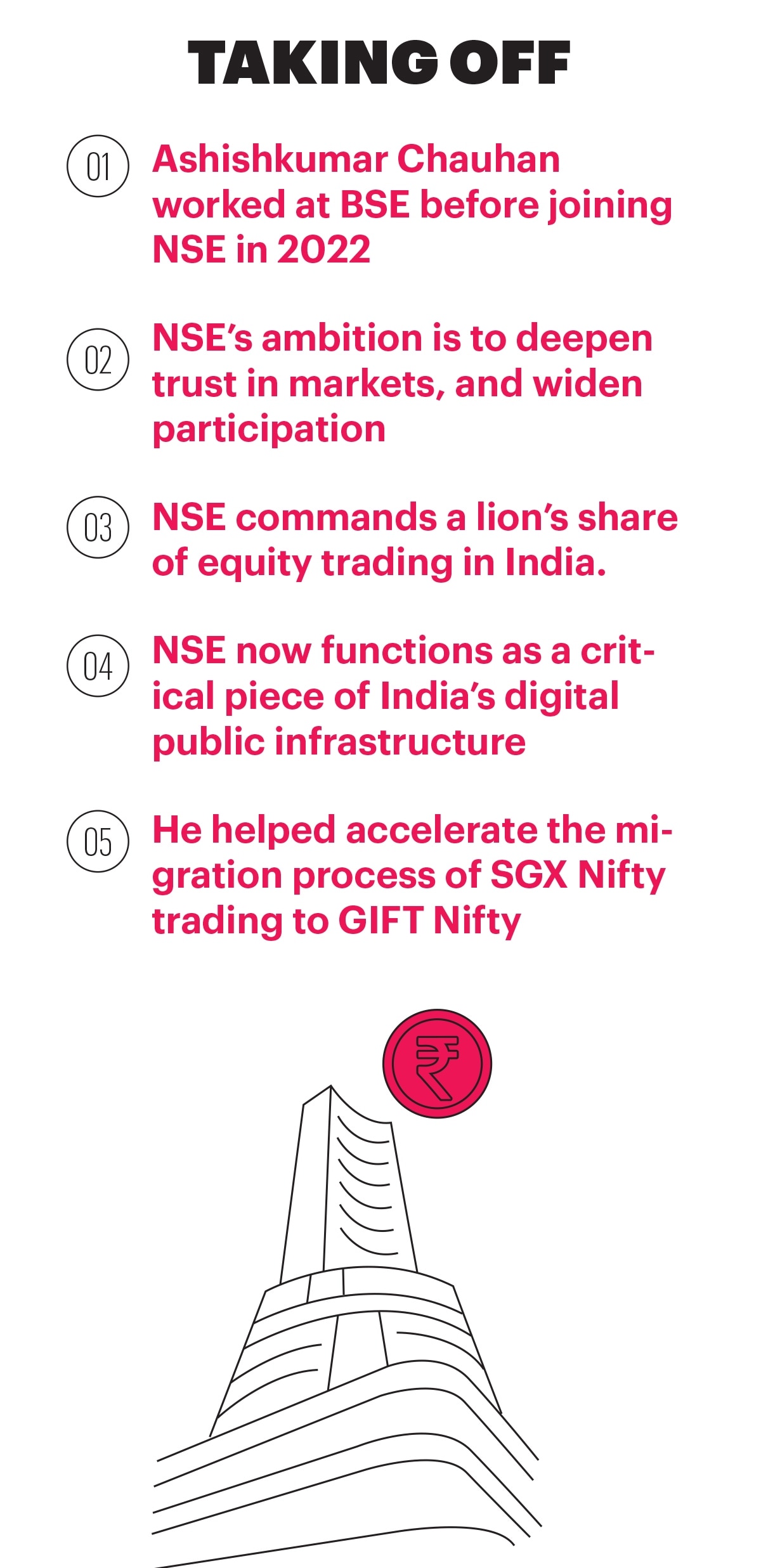
Within a year of taking charge, Chauhan helped accelerate the migration process of SGX Nifty trading to GIFT Nifty at Gujarat International Finance Tec-City. For years, global investors seeking exposure to Indian equities traded Nifty futures in Singapore. The launch of GIFT Nifty signals something larger: India’s ambition to build an international financial marketplace. NSE International Exchange (NSE IX), the exchange's global arm at GIFT City, commanded a market share of 99.6% among IFSC exchanges as on December 31, 2025
“The lessons we have learnt over the last 35 years about building markets can also be applied in other sectors,” says Chauhan. As part of this broader effort, NSE operates a Social Stock Exchange (SSE) segment that allows non-profit organisations (NPOs) and social enterprises to raise funds through the market ecosystem. It has also launched electricity futures, is developing natural gas futures contracts, and has approved the creation of a subsidiary to operate a national coal trading exchange.
The idea of a Social Stock Exchange (SSE), first articulated in the Union Budget 2019-20 by Finance Minister Nirmala Sitharaman, was to create a platform connecting social enterprises and voluntary organisations with investors. “So far, over 165 NPOs have registered on NSE-SSE, with 15 successfully raising over Rs 43.5 crore in total across diverse developmental sectors such as healthcare, education, water, sanitation, and hygiene skilling, agriculture, arts, culture & heritage, and poverty alleviation,” says Chauhan. Several countries have experimented with this concept, mostly outside traditional stock exchange platforms, but with limited success.
The Indian SSE is creating a global benchmark and becoming an inspiration to other countries. “Officials from Malaysia visited us to understand and learn the nuances and technicalities of SSE; they introduced SSE on a pilot basis and launched it formally last month,” says Chauhan.
When Chauhan took charge, one of the most closely watched unfinished tasks was the long-pending public listing of the exchange. After more than nine years of regulatory delays and uncertainty, the Securities and Exchange Board of India has granted a No-Objection Certificate for the issue. The IPO preparations are in full swing. “It will allow more investors to participate, since private markets are not easily accessible and sometimes involve risks,” says Chauhan.
Chauhan has one simple message: “Our guiding principle is purpose before profit. If India is to grow, strong and trustworthy marketplaces will be essential. NSE is a critical institution for society, and its most valuable asset is trust,” says Chauhan.


