













Naman Pushp, the 21-year-old founder of aerospace start-up Airbound, belongs to the third generation of entrepreneurs—one trying to build technologies relevant to the world, not Indian versions of concepts existing elsewhere.
The earliest generation, 20 years ago, may have dreamt of building the local equivalents of global online marketplaces Amazon and Alibaba, and ride-sharing app Uber. That dream produced Flipkart, Snapdeal and Ola.
Ten years later, the second generation was designing products to suit India’s unique realities—from social commerce sites like Meesho and quick delivery grocery app Zepto to digital payment platforms such as Paytm.
“Companies like Meesho and Zepto pioneered models that work exceptionally well for India,” says Pushp, whose Bengaluru-based start-up is developing autonomous, zero-infrastructure drones to slash the cost of last-mile delivery.
“But what excites me is building something universal. We’re not trying to make the Indian version of something that already exists. We’re targeting the same problem statements that the best companies in the world are solving—and trying to solve them better,” he says.
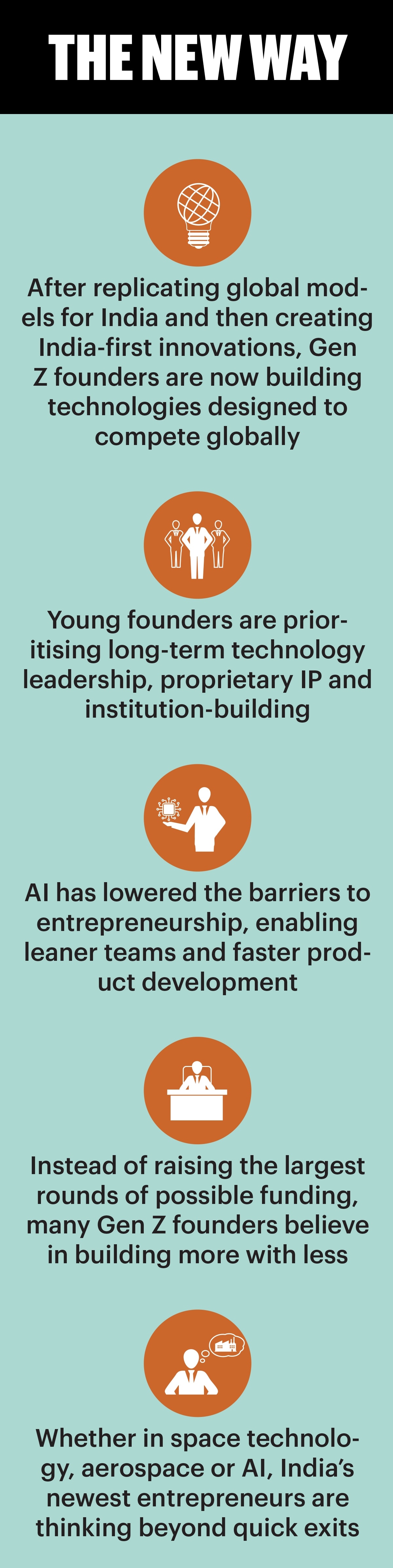
Raised on Artificial Intelligence (AI), smartphones and global digital access, India’s under-30 Gen Z founders like Pushp are less interested in adapting foreign ideas to India than in building technologies the world can use.
From space surveillance platform Digantara and Airbound to quick commerce leader Zepto and AI-native ventures emerging from research labs, they are entering sectors demanding greater technical depth, longer development cycles and vaster global ambitions.
They are not just building companies in a different funding environment from what prevailed in the days of their predecessors; they are redefining success in India’s startup ecosystem in the age of AI.
The demographic shift is significant. Boston Consulting Group says India’s Gen Z, numbering 377 million, is the largest generation India has ever produced. As the cohort enters the workforce and entrepreneurship in greater numbers, it is reshaping the innovation landscape.
Their ambitions are shaped by an ecosystem very different from the one that produced Flipkart or Ola. AI has lowered the barriers to building software, digital access has made global markets visible from day one, and access to capital has given way to greater scrutiny of business models.
Capital Efficiency
Roshni Rathi, Managing Director and Partner at BCG India, says the shift is more fundamental than incremental.
“Earlier generations often relied on raising significant capital to acquire customers and scale. Today’s founders can build, launch and monetise products much faster using AI and cloud infrastructure. They are optimising for speed, product quality and capital efficiency from day one. The playbook has shifted from ‘raise first, build later’ to ‘build first, scale intelligently’,” she says.
The early signs are already visible. A recent LinkedIn study found India recorded the highest year-on-year growth of 104% in the number of members adding the “Founder” title to their profiles. It also found that 77% of founders believe AI has made entrepreneurship more accessible by lowering barriers such as cost, expertise and access to networks.
Among Gen Z founders, 73% reported managing multiple income streams while using AI to start or expand businesses, reflecting the rise of a more flexible, AI-enabled entrepreneurial culture.
As a result, founders are placing greater emphasis on proprietary technology, long-term value creation and disciplined execution than on chasing growth at any cost.
Changing nature of success For India’s first generation of start-up founders, success was often measured by user growth, fund-raising milestones and unicorn valuations (start-ups worth at least $1 billion). Today’s investors and founders are redefining those metrics.
“It’s not a choice between building billion-dollar companies and sustainable ones,” says Rathi. “What’s changed is the maturity of both founders and the investor ecosystem. Capital efficiency has become a core operating principle—not because founders are less ambitious, but because sustainable economics are now seen as the foundation for building enduring billion-dollar businesses.”
Anirudh Sharma, 27, co-founder of Digantara, says that when India’s start-up ecosystem was taking shape, most companies were focused on solving consumer problems because that was where the opportunity—and the capital—was.
“Back then, we didn’t have a strong R&D (research and development) ecosystem to build deep-tech companies,” he says.
Digantara is a Bengaluru-based space surveillance company founded in 2018 that is building what Sharma describes as a “GPS for space.” GPS is short for Global Positioning System, a satellite-based radio navigation system.
Digantara tracks satellites, debris and other objects in Earth’s orbit using a proprietary network of space- and ground-based sensors. The company recently raised $50 million in funding led by Reliance Industries, with participation by 360 ONE, SBI Ventures, Ronnie Screwvala and existing investors Peak XV Partners and Kalaari Capital at a valuation of $200 million.
Then and Now
In the early years of start-ups, founders were under pressure to hit growth milestones quickly to unlock subsequent rounds of funding. That naturally steered entrepreneurs towards consumer Internet businesses with faster paths to scale and monetisation.
“Over the last five or six years, that has changed. India is now seeing a wave of deep-tech entrepreneurs building technology-driven businesses,” says Sharma.
That ambition is also changing how young founders think about growth and fundraising. Unlike the start-up boom years, capital these days is only valuable if it accelerates technology development, says Sharma. “I want to raise as little as possible and build as much as possible,” he says. “The moat is being able to build technology faster. In the AI era, time matters much more than just capital.”
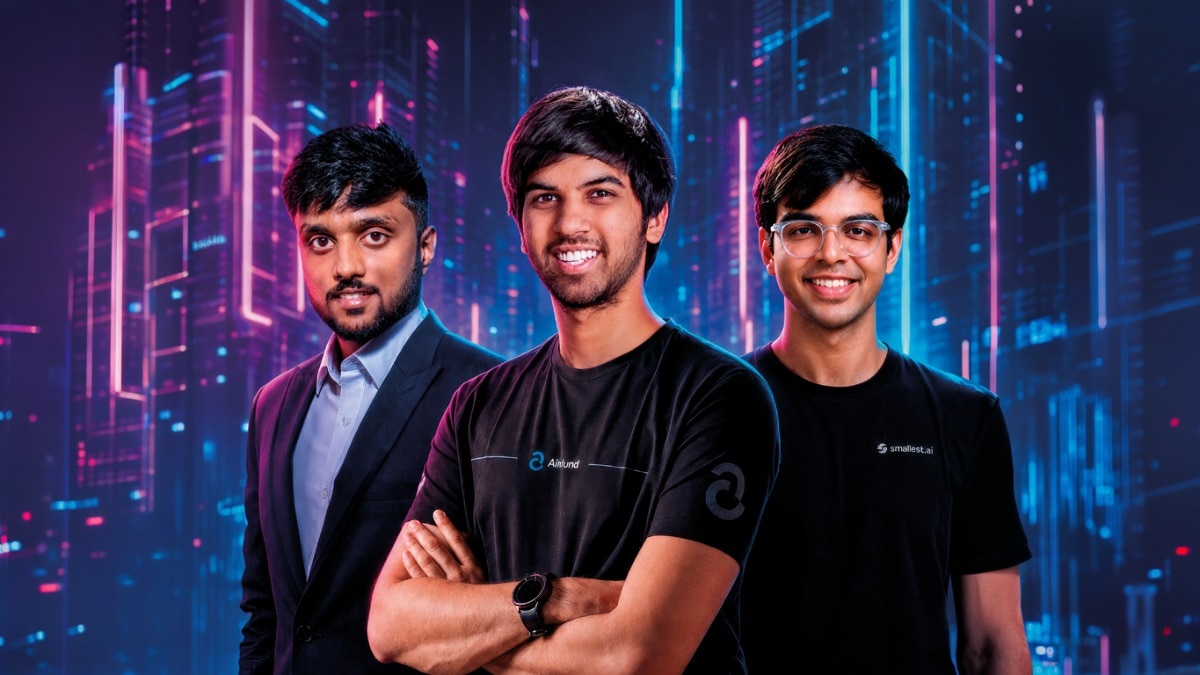
Sudarshan Kamath, 29, co-founder of AI voice start-up smallest.ai, says AI has also changed what founders spend capital on. While the AI boom has pushed fundraising and valuations to record highs, he argues that the nature of spending has fundamentally shifted.
“People are raising more capital than ever,” he says. “But the capital is going towards AI infrastructure, not people. Companies are spending on compute, tokens and tools rather than hiring.”
Sharma and Pushp echo a common belief that India’s newest founders are no longer content with adapting successful global ideas or building businesses purely for rapid scale.
Instead, they are chasing technology breakthroughs, targeting global markets from inception and measuring success by the durability of the institutions they create than the speed at which they become unicorns.
Building Institutions
Perhaps the sharpest departure from the previous generation lies in how these founders think about the endgame. For many consumer Internet entrepreneurs, building, scaling and eventually exiting a company became an accepted entrepreneurial cycle.
But founders building start-ups in frontier technologies argue that mindset simply doesn’t work for businesses whose products can take years, even decades, to mature.
For Sharma, sectors such as space, defence and semiconductors require a fundamentally different horizon. “I want to build a generational company that truly moves the needle for humanity.”
Airbound’s Pushp echoes that sentiment. “I want to build one of those companies that meaningfully reshapes humanity,” he says.
Kamath believes that building enduring companies will also require founders to look beyond crowded AI markets and solve problems with global relevance.
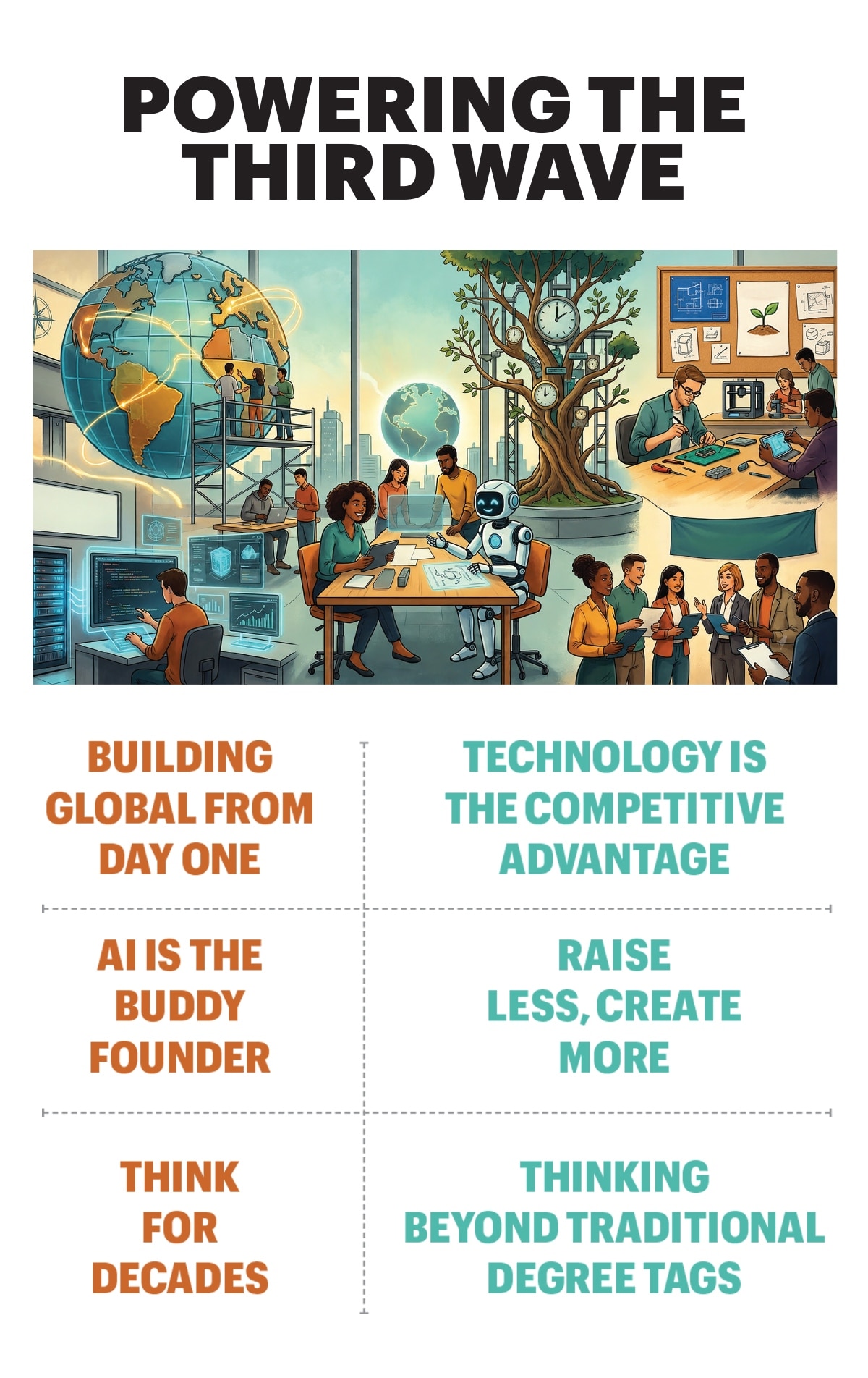
Taken together, the Gen Z founder playbook rests on a few common principles— building globally from day one, prioritising technology over valuation, using capital efficiently, hiring for ownership rather than hierarchy, and measuring success by the institution a company becomes rather than the speed at which it reaches unicorn status.
The latest start-up wave is attempting to build enduring institutions from India that compete with the world’s best.
@PalakAgarwal64


