













The phrase ‘senior housing’ has come a long way from old-age homes: dilapidated buildings, minimal services, poor facilities and basic healthcare to spell premium lifestyle communities.
As India’s elderly population grows and more affluent seniors enter the market, senior housing is evolving into ‘senior living’—communities that combine independence, social life, wellness, healthcare and assisted living, albeit at a price.
People from a variety of professional backgrounds are moving into senior homes, with industry estimates pointing to 80-85% occupancy at well-established communities.
“We have people who come from professional backgrounds, government and PSUs, the armed forces, as well as doctors and professors. There are also several residents from business backgrounds,” says Ankur Gupta, Joint Managing Director of Ashiana Housing. “Having lived a rich and fulfilling career, they opt for communities that give them the freedom of choosing activities they never got time to pursue in their working years.”
“People don’t necessarily want somebody to ‘look after’ them; they want people to have dinner with, travel with, exercise with and pursue interests with,” says Adarsh Narahari, Founder & Managing Director of Primus Senior Living and Marzi By Primus.
And it’s not only the seniors themselves who are looking for appropriate housing for the next stage of their lives. “We see significant interest from people in their 40s and 50s exploring senior living for their parents,” says Dhruv Badruka, Co-Founder of Amaya Senior Living, a fledgling senior living developer and operator in Hyderabad. “Over time, we expect senior living to increasingly become a planned lifestyle decision rather than a need-based decision.”
These trends are creating a big market for developers and senior living operators. According to the India Ageing Report 2023, people aged 60 years and more comprised 10% of the country’s population in 2023. This is expected to rise to 14.9% in 2036 and 20% in 2050.
The Longitudinal Ageing Study in India, 2021, estimates that about 349 million seniors will need housing in India by 2050, which is both a challenge and an opportunity, given the economics remain difficult and the demand-supply gap significant.
Colliers Research estimates the current market for senior housing at about Rs 30,000 crore, with overall demand at 2–2.2 million units against organised supply of just about 25,000 units. By 2030, the market value could exceed Rs 1 lakh crore, with demand projected to reach 2.8–3 million units.
India also remains significantly underpenetrated at 1.3% of the addressable market, compared to 6–7% in the US and 14–15% in New Zealand. “This creates both a major supply gap and a long runway for organised operators,” says G. Raja Gopal, chairman of the Association of Senior Living in India (ASLI), which represents over 85 organisations including senior and assisted living operators, healthcare and home-care providers, technology, wellness and other allied organisations.
Institutional interest and investments have been growing to tap the surging demand. Colliers estimates that more than Rs 13,000 crore of investments have been announced since 2025, which could support the addition of nearly 75,000 organised senior living units over the next three to four years.
Difficult economics
Currently, no standardised national benchmark for operating costs across senior living and care formats exists as the economics vary considerably depending on the product (apartment), services and care provided.
The physical product requires investment in accessibility, fall prevention, wider and barrier-free circulation, emergency response systems, power backup, medical infrastructure and significantly more thoughtfully designed common spaces. Government model guidelines, too, prescribe wheelchair accessibility, ramps, anti-skid surfaces, emergency alarms, medical facilities, ambulance access, recreation, fitness, housekeeping and other services.
Major recurring costs include trained caregivers and nursing manpower, healthcare support, food, housekeeping, security, wellness, maintenance and resident services.
According to Narahari, apartment complexes with less than 150-200 homes do not work from an operating perspective. “About 250-400 homes is the optimum number for a full-service independent senior-living community,” he says. “Above 400-500 homes, I would start creating smaller neighbourhoods or clusters within them so that you don’t lose intimacy.”
Gupta of Ashiana adds that break-even happens when around 70% of the flats have been delivered, which is similar to the economics of a real estate project. “Once the community is operational, there is a continuous requirement to manage the services and day-to-day operations effectively,” he says.
“While development economics are similar to residential real estate, the operating platform takes time to mature and benefits significantly from scale and occupancy,” says Badruka of Amaya.
Anantharam Varayur, co-founder of Manasum, says that as of now, “the services portion is still either bleeding or sometimes at breakeven. Profitability comes once you scale up and start managing a large number of units”.
The cost of it
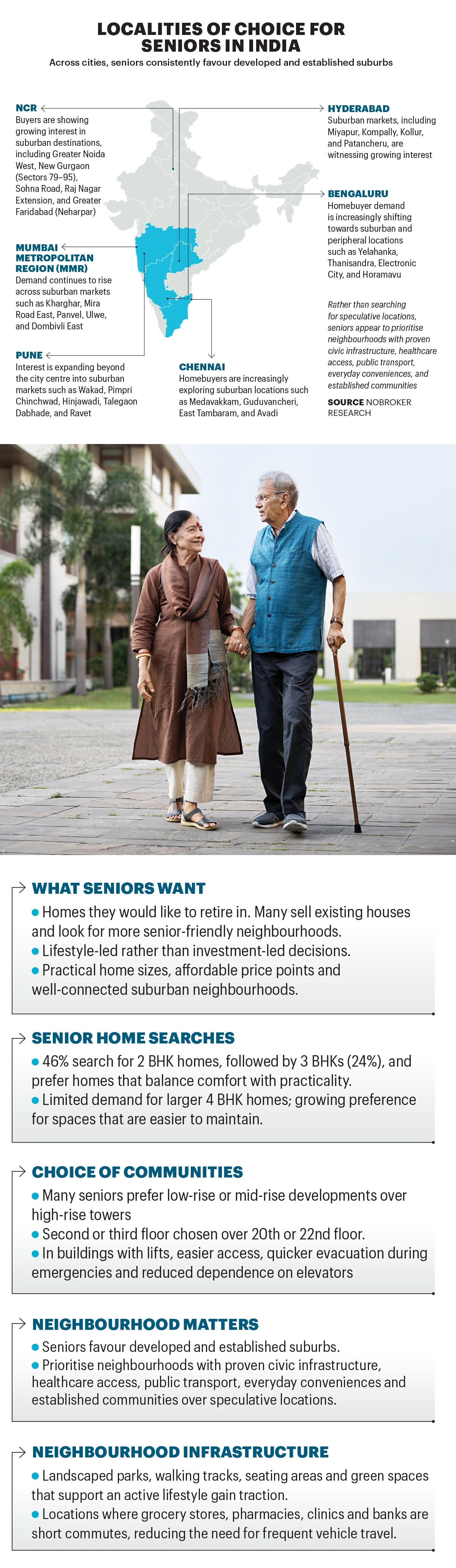
NoBroker research shows that people appear to be making value-conscious buying decisions when it comes to senior homes. “Nearly 67% of searches are for homes priced at Rs 1 crore or below, with the highest concentration in the Rs 50 lakh-80 lakh and Rs 80 lakh-1 crore segments,” says Saurabh Garg, Co-founder and chief business officer of NoBroker.
The market is already beginning to span a wide price spectrum, from relatively mass-market retirement communities to ultra-luxury projects.
“Our first senior-living development, Elements at Hiranandani Parks, Oragadam, Chennai, is being developed across approximately 4.5 acres, with a development potential of around 1 million sq. ft,” says Niranjan Hiranandani, co-founder and Managing Director, Hiranandani Group.
“The project comprises 400 residences across two phases, planned as approximately 700 sq. ft. 2-BHK homes. The project value is estimated around Rs 300 crore, with prices starting from approximately Rs 60 lakh,” says Hiranandani.
He plans to leverage current group capabilities across healthcare, hospitality, education, retail, and entertainment, giving them an ecosystem capable of supporting the development of integrated senior communities.
Luxury players like DLF have also announced their entry into the sector with The Aureva Senior Living in Sector 63A, Gurugram, with units costing over Rs 10-11 crore each.
A March 2025 report by CREDAI and KPMG identifies freehold sale, pure rental and leasehold as the three principal development structures.
Narahari says over 60-70% senior buyers opt for outright ownership. Pure rental, leasehold and care-led, assisted-living models, where accommodation and services are bundled into a monthly payment, account for the remaining 30%. Increasingly, as more seniors seem reluctant to lock up their retirement corpus in another home, the industry believes lease will become more significant.
And then comes care
However, senior living is about more than buying an apartment. It also brings a range of services and care into the equation.
“Senior living and senior care are not a single format,” explains Raja Gopal of ASLI, who is also Co-Founder, Director & CEO, Lifebridge Group, promoting Serene Communities by Columbia Pacific and KITES geriatric care. “Seniors will require different levels of support at different stages of ageing—from independent living and preventive wellness to home care, assisted living, rehabilitation, dementia care and palliative care.” These require strong linkages with hospitals, diagnostics, pharmacies, rehabilitation providers, technology, emergency response systems, nutrition, and wellness services.
Gupta says more than 25-30% of the population in Ashiana utilises nursing, outpatient facilities, physiotherapy, visiting doctors, dentists, and other healthcare services. Just 10% of residents use assisted living or caregiving support.
In Manasum’s format, the senior buyer pays the real estate cost and senior care charges, which includes common area maintenance (CAM), senior amenities maintenance charges (SAM), and one-time senior set up charges.
For independent senior living services, Narahari estimates that a reasonable broad industry range today would be around Rs 15,000-Rs 30,000 per month per household for the core service layer, with premium projects going to Rs 25,000-Rs 50,000-plus, depending on what is included.
Assisted living is a different category because manpower intensity changes dramatically. Current metro-market examples are often Rs 40,000- Rs 60,000 a month and can go substantially higher as nursing, dementia or one-on-one care requirements increase.
Moving into small-town India
The senior living model is also moving beyond India’s metro cities and into smaller cities and towns.
“Over the next three-four years, as awareness and acceptance of senior living projects continue to grow and expand beyond Tier I cities, emerging Tier II/III cities will see their share rising to 30-40%, broadening the segment’s geographic footprint across the country,” says Vimal Nadar, National Director and Head of Research at Colliers India.
According to Nadar, cities like Coimbatore, Puducherry, Dehradun, Vadodara and spiritual hubs such as Tirupati, Vrindavan, and Ayodhya are likely to gain traction.
Badruka believes that for senior living, “the ideal location is connected rather than central—close enough to hospitals, the city and airport, but with sufficient space and greenery to create a high-quality living environment”.
The operators are following the seniors into these markets. Ashiana Housing, which is currently present in Delhi-NCR, Jaipur, Pune, Mumbai and Chennai, is now looking at entering Bengaluru and Hyderabad.
Manasum is graduating from Bangalore and Goa to Mysore, Tirupati and Ahmedabad (GIFT city), as also Gurugram, Kolkata, Cochin, Lucknow and Chennai.
Challenges
Industry players say the sector also needs greater policy coherence. India has multiple policies and schemes addressing different aspects of ageing, but the framework remains fragmented, says Raja Gopal of ASLI.
He adds that access to long-term institutional capital, rational taxation, stronger insurance coverage and a larger professionally trained caregiving workforce are required to hold the multiple policies and schemes together in a framework.
Nadar of Colliers recommends broader government support, innovative financial solutions, public-private partnerships and incorporation of advanced construction technologies to help improve affordability and expand access.
The future is about building a continuum of living and care around the elderly, rather than viewing housing and healthcare in isolation.
As Narahari puts it, “Senior living ultimately needs the discipline of a hotel, the reliability of a hospital and the warmth of a home.”


