












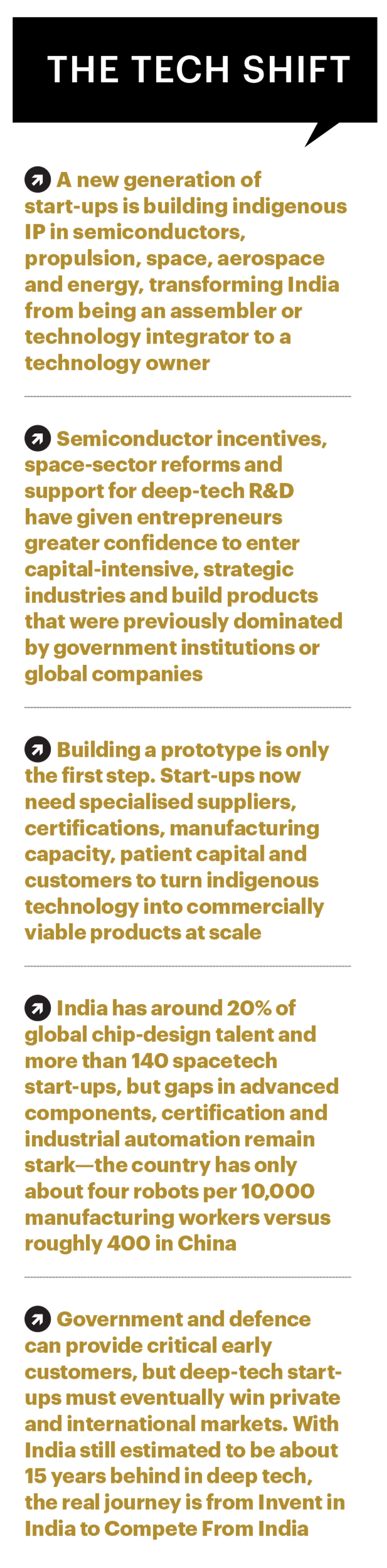

The next generation of Indian start-ups is not building another app. Instead, it’s trying to build things India has traditionally imported—from microchips and rocket engines to advanced energy systems.
It’s taking on problems that require years of research, specialised engineering, expensive prototypes and, often, technologies that have never before been commercially built in India.
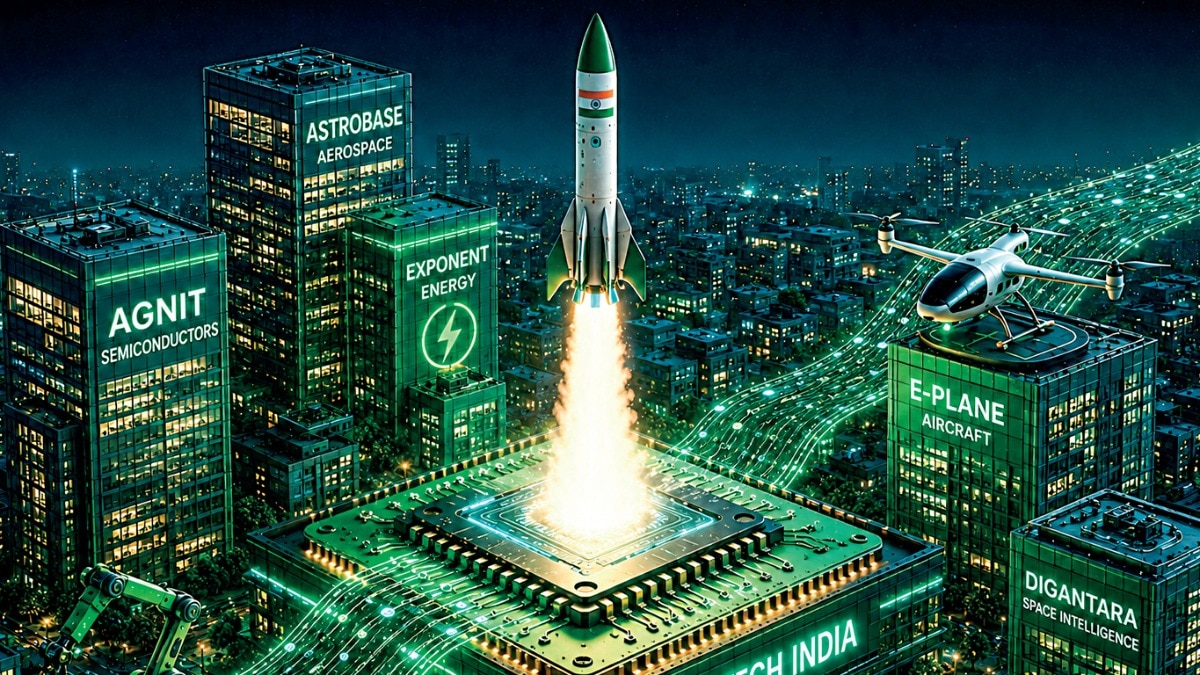
For instance, AGNIT Semiconductors is building Gallium Nitride (GaN) semiconductors in India. GaN is a semiconductor that outperforms silicon. The company has filed for over 20 patents and has five products in field trials; two are completely indigenous.
Exponent Energy has filed for 37 patents and built a battery and charging technology designed to charge in 15 minutes. E-Plane is developing an electric aircraft in which more than 80% of roughly 1,500 components are of Indian origin.
Astrobase is working on an 800 kilo-Newton full-thrust combustion engine for a medium-lift rocket capable of carrying eight tonnes to low orbit. D-Propulse is developing a rotating detonation engine, betting on a fundamentally different approach to propulsion, one of India’s biggest aerospace and defence gaps, for future applications.
Together, they point to something bigger happening in India’s entrepreneurial ecosystem—it is beginning to move from the application layer to the technology layer.
Greater localisation across the value chain, driven by strategic priorities, global competitiveness, policy reforms and a maturing talent pool are behind the shift, says P.S. Easwaran, Partner and leader of the supply chain practice at Deloitte India.
And the shift is beginning to show up in data.
Inflection Point
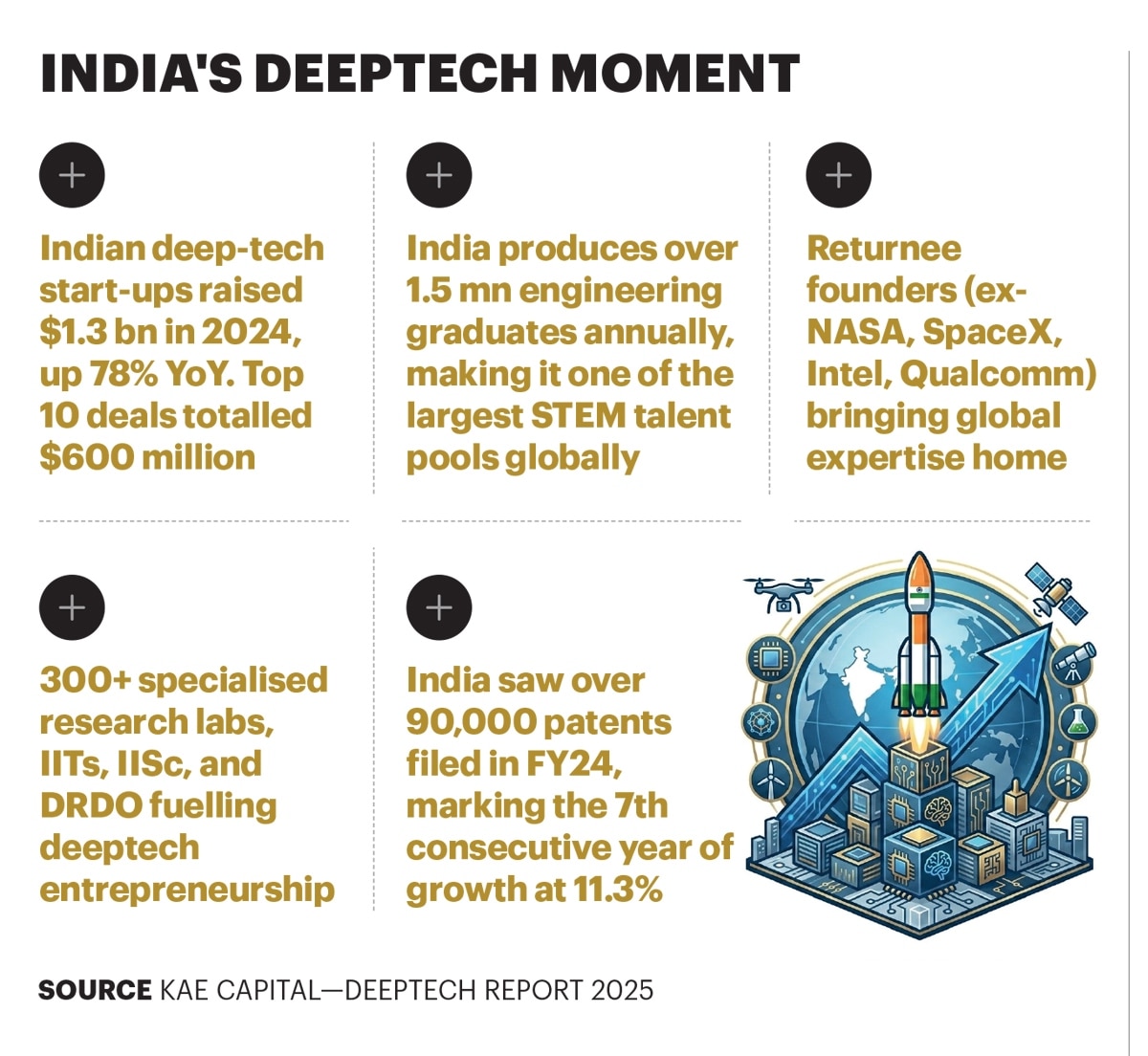
According to The Kae Capital India Deeptech Report 2025, the deep-tech ecosystem in the country is at “inflection point”, with more ventures being incubated, funded and reaching successful exits.
It has identified robotics and automation, energy tech, agritech, cybersecurity and consumer deeptech as areas with significant potential and advanced materials and semiconductors as technologies that can underpin multiple industries. Spacetech and quantum technologies are areas in which India could potentially play a leading global role.
The report notes that around 20% of global chip-design talent resides in India, but fabrication, Outsourced Semiconductor Assembly And Test (OSAT) and packaging capabilities have been historically missing. That landscape is now changing, with the India Semiconductor Mission and large policy support pushing the country towards fuller semiconductor capabilities.
The same pattern is visible in spacetech. The report counts more than 140 start-ups working across India’s spacetech value chain. It attributes the growth to the opening-up of the sector, ISRO’s encouragement to private participation and the opportunity created by a growing commercial space economy.
Engineering Talent
For AGNIT co-founder and CEO Hareesh Chandrasekar, this is not merely another start-up cycle. “We are in the middle of a shift from mainly a service-driven economy to an economy that actually owns IP (intellectual property),” he says.
India’s strength in engineering has never really been in question. The problem was where that talent sat in the value chain.
What is changing is the willingness—and increasingly the ability—to turn that expertise into Indian-owned products.
“Pre-2021-2022, nobody was even interested in semiconductors,” says Chandrasekar. “That changed once the ISM and DLI schemes were announced to encourage start-ups to own IP-designed products.”
ISM is short for India Space Mission and DLI stands for Design-Linked Incentive scheme.
From Software to Physical Technology
The transition becomes particularly interesting when viewed across sectors.
At Exponent Energy, co-founder and CEO Arun Vinayak says the company’s starting point was not to build another electric vehicle but to solve what he sees as the harder problem—energy.
Commercial vehicles account for only 10% of vehicles but consume 70% of India’s energy, he says. Exponent has built a technology stack around rapid charging and battery durability. Its batteries last 3,000-4,000 cycles and charge in 15 minutes; the company says they are designed to last one million kilometres.
“For the first time, large OEMs (original equipment manufacturers) now have an Indian technology partner, not just a supplier for plastic or sheet metal parts,” says Vinayak.
That distinction—technology partner rather than component supplier—could define this new phase of Indian manufacturing.
The problem is not simply inventing something. It is about building everything around the invention. That becomes even more apparent in aerospace.
Rockets, Aircraft, Chips
Astrobase co-founder and CEO Neeraj Khandelwal believes reusability will eventually transform the economics of launch vehicles.
“In 10-15 years, every rocket will need to be reusable—landing back and flying again instead of building a new one each time,” he says. “Reusability changes the entire economic equation.”
The company’s proposition is also part of a much larger space transformation in India, which is targeting a space economy of more than $40 billion by 2040.
The important change is that private companies are no longer simply supplying components to India’s space programme. They are attempting to build launch vehicles, engines, satellite systems and downstream applications.
“ISRO has done an amazing job for 50-60 years, but it cannot do this alone,” says Khandelwal. “The space sector needs to be industrialised, and private companies are very good at industrialising things.”
E-Plane represents another version of the same ambition.
The company is currently on the Directorate General of Civil Aviation (DGCA) certification pathway for its electric aircraft. It expects Phase II to be completed by October, followed by prototype construction and flight testing. It is targeting the end of the first quarter of 2028 for full certification.

Expensive Final Gap
Professor Satya Chakravarty, the company’s founder, says the underlying technology is 100% indigenous. The 20% of parts that are currently imported account for about 50% of the cost, he says.
It is a revealing statistic because it captures India’s deep-tech challenge in one number—the final gaps in localisation can be disproportionately difficult and expensive to fill.
The same challenge appears in semiconductors. The Kae report says India’s semiconductor journey is now pivoting from decades of chip design towards end-to-end capability—from IP and fabrication units to OSAT.
It notes that India is initially focusing on areas such as 28-65 nm nodes, power chips and compound semiconductors such as GaN rather than immediately competing at the most advanced logic nodes.
After The Prototype
For all the excitement around India’s deep-tech ecosystem, the biggest question is whether these companies can cross the gap between invention and industrialisation.
Capital is particularly important. A software start-up can potentially build and iterate relatively cheaply. A space, semiconductor or aerospace start-up may need millions of dollars before it even has a commercially viable product.
Experts say the first breakthrough is not revenue or profitability but whether the technology can become a “founding block” for the future of that sector.
That changes the investment equation.
Founders may need to think in 5-, 10- or even 20-year horizons. Investors have to understand that product validation, certification, manufacturing scale and customer adoption can precede meaningful financial returns by years.
Then there is the customer.
A semiconductor start-up can develop a chip, but an OEM must be willing to qualify it. An aerospace start-up can build a prototype, but certification and production capacity have to follow. A robotics company can demonstrate an autonomous machine, but manufacturers must be willing to deploy it at scale.
Adoption Is A Challenge
That’s why the next phase of India’s deep-tech story may be less about how many start-ups are being funded and more about how many technologies are actually being deployed.
The Kae report’s robotics findings offer a useful warning. India has only about four robots per 10,000 manufacturing workers, compared with roughly 400 in China, while domestic supplier depth remains limited and imported components raise costs. So while the opportunity is enormous, adoption and industrial capability remain bottlenecks.
According to Khandelwal, the technology being developed in India already exists globally, and India is still about 15 years behind in deeptech. Closing that gap will require moving much faster rather than following a linear path of catching up.
That is ultimately what makes India’s current deep-tech moment different, and more difficult, than the preceding start-up boom.
The first generation proved India could build businesses at Internet scale. This generation is attempting to prove that India can own the technology, manufacture it and build industries around it.
The journey from Make in India to Invent in India has begun. But invention is only the first milestone. The real test will be whether today’s deep-tech start-ups can move from laboratories and prototypes to factories, customers, and markets.
@PalakAgarwal64


