









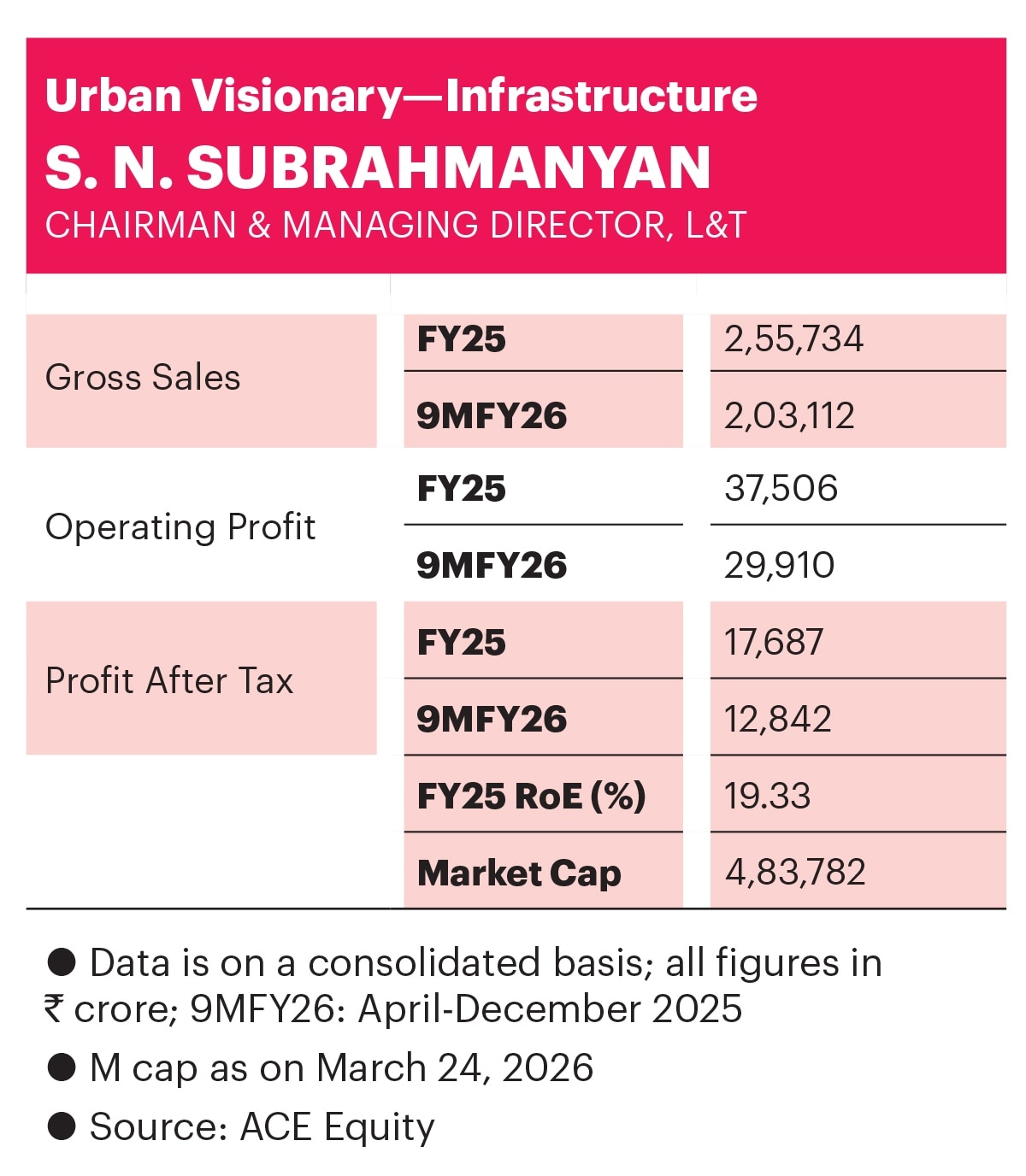

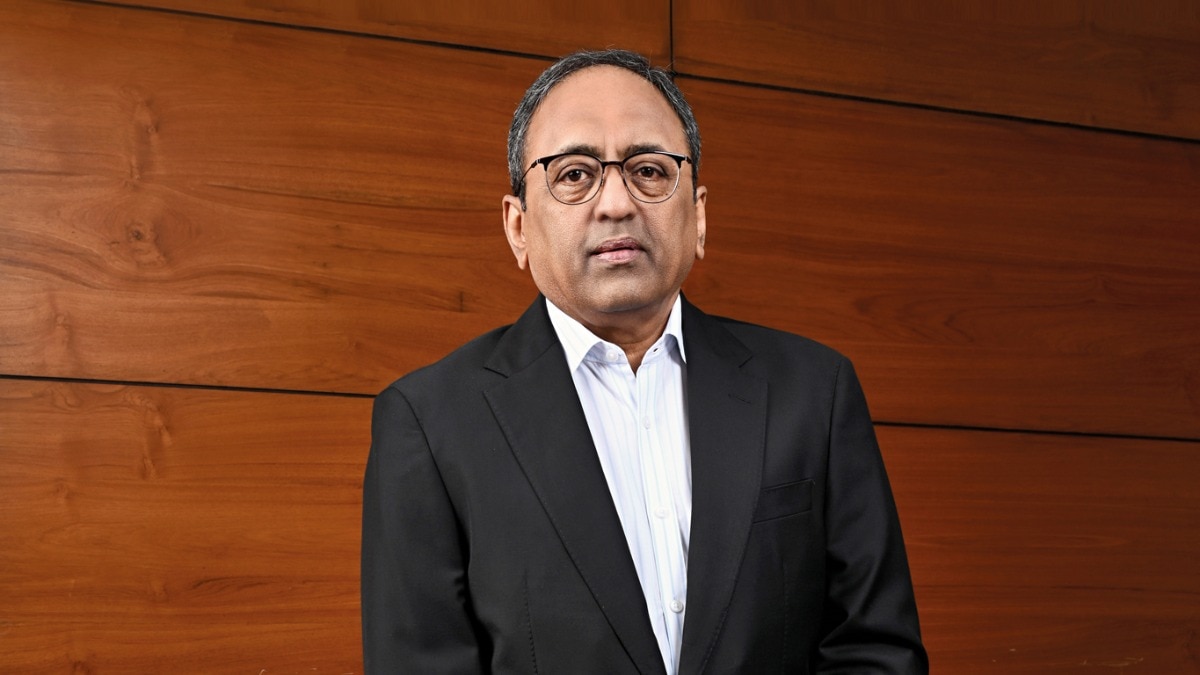
Think Larsen & Toubro (L&T) and what comes to mind are large projects. But that is a relatively simplistic way of summing up a conglomerate with multiple businesses. S.N. Subrahmanyan, its Chairman & Managing Director, says L&T is best described as a “tech company.”
“This is the path we are on. The story is all about engineering and technology. While we do projects, we are fundamentally into technology and will go wherever it leads us,” says Subrahmanyan.
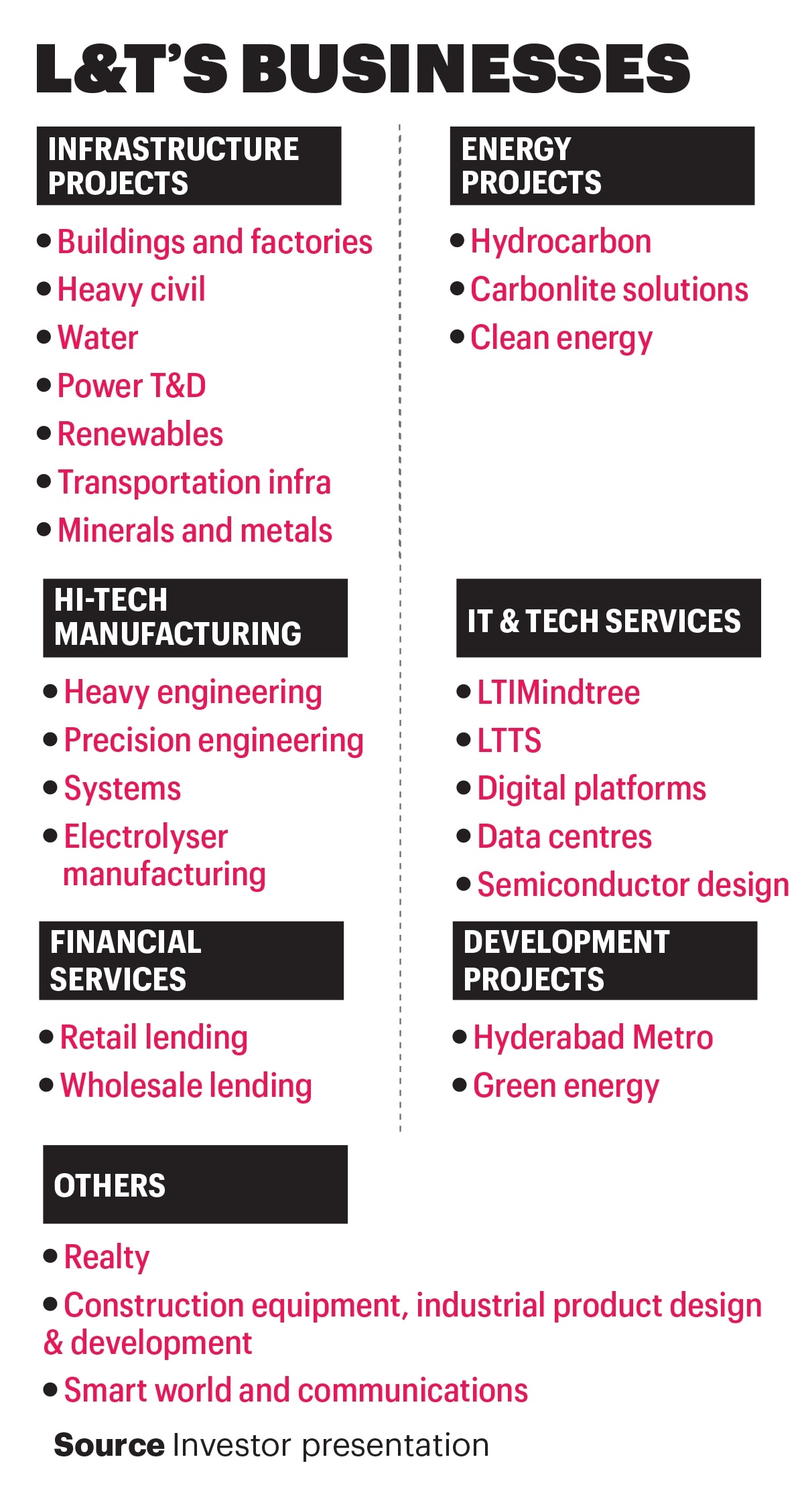
Today, L&T operates in infrastructure projects, energy projects, hi-tech manufacturing, IT & technology services, financial services and development projects. What joins these diverse businesses is one word—technology, which is something Subrahmanyan is looking to bolster across verticals.
Breaking It Down
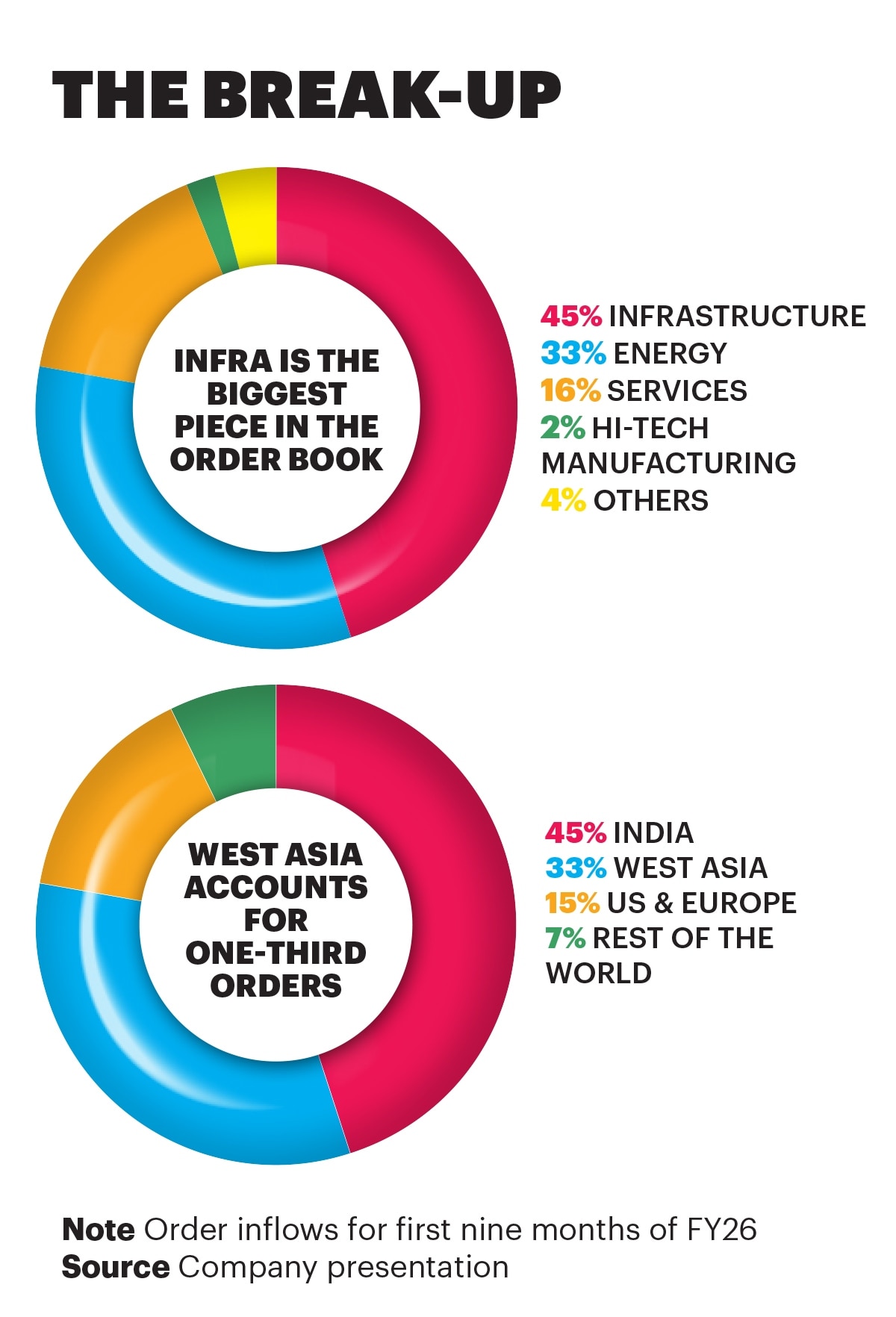
L&T is a complex conglomerate with a maze of businesses. “Projects are still a big part of what we do and that includes construction of infrastructure projects. Energy is also big,” says Subrahmanyan. There is also renewable energy. “Then, there is manufacturing, which is heavy engineering and precision engineering (defence),” he says. The services piece has IT and financial services.
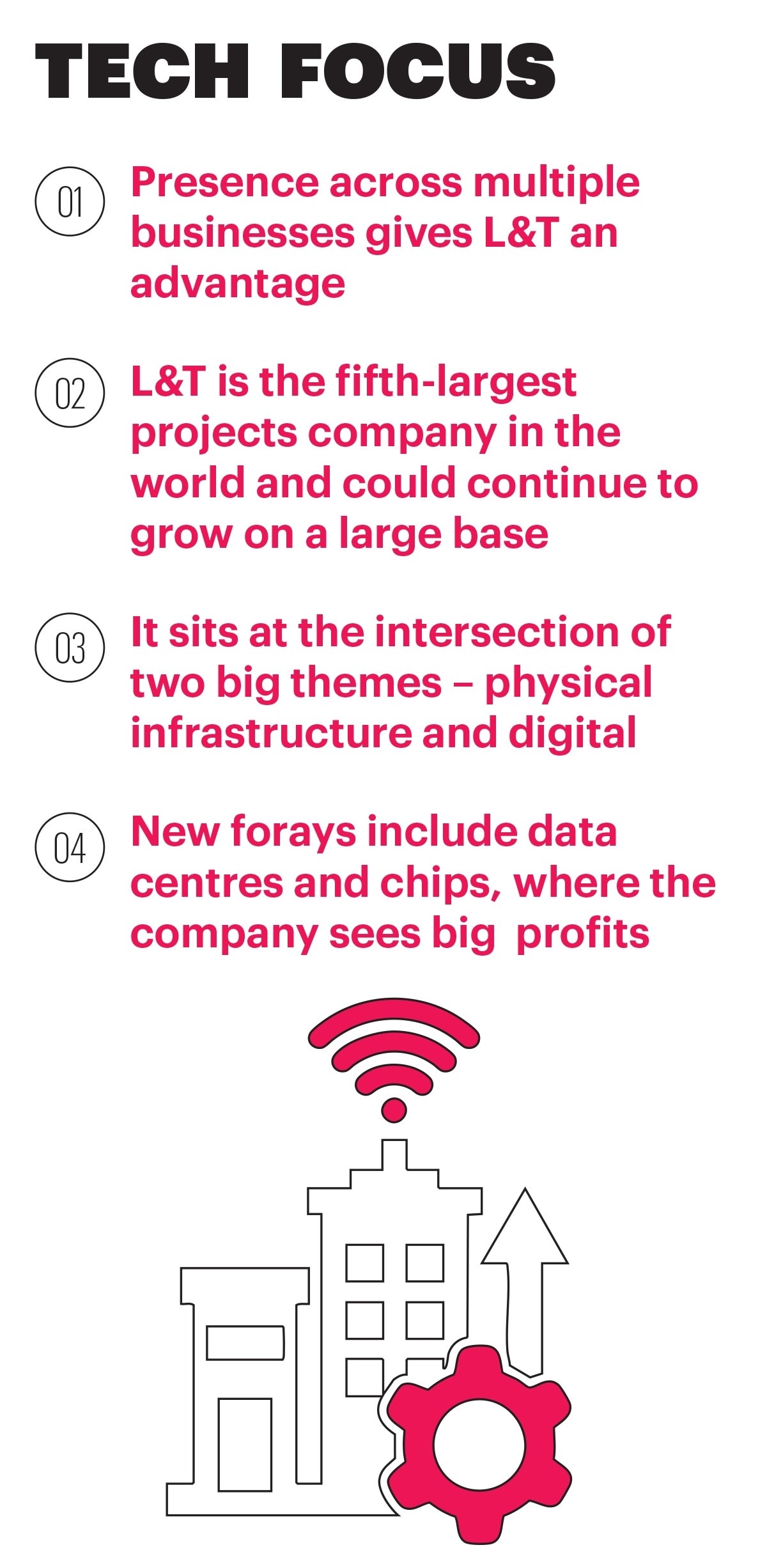
Vipul Prasad, Founder & CEO, Magadh Capital Advisors, is impressed by diversification across old and new economy businesses. “That helps it tap opportunities in domestic and overseas markets. Such end-to-end capability at the scale at which L&T operates is difficult to replicate and gives it a significant advantage in winning complex, high-value orders,” he says.
Growth on a large base is anything but easy. But not at L&T. “We are at a reasonable size today and probably the fifth-largest projects company in the free world,” says Subrahmanyan. Prasad, a long-time L&T tracker, says the company sits at the intersection of two themes—physical infrastructure and digital transformation—putting it in a strong position. “Very few companies globally, let alone from India, can credibly claim to lead in both the domains,” he adds.
Biting the Bullet
When the growth opportunity is compelling, choosing the business where one wants to be requires clarity of thought. Equally, L&T has taken tough decisions too. “We give it our best shot. If we cannot do it well, maybe someone else can do it better. Sometimes, the theory, grow to sell and shrink to grow, works,” says Subrahmanyan.
L&T’s exits under Subrahmanyan include the electrical and automation business (sold to Schneider Electric), construction equipment (to Pai Machines) and, most recently, Nabha Power (to Torrent Power). During the period, L&T also moved out of hydel power, and transformed the financial services business (exiting mutual fund, wealth management and insurance pieces). The idea is to grow businesses that are more profitable. “When we get out of a business, we find it imperative to think 5-10 years ahead and sow the seeds for something to benefit the balance sheet tomorrow.”
Prasad says L&T is an institutionally owned and professionally managed company. “Understandably, capital allocation decisions are made with more discipline and less empire-building instinct. L&T has been prompt in getting out of businesses that do not meet return thresholds, which is not something you see often in Indian conglomerates.”
New Forays
Various factors determine the areas L&T enters. “The company must grow where the country is growing,” says Subrahmanyan. Take AI. “I think it is an imperious tool and one who does not use it will get lost. We better get on to it as early as possible,” he says. L&T has a programme that trains staff across businesses on AI; Subrahmanyan has also attended the training. “These are changing times, and if you don’t adapt, you will be left behind.”
L&T’s IT businesses have been sharpening their AI skills in line with what the clients demand. Subrahmanyan calls it “transformational,” before stating that data centres has been a strategic foray. It was one of the businesses the company incubated. “We did not want to be a simple co-location data centre and wanted a play in cloud services,” he says. In late 2024, L&T announced that it would pick up 21% of E2E Networks. “They are into deep view cloud services and we use that extensively.” Earlier this year, L&T announced it was teaming up with Nvidia to build India’s largest gigawatt-scale AI factory.
There is no paucity of new ideas for L&T. In case of semiconductors, work on design for chips and modules was already being done.
In defence, L&T operates in naval systems (shipbuilding, submarines), land systems (includes K-9 Vajra-T, light tanks) and electronics (such as high-power radar and close-in weapon systems).
Prasad says L&T typically moves into business adjacencies that can plug future gaps. “The decisions are almost never opportunistic and determined by a broader long-term plan that assists growth and return ratios. The entry into power sector EPC, defence manufacturing or shipbuilding has largely been an extension of its core engineering and project management expertise,” he says. Likewise, IT services, in his opinion, was driven by the recognition that digital engineering and embedded systems were becoming integral to physical infrastructure, a domain where L&T excelled.
The shift towards becoming the builder of India’s 21st century infrastructure is underway. “It’s not just about roads and metro rail projects but AI factories, hydrogen plants and chip design capability. It is logical for leaders in these industries to enter and expand their presence through partnerships with companies such as L&T,” says Prasad.
The world is amid disruptions that seemed unimaginable a couple of years ago. Be it business or geopolitics, organisations have to brace themselves for a future that will push their resilience to the limit. It is no different for L&T. A Motilal Oswal Financial Services report on L&T in early March outlines headwinds in two areas—the company’s international revenue (West Asia order book if big) and the IT subsidiary’s valuation getting impacted by the AI-led disruption.
L&T has the scale and prowess to become even larger. Subrahmanyan is banking, among other things, on technology to get the best out of the opportunities. “We are a technology company and people like me understand it, relish it and are soaked in it. We understand a bit of business too,” he says, adding that L&T is in “a sweet spot.” The positives are a stable government, a conducive business environment and reform of several laws. “These are big things and we must take advantage of all of them. The situation is in our favour, and we just have to get to work,” sums up Subrahmanyan. In his own way, he reflects a quiet confidence, matched by determination—both tremendously handy skills to possess today.
@krishnagopalan


