













Just as countries across the world were beginning to heave a sigh of relief after the US Supreme Court struck down the reciprocal tariffs imposed by US President Donald Trump, a new crisis opened up.
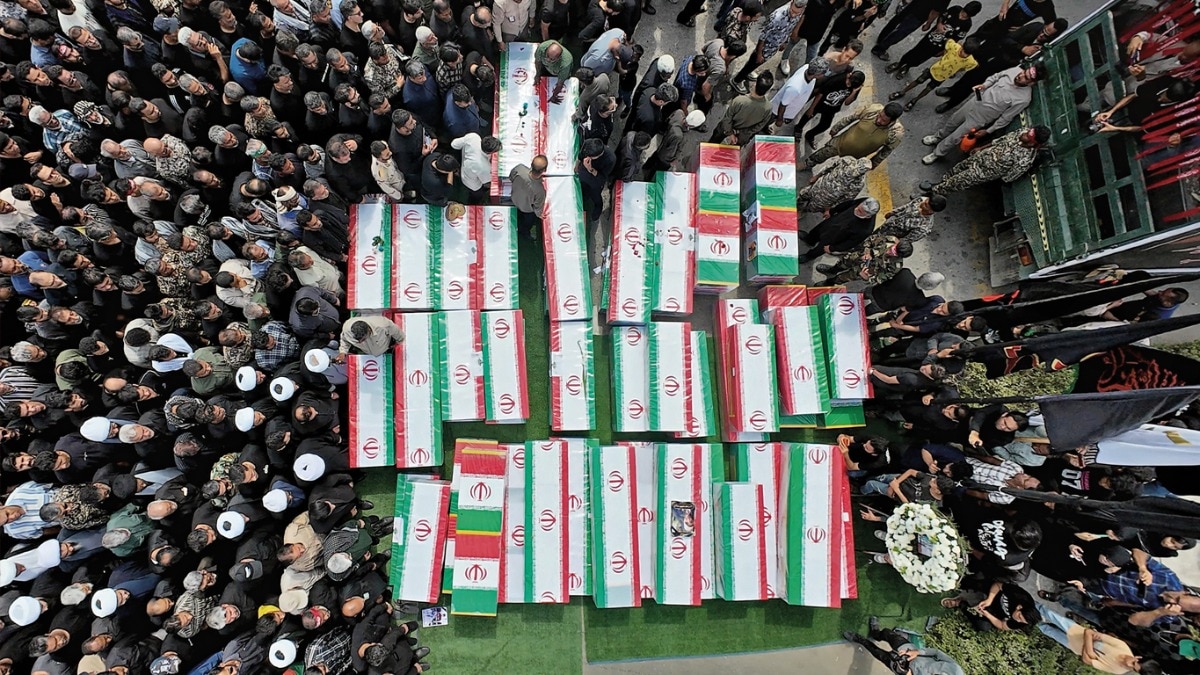
On February 28, the US and Israel began coordinated attacks on Iran, killing Iran’s Supreme Leader Ayatollah Ali Khamenei and sparking Iranian attacks across West Asia. As the war escalated, energy supplies, global trade and supply chains came under intense pressure as Iran blockaded the crucial Strait of Hormuz.
The Strait of Hormuz, which extends between Oman and Iran, is a vital maritime corridor for global shipments and connects the Persian Gulf with the Gulf of Oman and the Arabian Sea. As per a CareEdge report, about 20% of the global oil supply and one-third of the world’s liquified natural gas (LNG) flows through the Strait.
The other route is through the Red Sea via the Suez Canal, but this has been disrupted for over a year because of attacks by the Houthi rebels of Yemen, with just about 30% of the usual traffic flowing through it.
Kristalina Georgieva, Managing Director of the International Monetary Fund, says global economic resilience is being tested yet again. “This conflict, if it proves to be more prolonged, has obvious potential to affect global energy prices, market sentiment, growth, and inflation, placing new demands on policymakers,” she warned, adding that for most of Asia, what is at stake is energy security and, through that, confidence. Stock markets across the world have seen wild swings since the war broke out.
For India, a prolonged conflict could spell further trouble. As the world’s third-largest crude oil importer, the conflict has not only disrupted oil supplies but has also jacked up crude oil prices. This in turn could upset fiscal projections, impact the trade deficit, balance of payments, further weaken the rupee, and lead to higher inflation in the long run.
Union Finance Minister Nirmala Sitharaman has, however, said given India’s inflation is near the lower bound of the Reserve Bank of India’s target of 4% with plus/minus 2% either side, the impact of the West Asia crisis and rising crude oil prices on inflation is not estimated to be substantial at this point.
The Union Budget 2026-27, which was presented just a month ago in very different circumstances, was drawn up when the Brent crude oil price hovered around $69 per barrel on January 30.
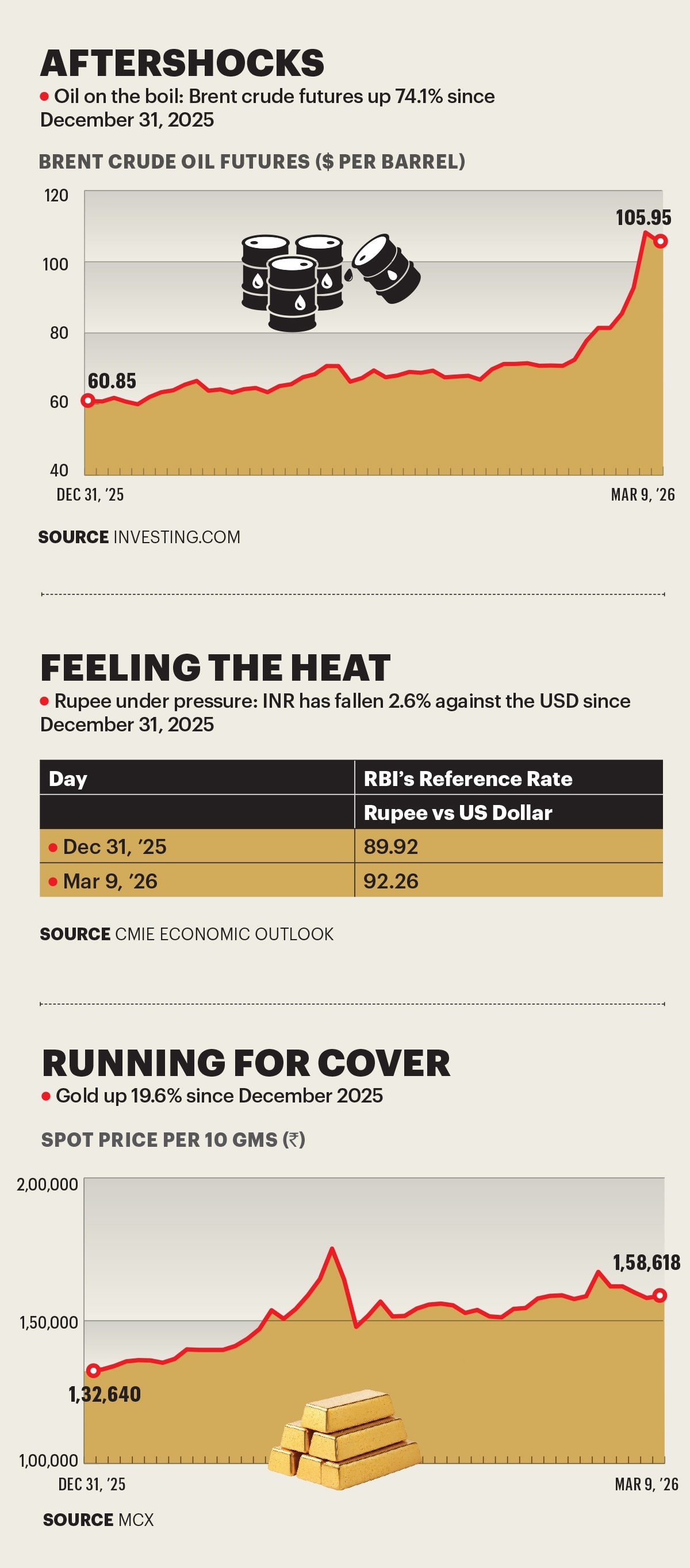
Fast forward to March 9, and Brent crude had crossed $100 per barrel for the first time in four years, touching a high of $119.5 during the day. Prices cooled down a little after Trump later announced that the war would end soon, though he did not say when. However, they inched back up again subsequently.
As a result of the war, the average price of the Indian basket of crude oil has jumped 40% since January to $88.16 per barrel in March. The Indian rupee, which was already weakening, has fallen another 2.6% since December and touched a record low of 92.28 against the US dollar on March 4.
Meanwhile, gold prices have risen about 20% since the end of 2025 to Rs 1.58 lakh per 10 grammes as investors fled to secure assets, making it more difficult for Indian households to buy the precious metal. Investor sentiment has also remained volatile and the Nifty 50 has fallen 8% this year. (See table)
The government is keeping a close tab on the situation in West Asia and policymakers are hopeful that the war will end in the coming weeks, if not days. Petroleum Minister Hardeep Singh Puri has said India has adequate stocks of crude oil. Sources have indicated that India holds 25 days of crude oil stock and of petroleum products. India has also started purchasing Russian crude oil as the conflict dries up supplies through West Asia.
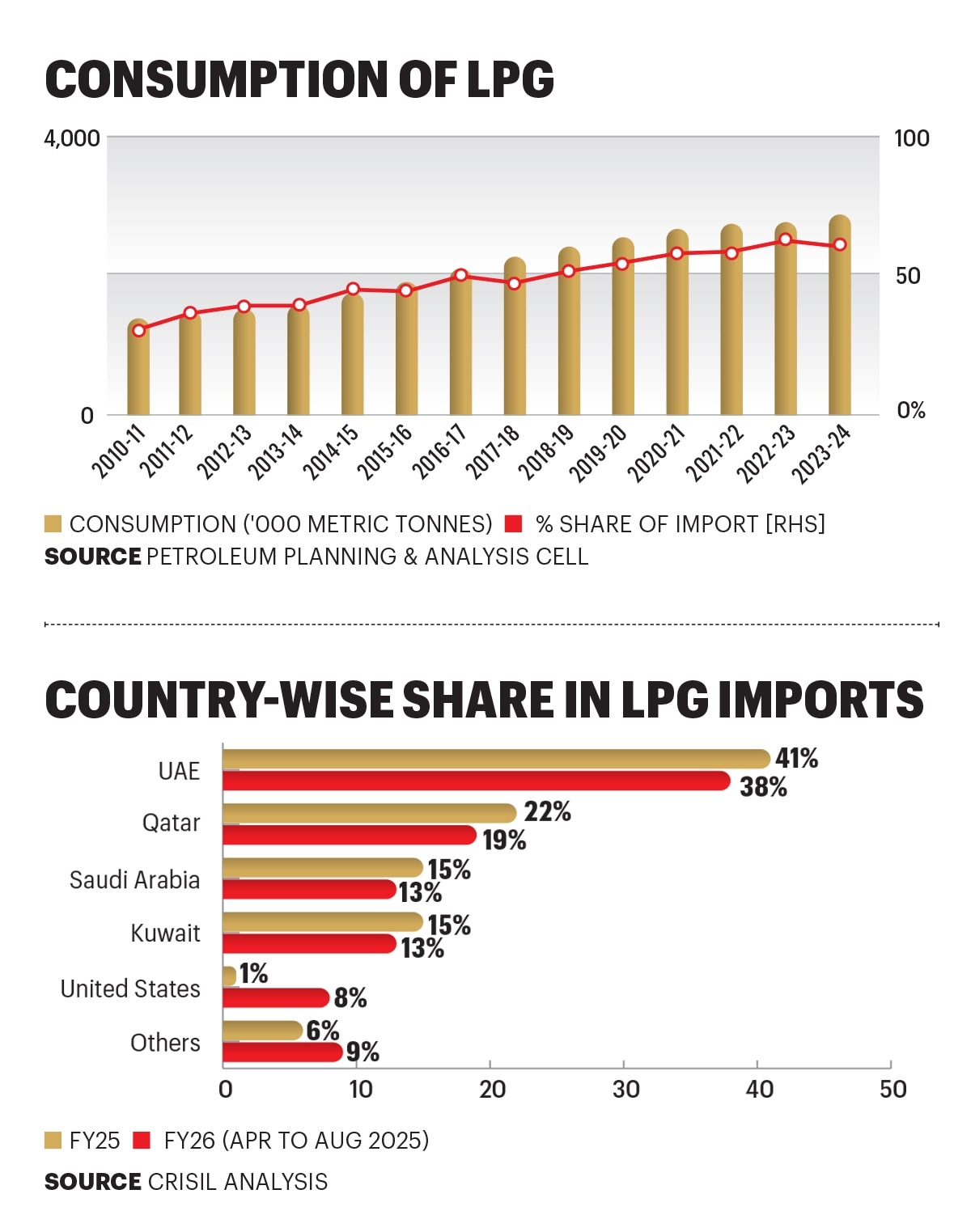
However, a bigger crisis is emerging on natural gas and the government has invoked the Essential Commodities Act (ECA) to protect domestic households that use cooking gas and has asked refineries and petrochemical units to maximise production of liquefied petroleum gas (LPG). This followed an increase in the price of domestic cooking gas cylinder by Rs 60 after India’s top gas importer Petronet LNG issued a force majeure notice. However, hotels and commercial establishments will face some cuts.
India imports close to 85% of its crude oil requirement—primarily from West Asia and Russia. The Strait of Hormuz accounts for nearly 50% of those shipments. Around 40-45% of India’s crude imports come from the UAE, Saudi Arabia, Kuwait, and Iraq. Crucially, the conflict has come at a time when India was planning to reduce its imports from Russia following an interim trade agreement with the US.
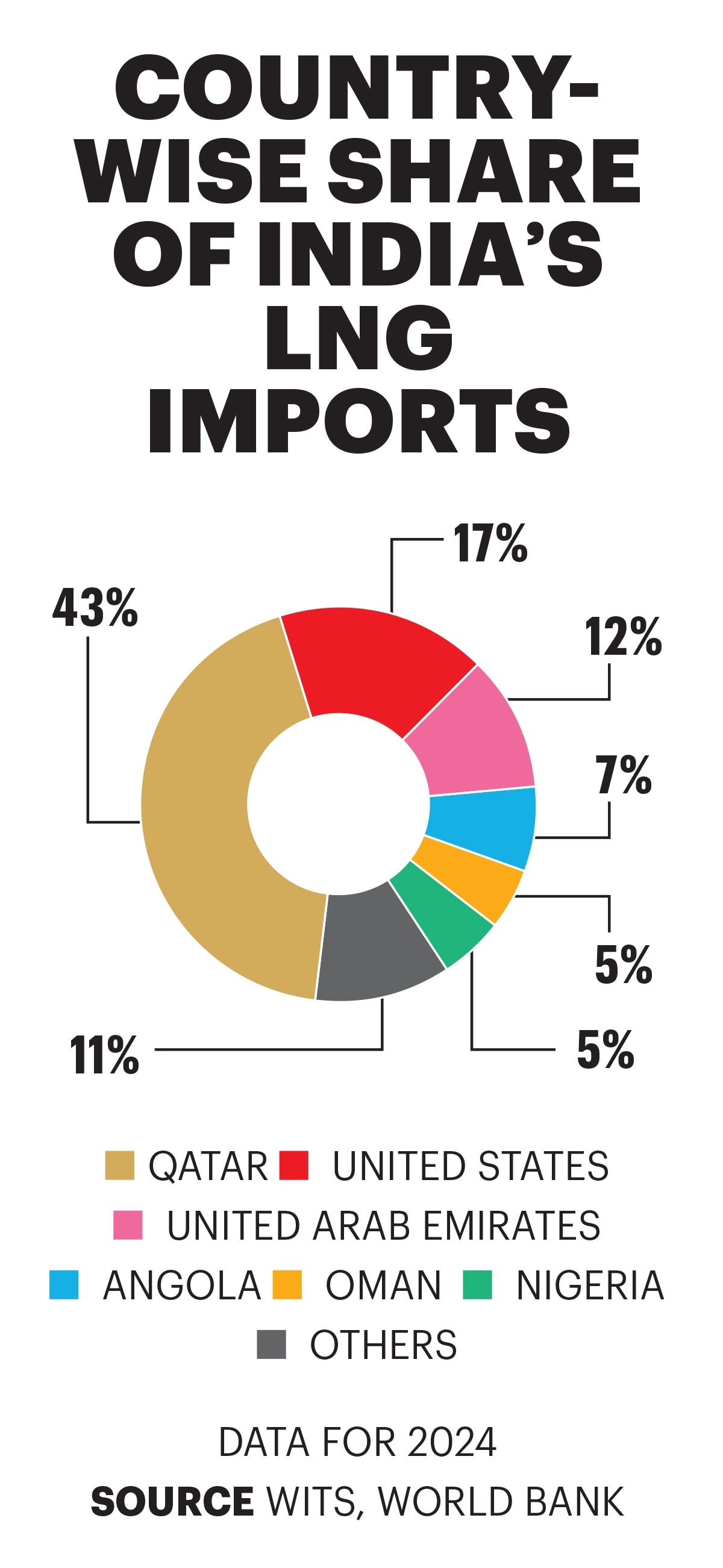
West Asia supplies 68.4% of India’s LNG imports.
Geopolitical Expert Narendra Taneja says that India consumes around 5.8 million barrels of oil a day of which it imports around 5.2 million barrels from 41 different countries. India imports the bulk of its oil requirements from the Gulf region, including Saudi Arabia, Oman, Kuwait, Iraq, Abu Dhabi and liquified natural gas from Qatar. “The current war has led to a twofold challenge—a rise in prices of crude oil and a disruption in oil availability and supply,” he says.
Indian trade is feeling the heat and exporters are worried about delayed shipments, higher freight and insurance premium. The Department of Commerce is in talk with exporters and the government has set up an inter-ministerial group for supply chain resilience to facilitate effective coordination, monitoring and follow-up. Shipments bound for North America and Europe could take longer if ships are forced to pass through the Cape of Good Hope.
India’s export exposure to the West Asia is relatively moderate, with the Gulf Cooperation Council (GCC) countries accounting for about 13% of total exports. However, these include crucial items, including fertilisers, rough diamonds, polythene and limestone, sulphur and gypsum, as a report by GTRI pointed out.
India could face a potentially bigger crisis as supply of fertilizer and urea, a key import from the Gulf region, get impacted as supplies dwindle and prices rise ahead of the main Kharif sowing season, which accounts for 55% of the country’s agricultural output. India imports about 30% of its fertilizer requirement and the region supplies nearly 40% of it, as per Crisil Ratings. The domestic industry is facing supply chain shocks across other commodities as well. The government hopes that the war will be short lived and contained. But if the conflict prolongs, its repercussions would be far reaching for both India and the world.
@surabhi_prasad, @PrinceInMedia


