













When Japanese carmaker Suzuki partnered with the Indian government in the early 1980s to roll out small, affordable cars under the Maruti badge, few would have imagined that India would become the Japanese automaker’s biggest export hub and account for two-thirds of Suzuki’s global production four decades later.
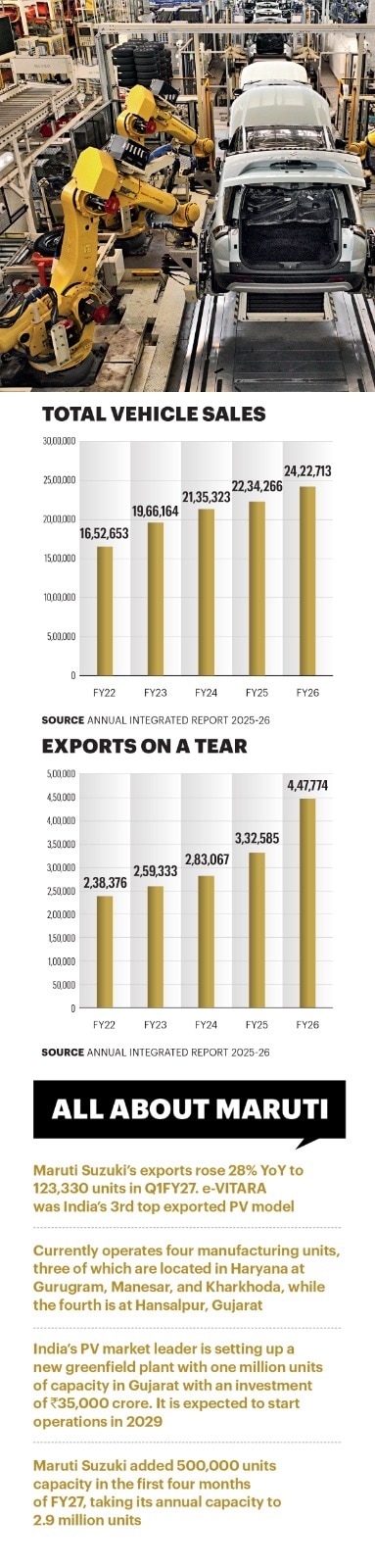
Maruti Suzuki produced a record 2.3 million cars and SUVs in FY26, about 2,00,000 more than the next three carmakers combined. It exported 4,47,000 vehicles in FY26, up 34% over the previous year—cornering a whopping 49% share in passenger vehicle exports out of India.
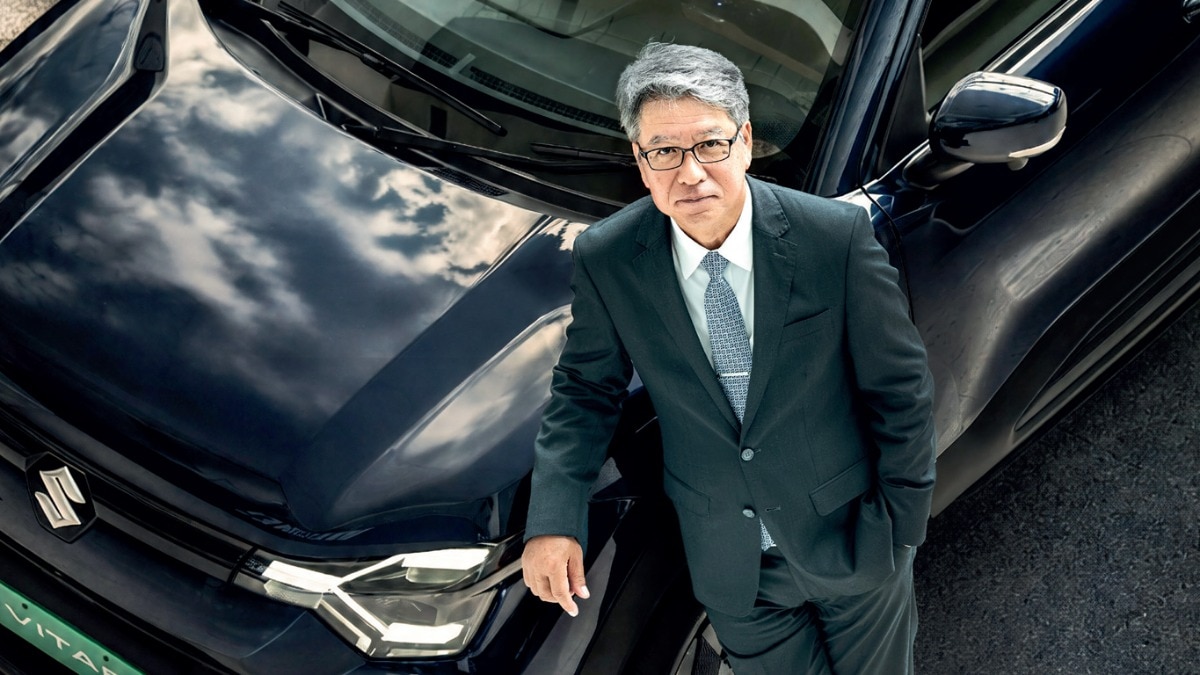
“In the first quarter of FY27, our share of passenger vehicle exports has risen to 55%,” Hisashi Takeuchi, managing director and CEO of Maruti Suzuki, tells BT in an interview.
In 2025, Suzuki became Japan’s top car importer, thanks to Made-in-India SUVs, including the Fronx, the Jimny and the e-Vitara. “Since we are producing cars in India and exporting to Japan, Suzuki became the biggest importer of cars from abroad,” says Takeuchi.
Thanks to strong domestic demand and robust exports, almost two-thirds of the global production of Suzuki Group now comes from India, he adds.
To meet rising demand for domestic sales and exports, Maruti Suzuki is expanding at breakneck speed. It added 5,00,000 units of capacity in the first four months of FY27, taking its annual capacity to 2.9 million units. By FY31, the company is targeting annual capacity of four million units, with 8,00,000 units reserved for exports.
Few companies have shaped India’s manufacturing story as significantly as Maruti Suzuki. After spawning industrial clusters around its plants in Haryana’s Gurugram and Manesar, the automaker’s 640-acre facility in Gujarat’s Hansalpur, set up at a cost of Rs 25,289 crore, brought about 100 auto parts suppliers to the western state. “When we started production at Hansalpur, it was a big challenge because our supplier locations were mainly in Haryana. Hundred suppliers came and built their factories in Gujarat because transportation cost is reasonably big. They understand that there is economy of scale. We have gradually expanded our production at Hansalpur from 250,000 to 1 million. For them it made sense to open a new factory,” says Takeuchi.
Hansalpur is not the only plant with annual capacity of one million units. Maruti Suzuki is also doubling capacity at its 800-acre facility in Haryana’s Kharkhoda to one million units once it becomes fully operational. The carmaker has already acquired land for Rs 4,940 crore for its second plant in Gujarat’s Sanand. The 1,750-acre facility, which is coming up with an investment of Rs 35,000 crore, will also have a capacity of one million units.
“The Sanand plant is expected to create 25,000 jobs and it will have facilities such as dormitories,” says Takeuchi.
Even though Maruti Suzuki has lost some market share to homegrown rivals in recent years due to its limited SUV portfolio, the carmaker was quick to recalibrate its strategy. “We had only two SUVs in our portfolio in 2021 but now we have six. We have much bigger vehicles which were not there in the past,” says Takeuchi. Maruti Suzuki’s market share in the SUV segment has jumped from 11% in FY22 to 21% in Q1 of FY27.
Wooing back loyal customers
The carmaker is widening its SUV portfolio with plans to launch seven new nameplates over the next five years, aiming to woo back earlier customers who may have switched to other brands.
“Maybe, five years back, our line-up was not good enough to attract those customers to buy a second or third Maruti Suzuki,” Takeuchi says, adding that the carmaker is developing more products with new designs. “We will try to attract those customers who left Maruti Suzuki. The next important thing is trying to get their repeat orders. Our customers can always come back and buy bigger vehicles. Now the situation is different, and we can attract those customers with a wide variety of products,” he adds.
But the focus on SUVs doesn’t mean India’s biggest carmaker is ignoring first-time car buyers. “We have to be mindful that India is a country that is still developing quite rapidly. So, more and more first-time buyers will arrive. It is important to capture those first-time buyers,” he says, citing low car penetration in India.
Though Maruti Suzuki has launched a slew of SUVs in recent years, it is still absent from some SUV segments, most notably the subcompact segment, which gets several first-time car buyers.
“We would like to add products to the segments where we don’t have a product right now. We would like to do it as quickly as possible,” says Takeuchi, adding that a subcompact SUV is certainly in the pipeline. “We are preparing for that. If we don’t have any product in the segment, we are missing a whole bunch of opportunities over there,” says Takeuchi.
“In order to achieve a higher market share, we have to improve our market share of every segment,” he says. “In some segments, we have a market share of as high as 70%. On the other hand, in SUVs, we are only enjoying a little more than 20%, which is much lower than our national average market share (40%). In those areas, we want to make our presence stronger, and we hope that we improve our total market share,” says Takeuchi.
On competition from newer entrants in the Indian car market, Takeuchi points out that the company has more than 6,000 service outlets across the country. “This is substantially much more than the competition. Wherever our customers go, they can get service and necessary parts,” he says.
Catching up on EVs
With the launch of its maiden battery electric vehicle (BEV), the e-Vitara, earlier in 2026, Maruti Suzuki has emerged as India’s fourth-largest EV maker by volume. “It is doing more sales in India than our plans,” Takeuchi says. “We are trying to remove customer pain points around EVs with home charger installation, battery-as-a-service (BaaS) offering and assured buyback,” he adds.
On the company’s plans for low-cost EVs, Takeuchi says EVs will start with big cars and mid-size cars before gradually penetrating the small car segment. “An EV is a second car at home and not the first car because charging infrastructure is not perfect. Still, people would like to have a first ICE car,” he says, adding that scale in EVs will come eventually.
Maruti Suzuki expects 15% of sales to come from BEVs by FY31, 25% from hybrid vehicles, 35% from CNG and 25% from ICE (internal combustion engine) or flex-fuel vehicles.
“If you move to EVs very quickly, you cannot make it fully in India. The development of ecosystem and sales should happen simultaneously,” says Takeuchi, adding that Maruti Suzuki is setting up an ecosystem to help make rare earth elements in India.
While the carmaker currently imports battery packs from China’s BYD, Takeuchi says the company is in talks with local cell manufacturers for when they start production. “If you rely on some specific source for components and materials, it is high risk because you will be controlled by that company or country who is the sole supplier of that component,” he cautions. Imports of lithium-ion cells have gone up five-fold over the past five years to Rs 41,667 crore in FY26 with China accounting for 84% of battery cell imports. For rare earths, the dependence is even higher at 85–90%.
Maruti Suzuki’s four-decade-long journey has had a multiplier effect on India’s manufacturing industry, with the automaker buying 91% of its components by value from suppliers in India and creating hundreds of jobs not only within factories but also across parts suppliers, transport and other ancillary businesses.
@karandhar11


