













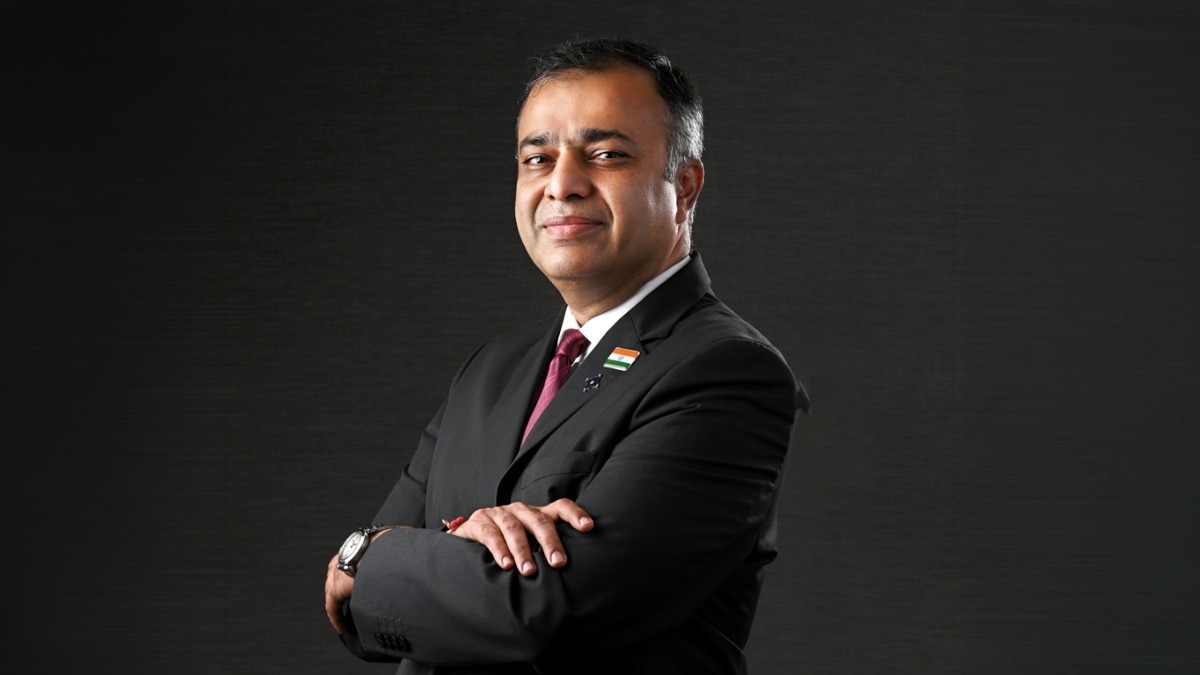
Throughout his career, Nehal Vora, Managing Director and CEO of Central Depository Services (India) Ltd (CDSL), India’s largest depository by number demat accounts that maintains ownership records of shares and securities, has chosen the more challenging path over the comfortable one. Starting as a young MBA graduate who did not join the family business, he opted for a role with modest pay at the new regulator, the Securities and Exchange Board of India, in the mid-90s. It promised learning and a larger canvas.
Over the years, he continued to step into unfamiliar territory, from policy making and surveillance systems to market player DSP Merrill Lynch and then the BSE. Each transition meant giving up stability to build something new.
Vora is now in a market infrastructure space, another new territory. What attracted him to CDSL? First, regulation at the depositories is at the forefront, he says. “In a market infrastructure institution, it’s a frontline function. In other organisations, compliance is often behind the scenes,” says Vora. Second, the mass impact it creates. “You are impacting millions of lives,” he says. Third, it is the backbone of the country. “You are holding people’s savings in demat form and promoting investment culture,” says Vora.
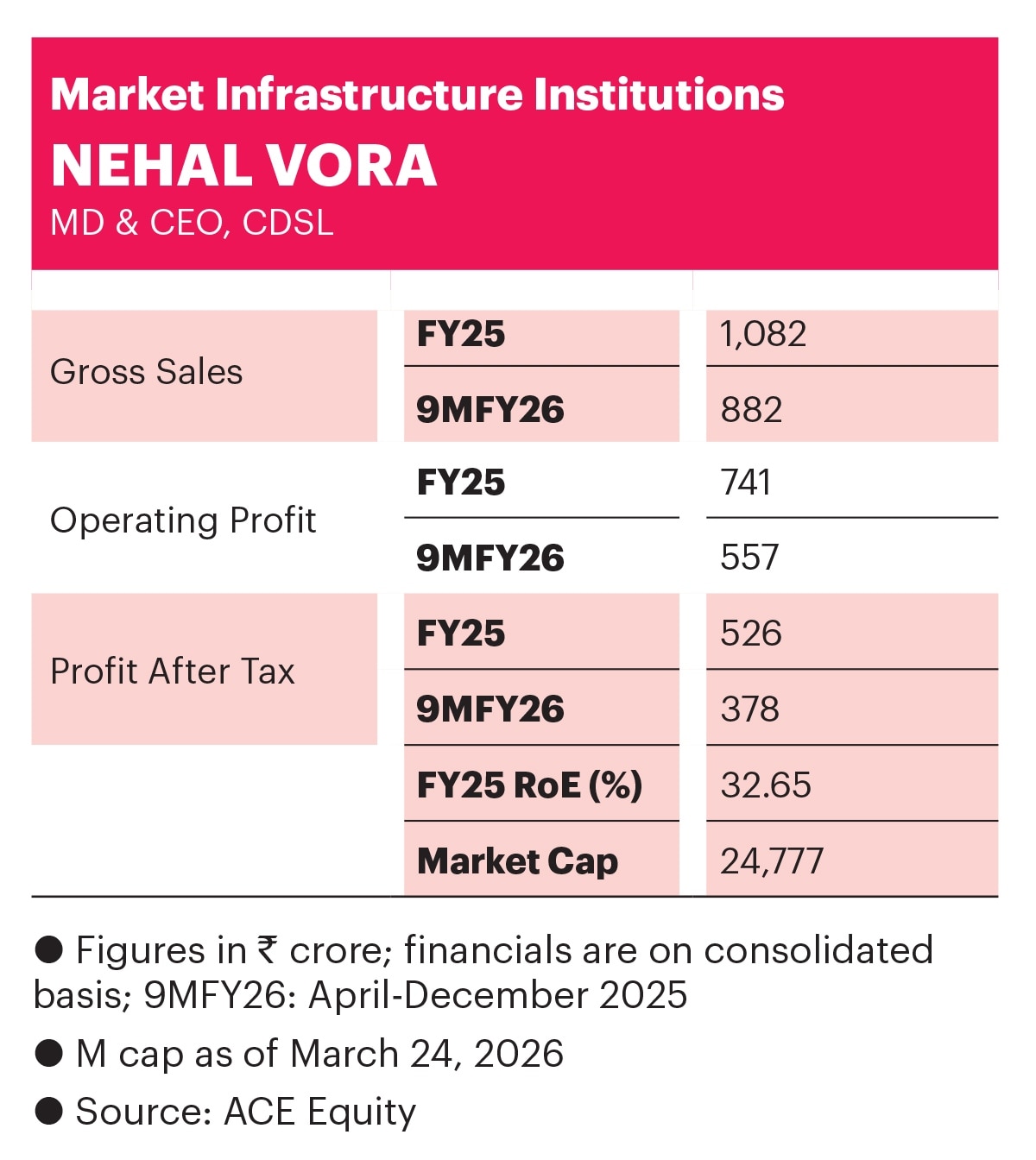
Call it a coincidence or a quirk of fate, the high-growth journey of CDSL— promoted by BSE—coincided with his entry in September 2019. During that time, CDSL had only 18 million demat accounts. Today, it has 178 million investor accounts. This is reflected in the financial performance as well. In this year’s BT-PwC India’s Best CEOs, Vora’s leadership has been recognised in the Market Infrastructure Institutions category.
The pandemic triggered an unprecedented surge in demat account openings. CDSL reached the first 10 million demat accounts in August 2015. It added the 10 million in more than five years and the next 40 million in just two pandemic years. During the pandemic, CDSL transitioned its core technology platform from Unix to Linux. The technology infrastructure has scaled ahead of its user base. “The migration was carried out without disrupting operations,” says Vora.
CDSL’s expansion into new business areas has often been shaped by regulatory evolution. Alternative Investment Funds (AIFs) are now held in demat form. Large private limited companies have also been brought into the dematerialised ecosystem. Corporate bonds are also gaining traction. Mutual funds, too, have seen a sharp rise in demat adoption. The pandemic also added new business lines as CDSL enabled virtual AGMs and electronic voting. It also introduced a single sign-on facility, allowing investors holding shares across multiple companies to log into their demat account and vote on all shareholder resolutions.
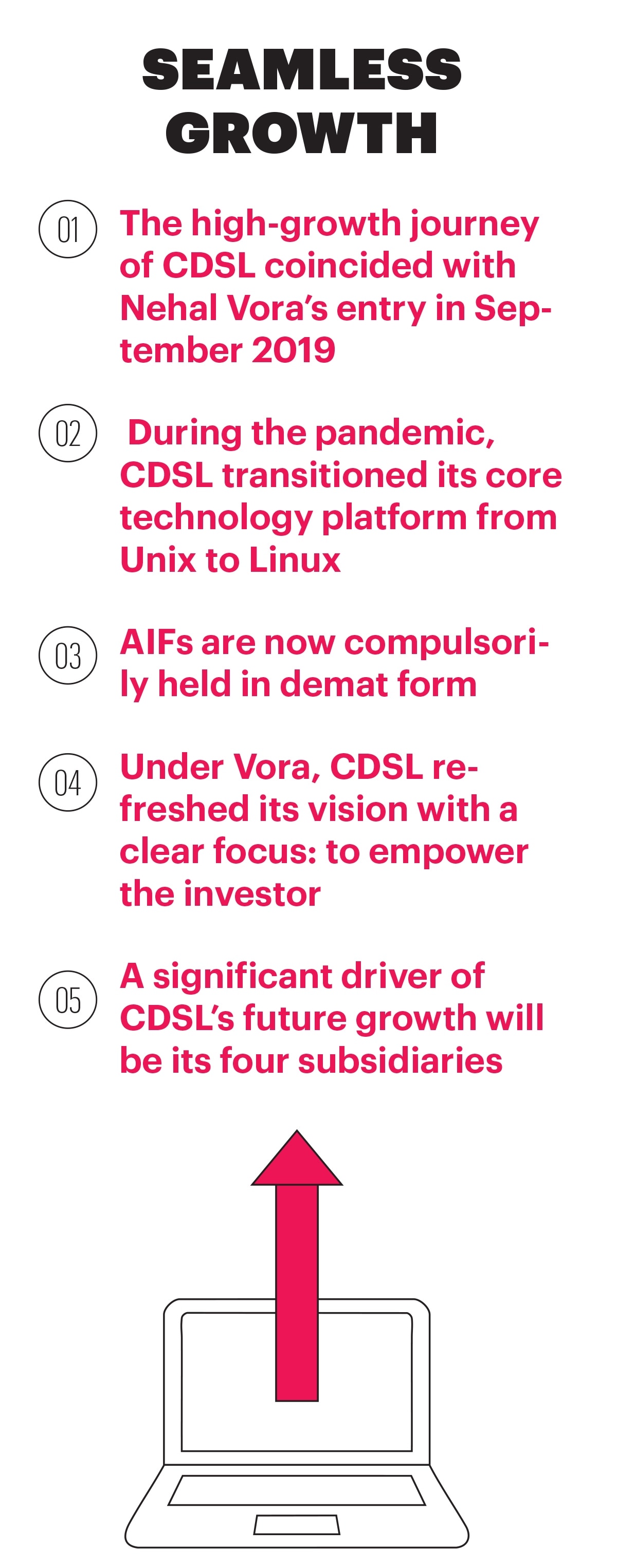
When Vora took charge, one idea that became central was self-reliance. CDSL refreshed its vision with a clear focus: to empower the investor.
A significant driver of CDSL’s future growth is expected to be its four subsidiaries, each building digital infrastructure across different segments of the financial ecosystem. CDSL Ventures Ltd (CVL) is evolving beyond a KYC Registration Agency into a broader digital identity and onboarding platform integrated with Sebi, Unique Identification Authority of India, and Goods and Services Tax Network systems. The insurance subsidiary, CIRL, is developing a demat-like repository for insurance policies, aiming to accelerate the adoption of e-insurance accounts. “Insurance dematerialisation has huge potential,” says Vora.
Countrywide Commodity Repository Ltd focuses on commodity digitisation through electronic warehouse receipts, enabling pledge financing and improving formal credit access for farmers and farmer producer organisations. Meanwhile, CDSL IFSC Ltd in GIFT City is positioned to support international issuers and investors as India’s offshore financial centre grows. Together, these initiatives could open new avenues of growth beyond traditional depository services.
“Today, India has over 135 million unique investors, representing only about 9% of the population, so a huge upside remains,” says Vora, whose organisation continues to invest in technology, especially hardware, applications, security, and connectivity.
“If we want to remain relevant—and more importantly, remain at the top of the curve in terms of value, we need to invest in people and technology,” says Vora.


