














For 125 years, The Phoenix Mills has witnessed the best and the worst of Mumbai’s industrial landscape. Starting in 1905, during the golden period of the city’s textile industry, the 17.3-acre premises in Lower Parel have been the city’s premier landmark. The mill ran successfully for decades—the post-Independence boom even led to a listing in 1959—before labour strikes and worsening business environment in early 80s forced hundreds of textile mills to close or shift outside the city. But Phoenix thought differently and reinvented itself into a real estate and retail giant, thanks to its land bank and the vision of the founders, the Ruia family.
By 2000, High Street Phoenix was a well-established retail destination, and six years later, the company announced the launch of the luxury Palladium Hotel. The retail expansion into other cities coincided with the mall boom in India, with new properties in Pune, Bangalore, Chennai and, of course, Mumbai.
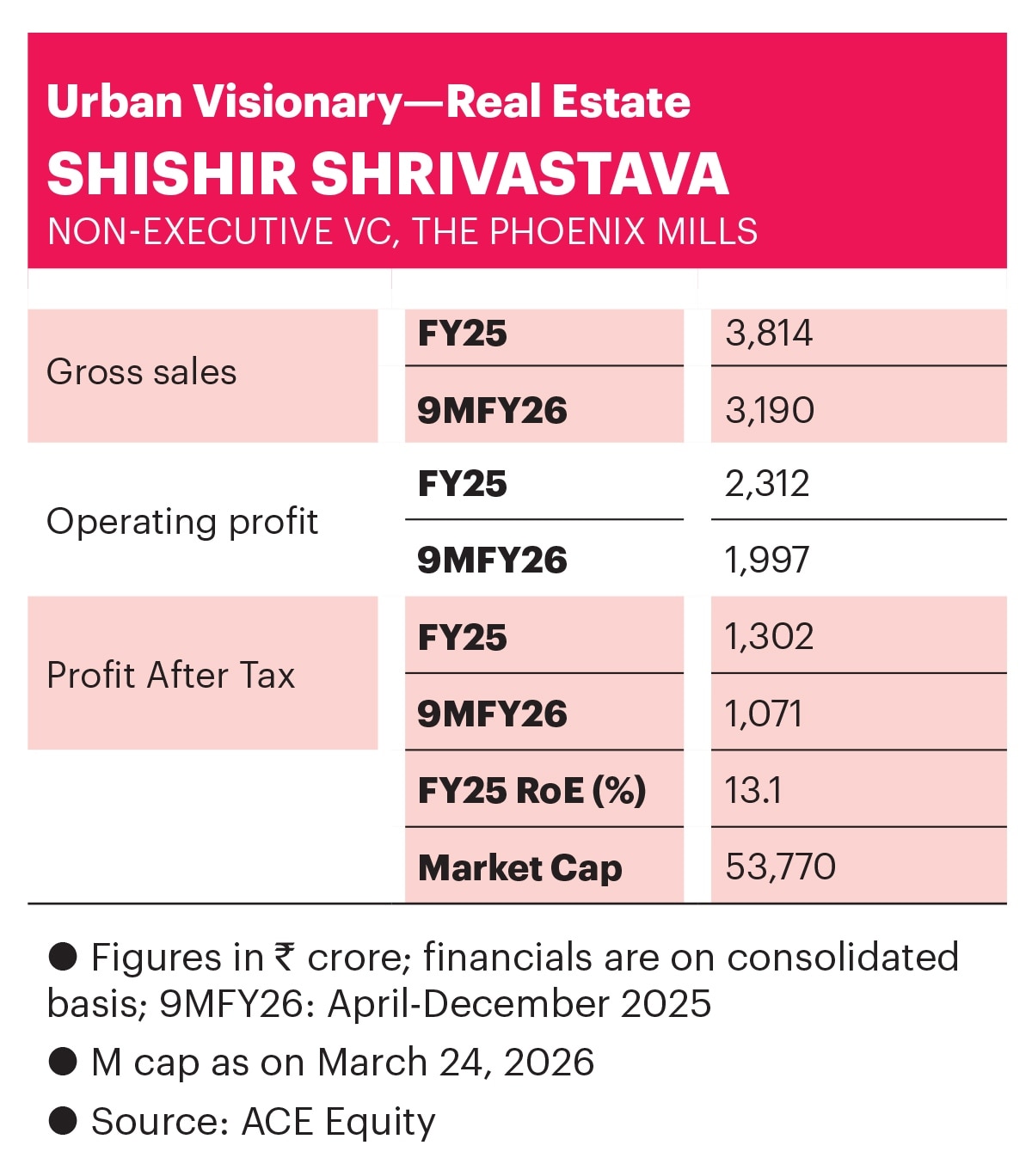
Today, Phoenix is a name in the real estate business, with a business model that cuts across retail, residential, commercial, and hospitality. Shishir Shrivastava, Non-Executive Vice Chairman, Phoenix Mills, has been recognised as an Urban Visionary in the real estate category in this year’s BT-PWC India’s Best CEOs.
In 2010, The Phoenix Mills had a portfolio of 0.9 million square feet, driven by the upmarket Palladium luxury mall in Mumbai. Over time, its presence spread into Pune, Bengaluru, Chennai, and Ahmedabad. Its portfolio was over 18 million square feet at the end of 2025.
During the earnings call for the third quarter of FY26, Shrivastava emphasised the company continues to maintain a prudent and flexible balance sheet. “This has been supported by strong operating cash flows and disciplined capital allocation,” he stated. The result of this effort has enabled Phoenix to fund its ongoing capex and the Island Star Mall partner buyout “primarily through equity, while keeping overall leverage at prudent levels,” he added.
A report by ICICI Direct in December said Phoenix is expanding across segments—retail, office, hotels and residential—to transition from a retail-focused player to an integrated one. “Its retail area of around 11.5 million square feet (across 12 malls) is slated to increase to around 18 million square feet (17 malls) by 2030,” it said. The target is to increase the office/hotel portfolio from four million square feet (588 keys) to around nine million square feet (2,188 keys). Phoenix is well-placed for this expansion (FY25-30) with strong internal cash flow generation and headroom for leverage. ICICI Direct’s report expects it to generate over Rs 8,500 crore operating cash flow in FY25.
Phoenix acquired a 49% stake in its joint venture company, Island Star Mall Developers, from CPP Investments last year for Rs 5,450 crore. The other 51% was already with Phoenix. Island Star has a portfolio of around 4.5 million square feet, including Phoenix Market City Bengaluru, in addition to mixed-use projects in Pune, Bengaluru, and Indore.
The long-term approach has helped the company get it right in new areas and strengthen what it is already good at.
@krishnagopalan


