












At Aero India last year, the Ministry of Defence announced that 65-70% of India’s defence needs were now met indigenously. This was a complete reversal from a decade ago, when this was the import percentage. Defence production reached a record high of Rs 1.27 lakh crore ($15.4 billion) in FY24. This was a 174% increase from FY15. Exports crossed Rs 23,622 crore ($2.77 billion) in 2025 with Indian artillery, radars, counter-drone systems, and BrahMos cruise missile finding buyers from the Philippines to Armenia.
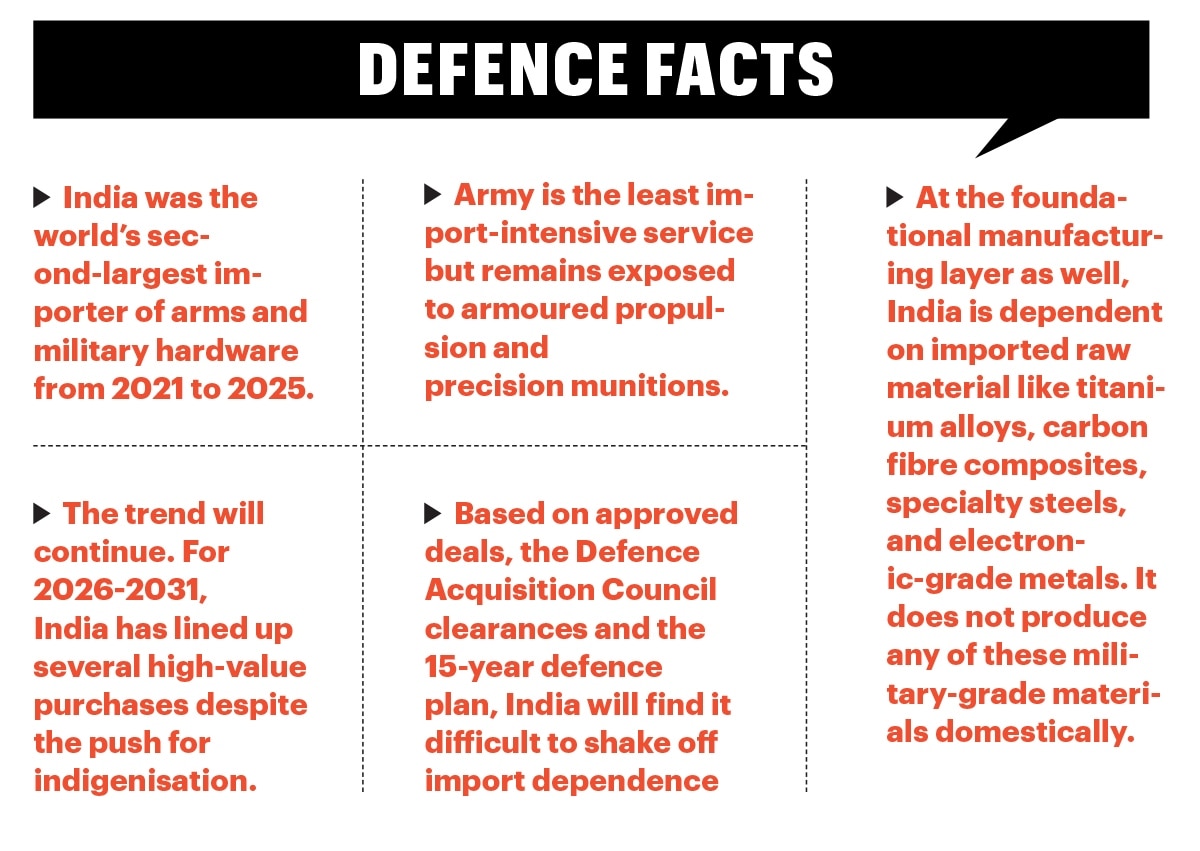
However, India continued to remain the world’s second-largest defence importer, preceded by Ukraine, which has been facing a protracted war. The Stockholm International Peace Research Institute (SIPRI) has ranked India as the world’s second-largest importer of arms and military hardware from 2021 to 2025.
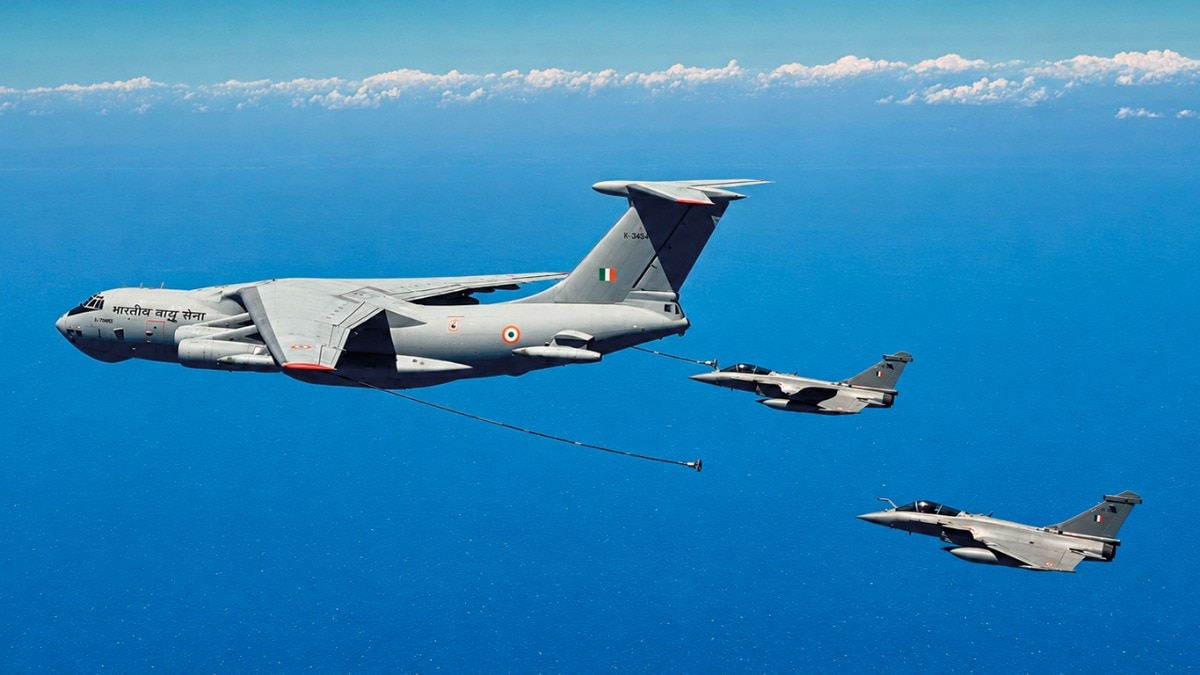
The trend will continue. For 2026-2031, India has planned several high-value foreign purchases, despite the push for indigenisation. Some of the big-ticket ones are 114 Rafale fighter jets for the Indian Air Force (IAF) from France, 26 Rafale M for the Indian Navy, again from France, MQ 9B drones from the US, P-8I reconnaissance and maritime surveillance aircraft from the US, additional S 400 air defence systems from Russia, jet engines from France, and advanced missile systems from Israel.
The Indian Army is the least import-intensive but needs foreign armoured propulsion and precision munitions. The 15-year plan calls for 1,800 futuristic tanks, 50,000+ next-generation ATGMs (Anti-Tank Guided Missiles), and 400 UAV-launched precision guided missiles, many of which will need foreign inputs. Javelin anti-armor systems ($46 million) and Excalibur precision-guided artillery rounds ($47 million) were among the US sales approved in FY25.
Based on approved deals, the Defence Acquisition Council clearances and the 15-year defence plan, India will find it difficult to shake off dependence on this critical high-end technology. At the foundational manufacturing layer as well, India is dependent on imported raw material such as titanium alloys, carbon fibre composites, specialty steels, and electronic-grade metals.
Broad dependency
India has sent a mission to the Moon and has reached the Martian orbit but is far from mastering the aero engine technology. And no other technology has proven to be a greater strategic liability than inability to build an indigenous propulsion system.
Propulsion—whether fighter jet turbofans, submarine diesels, ship gas turbines, or tank engines —is the single most important technology that India cannot produce at scale. Despite 30-plus years of the Kaveri programme and the nuclear-powered INS Arihant, India will remain almost entirely import-dependent for propulsion across all services through 2034 and likely beyond.
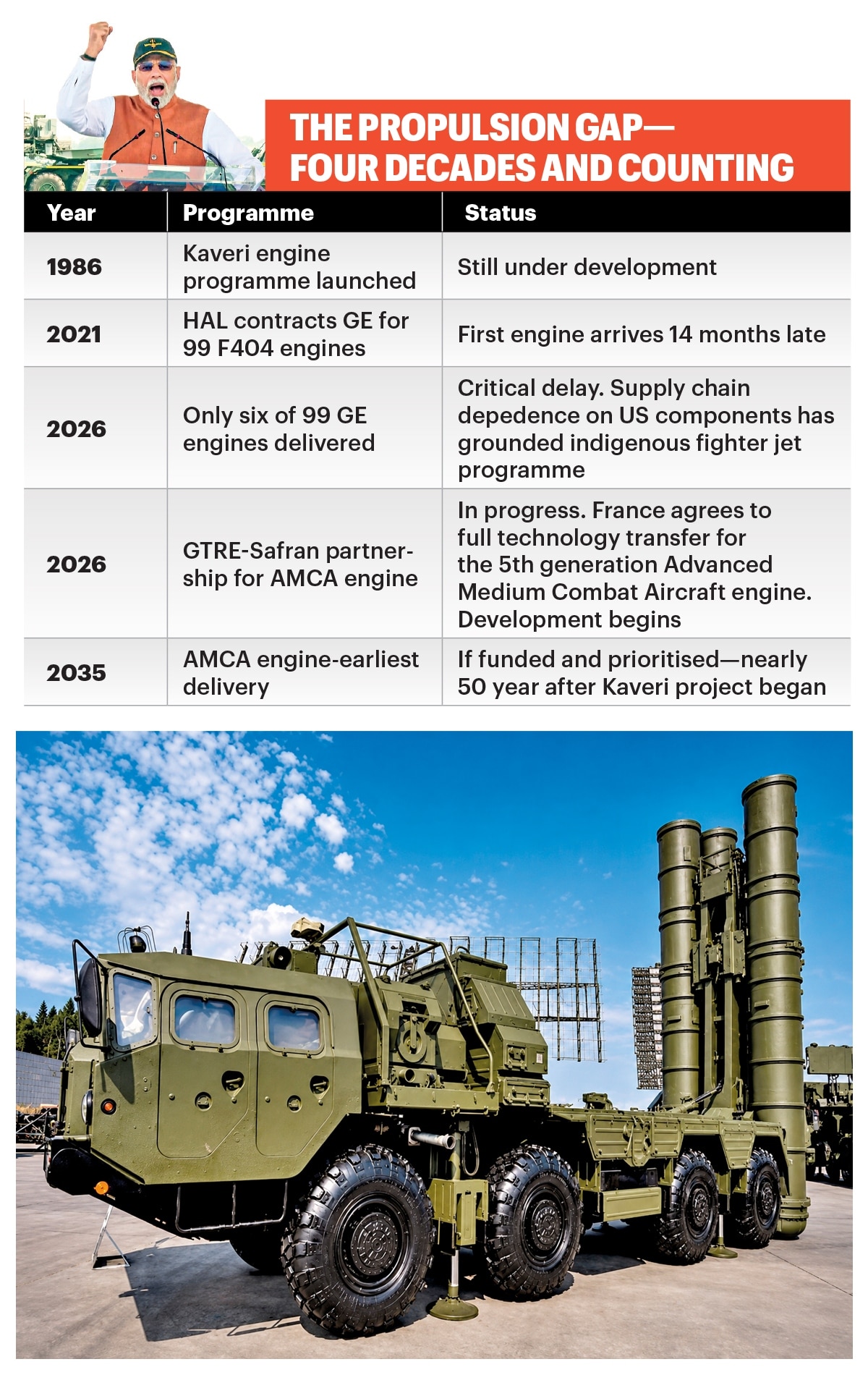
This technology gap derailed the delivery timelines of the indigenous Light Combat Aircraft (LCA) MK1A. In 2021, Hindustan Aeronautics Ltd (HAL) had contracted American General Electric for 99 F404-IN20 engines to power the 83 LCA Mk1A ordered by the IAF. The first engine arrived 14 months late. Only six engines have been delivered, underscoring how the American component has grounded the indigenous fighter jet ambitions.
“Jet engines remain a critical area where dependencies will remain for decades. Licensed manufacturing or co-development doesn’t mean fully independent. Dependency on original equipment manufacturers (OEMs) for critical parts will remain,” says Dinakar Peri, a fellow in the Security Studies programme at Carnegie India.
The Defence Research Development Organisation’s (DRDO’s) Gas Turbine Research Establishment has been working on development of the Kaveri engine since 1986. Four decades and thousands of crores later, the engine remains underpowered for fighter jets.
Ravi Kumar Gupta, former Scientist G and Director, Public Interface. of DRDO, says the gaps have been allowed to be “formed, persist and widen by non-availability of adequate funds (eg, Kaveri Engine, semiconductor devices, advanced compact seekers) and/or bureaucratic hurdles, leading to creation of artificial gaps (like Titanium-related technologies)”.
“Ironically, annual foreign exchange outflow on procurements and MRO (maintenance, repair, and operations) of aircraft engines ranges between $2 billion and tens of billions of dollars according to KPMG reports,” says Gupta.
GTRE is now partnering with France’s Safran to develop an engine for the 5th generation Advanced Medium Combat Aircraft (AMCA). France has agreed to full technology transfer. This means that India’s next generation fighter engine will arrive at the earliest by the mid-2030s. Commander Milind Kulshreshtha (retd), a strategic analyst with an expertise in technologies related to C4I solutions, explains how shortage of key spares for gas turbine maintenance “adversely impacts warship deployment cycles, thereby the Fleet readiness levels.”
“As a solution, the Navy has put a multi-supplier system where propulsion components are purchased from diverse sources, including Indian vendors, for engine controls,” he says.
Electronics
Another consequential dependence is software. India has been seeking access to source codes for Rafale fighter jets. It is likely to be the first country besides France to produce these jets, but it will not have access to the source codes that form the electronic brain of the jet. The source code covers the Thales RBE2 AESA radar, the Modular Data Processing Unit, and the SPECTRA electronic warfare suite, systems that collectively define the fighter’s sensor fusion, survivability, and electronic combat architecture.
The entire modern Active Electronically Scanned Array radar and electronic warfare ecosystem has a common denominator: Gallium Nitride (GaN). The single material can bring many ambitious Indian defence programmes to a standstill. India had sought this GaN chip technology from France with the first tranche of 36 Rafale fighter jets it purchased. However, France refused to transfer it under the offset clause. The DRDO scientists cracked the GaN fabrication in 2023 and established its production in 2024.
India has also developed its own AESA radar named the Uttam. It was declared production-ready in 2023. But equipping Indian fighter jets is going to be an arduous task. The first 40 LCA Mk1A fighter jets will be equipped with Israel EL/M-2052 radars; HAL intends to integrate the indigenous Uttam radars from the 41st unit onwards. The indigenous radar will feature in the second batch of 93 LCAMK1A.
India’s electronics dependency has three layers—first is hardware (GaN chips fabrication), the second is system-level integration (putting indigenous radar into weapon platforms like LCA, Su-30MKIs and future warships) and third is software sovereignty. Out of these three, software sovereignty, as indicated by the no software access on imported platforms, seems to be the most difficult to achieve through indigenous efforts alone.
India is dependent on different countries for foundational defence manufacturing. Titanium, carbon fibre composites and special alloys are all imported.
Rajanikanth Balaraman, Co-Founder and Chief Growth and Technology Officer of Unimech Aerospace and Manufacturing, says: “These are highly controlled technologies with long development cycles, rigorous qualification standards and significant intellectual property barriers.”
What Must Be Done?
The Indian government has been signing defence contracts with technology transfer clauses. The Rafale deal delivered fighter jets but not deliver aero-engine independence. The future contracts should correct this.
Aero-engine development needs to be treated as a national moonshot. The Safran-GTRE partnership for the AMCA engine is encouraging. It must be funded and prioritised at the level India once accorded to its nuclear programme. India needs a dedicated Aero-Engine Mission, with ring-fenced funding and a single accountable programme director.
The India Semiconductor Mission and the defence acquisition process currently operate in separate silos. Every new defence platform contract should specify domestic chip content requirements on a phased timeline. This would create demand signals that pull semiconductor investment toward defence-grade specifications.
India should not just focus on the final assembly. It needs to build capability in titanium and superalloy processing, advanced composites, precision optical systems, and the speciality electronics that underpin every modern weapons system. This is unglamorous, long-cycle work that delivers no ribbon-cutting ceremony. It is also the work that determines whether the next generation of Indian defence platforms is genuinely independent of imports.


