












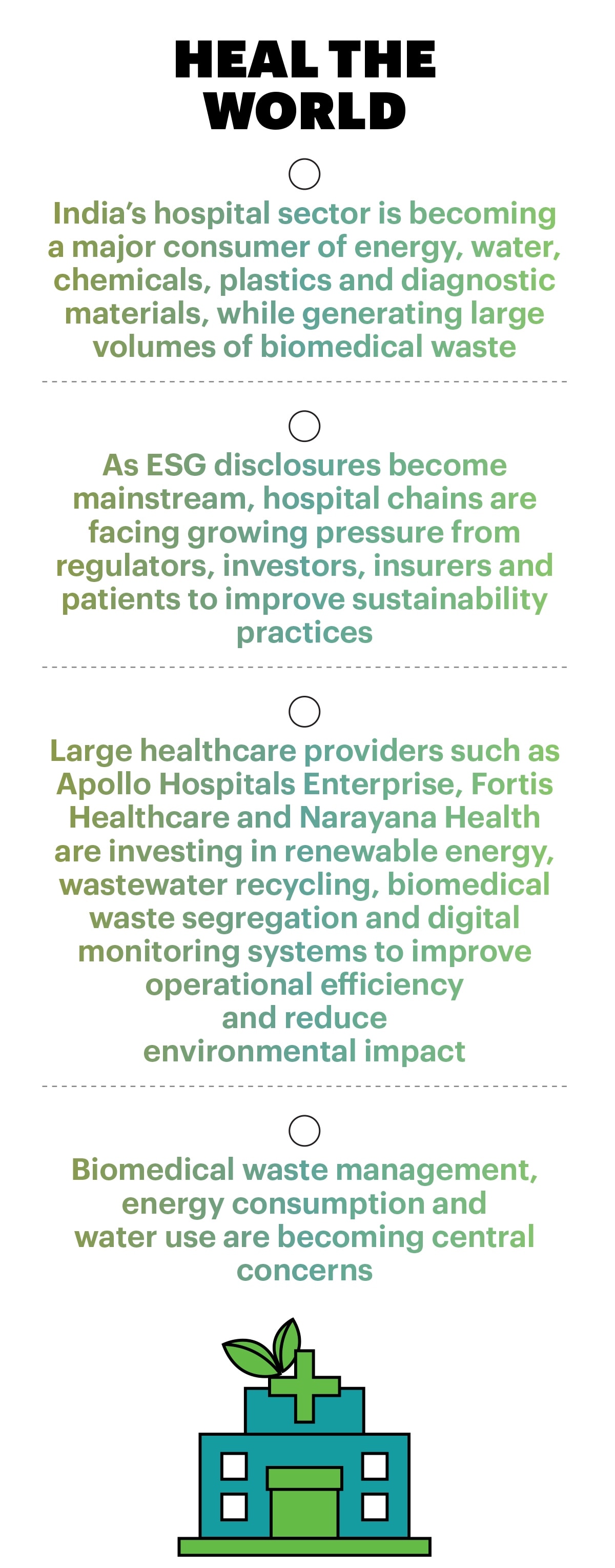


Walk through the back corridors of any large Indian hospital and you encounter a world invisible to patients—refrigerated biomedical waste units, cooling towers running through the night, diesel generators on standby, and laundry and sterilisation units consuming large volumes of water. A hospital never sleeps, and it never stops consuming.
India’s healthcare sector is expanding rapidly. In several Indian cities that are facing groundwater depletion and seasonal water stress, hospitals are under pressure to reduce freshwater consumption. The debate playing out in boardrooms and on construction sites is whether sustainability can lower costs and improve resilience or will it add another layer of expenditure.
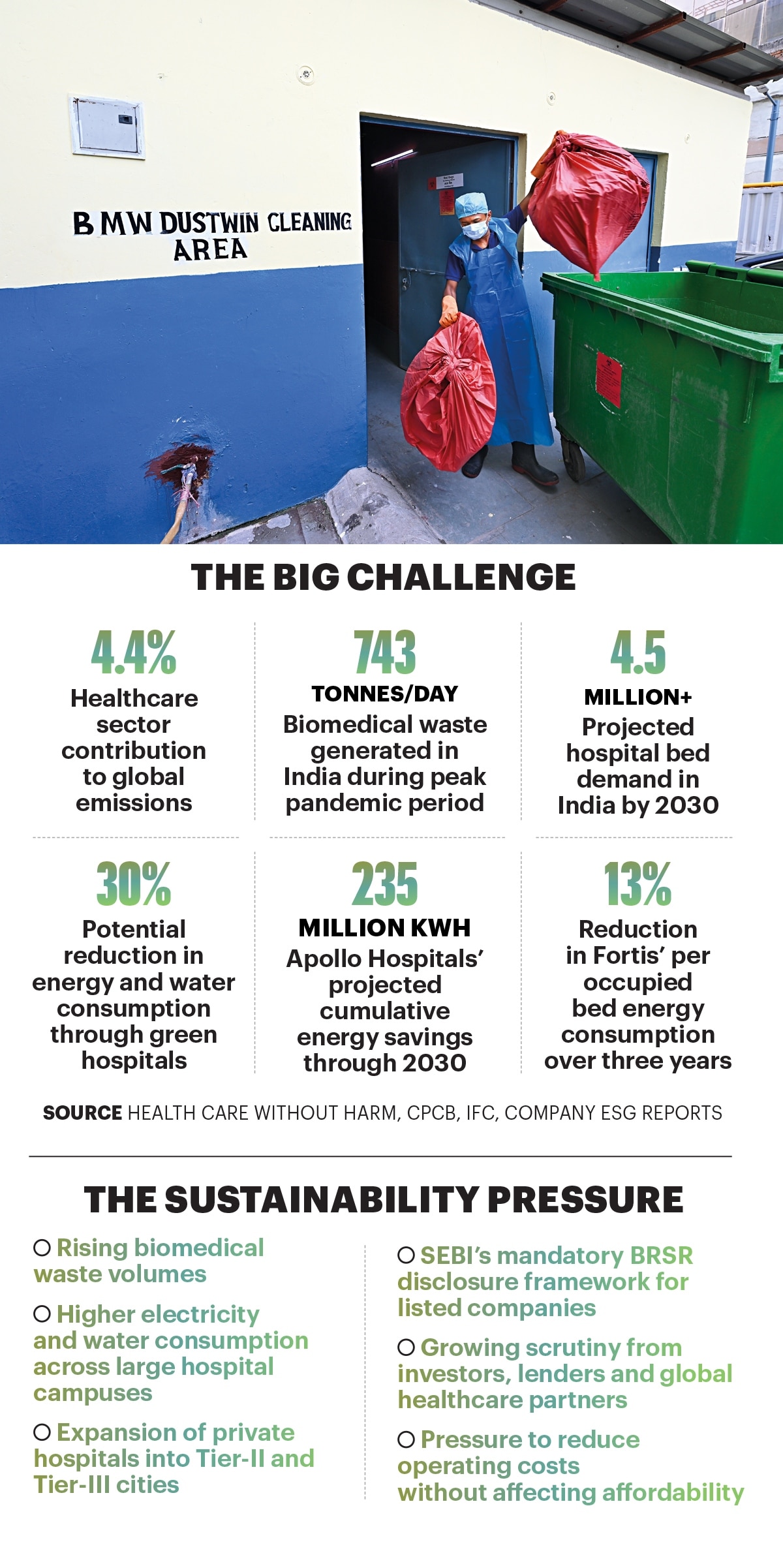
Map this: Health Care Without Harm, along with consultancy Arup, estimates that healthcare accounts for nearly 4.4% of the world’s greenhouse gas emissions. If it were a country, it would rank among the world’s largest emitters. In India, the Central Pollution Control Board (CPCB) recorded 743 tonnes per day biomedical waste generation during the peak pandemic period.
The Business Case
For much of its history, sustainability in Indian healthcare revolved around biomedical waste rules, pollution board filings and accreditation requirements. Large hospital chains are now beginning to link sustainability directly with operating costs, hospital design and investor scrutiny.
“Sustainability is no longer viewed only as a compliance requirement but a strategic enabler that supports operational efficiency and long-term value creation,” says Richa Singh Debgupta, Chief of Strategy and Group Head, ESG, Fortis Healthcare. Over the past three years, Fortis has achieved a 13% reduction in per occupied bed energy consumption. In FY26 alone, interventions cut per-bed Scope 1 and Scope 2 emissions by 8.7%, eliminating approximately 4,435 metric tonnes of CO2. The group recycled more than 2.75 lakh kilolitres of treated wastewater and diverted over 104 metric tonnes of plastic waste from landfills by replacing conventional bags with compostable alternatives.
At Apollo Hospitals, India’s largest private healthcare network with 74 hospitals and over 6,000 pharmacies, the sustainability roadmap is more structured. The Apollo Sustainability Action Plan or ASAP ties sustainability oversight to board-level monitoring and links outcomes to 5% of hospital CEOs’ performance evaluation. “Sustainability has moved from a peripheral obligation to a central pillar of Apollo’s long-term business strategy,” says Dr Preetha Reddy, Vice Chairperson, Apollo Hospitals.
Apollo’s ESG Report FY2024 outlines the scale of these interventions. Project Virya, covering 40 hospitals and around 200 conservation projects, has generated energy cost savings of Rs 297 crore over two years. A partnership with Smart Joules projects savings of 235 million kilowatt hours and Rs 200 crore through 2030 without upfront capital investment by Apollo. The group recycled over 530,000 kilolitres water in FY2024 and recovered 4,800 metric tonnes general waste.
Designed Green
New hospital projects are beginning to incorporate sustainability measures from the planning stage itself, even as older facilities continue retrofitting existing infrastructure. Decisions around hospital design, engineering systems and building certifications are being influenced by energy and resource efficiency considerations. “HVAC systems alone can account for 40-60% energy consumption in large tertiary-care hospitals,” says Swami Nijamritananda Puri, Administrative Director of Amrita Hospital, Faridabad. “Operation theatres, ICUs and imaging systems are highly power intensive.” The International Finance Corporation estimates that green hospitals can reduce energy and water consumption by 30% compared to conventionally designed facilities.
At Amrita Hospital, sustainability was built into the campus design, with sewage treatment plants, effluent treatment systems, water management infrastructure and energy-efficient engineering systems supporting a zero-wastewater-discharge objective. “These were incorporated into the design itself rather than added later through isolated interventions,” says Medical Director Dr Sanjeev Singh. “For many hospitals, sustainability is still a facilities management topic. Globally, however, it is beginning to shape how hospitals are designed and operated over the long term.”
Apollo has formalised this shift through a three-band tiering system for retrofits and newer greenfield projects built to IGBC (Indian Green Building Council) and GRIHA standards. GRIHA norms are national green building standards developed by TERI and endorsed by the Ministry of New and Renewable Energy.
Fortis, meanwhile, has developed a methodology that measures energy and water consumption per occupied bed rather than in absolute terms, linking environmental impact directly to clinical activity levels. The company says the framework helps compare sustainability performance across facilities and identify areas with high energy and water usage.
The Waste Problem
If energy is the most tractable sustainability challenge for hospitals, waste is the most visible. Since the pandemic exposed the scale of single-use plastics, consumables and biomedical material generated by healthcare facilities, waste management has come under scrutiny.
“Biomedical waste management has become one of the most watched areas in healthcare operations,” says Dr Singh. “Today, biomedical waste is not just about systems, but also about behavioural discipline across the institution.”
The Biomedical Waste Management Rules 2016 and CPCB guidelines have progressively tightened accountability. Apollo operates colour-coded segregation protocols across facilities, with biomedical waste handled through State Pollution Control Board-authorised treatment facilities. The group’s shift from conventional HDPE plastic bags to biodegradable corn-starch alternatives has removed around 200,000 kg conventional plastic from its waste stream. Apollo’s FY24 disclosures show waste generated fell by 200 metric tonnes compared to FY23.
Fortis follows a similar compliance structure and reports biomedical waste quantities to the Central Pollution Control Board. The company says its facilities conduct periodic staff trainings on waste segregation and disposal protocols.
Hospitals are also using technology to improve monitoring and resource utilisation. Digital systems are helping healthcare providers improve resource utilisation across hospital networks, says Himani Agrawal, Chief Operating Officer of Microsoft India and South Asia. “At Apollo Hospitals, unified data platforms provide real-time visibility across the network, enabling more efficient use of clinician time and infrastructure. Digital tools are streamlining functions such as reporting and claims, lowering operational overheads.”
Apollo’s real-time environmental dashboard captures sustainability data across 40 facilities representing 90% of the group's total energy consumption.
Affordability Paradox
Behind all these sustainability efforts sits a practical concern—can hospitals reduce their environmental footprint without making healthcare more expensive? India’s healthcare system is already under pressure to deliver affordable care at scale, and hospital groups argue sustainability measures work only when tied to cost savings and resource efficiency.
“Each sustainability initiative is assessed against its expected break-even period, operational impact, and savings potential,” says Debgupta. “Our approach is to integrate sustainability into efficient healthcare delivery, ensuring that environmental responsibility and healthcare delivery progress together.”
Apollo has approached this through financing models tied to savings. Under the JoulePAYS model with Smart Joules, Apollo pays for energy-efficiency upgrades from the savings they generate, without upfront capital investment. Dr Reddy says reductions in energy and water consumption are helping sustainability investments gradually fund themselves over time. “The savings are reinvested rather than extracted as margin, making sustainability programmes increasingly self-funding over time.”
At Fortis, sustainability investments are being assessed through savings and resource-efficiency metrics linked to hospital performance. The company says lower energy intensity and wastewater recycling measures are also reducing utility-related costs across facilities.
At Amrita Hospital, sustainability investments are a part of future hospital planning rather than an optional expense. “Hospital leadership is not about whether we can afford sustainability investments, but whether future healthcare systems can afford to ignore them,” says Swami Nijamritananda Puri.
Competitive Reckoning
Across large hospital groups, sustainability is increasingly being treated as a priority rather than a compliance exercise. SEBI’s mandatory Business Responsibility and Sustainability Reporting framework is bringing structured accountability to the sector, while NABH accreditation frameworks are beginning to incorporate sustainability standards. International healthcare partners, banks and investors are also scrutinising sustainability disclosures and energy-efficiency metrics more closely.
“Hospitals that invest early in sustainable infrastructure and efficient operations are likely to be better prepared as reporting standards and procurement expectations evolve,” says Dr Reddy. “Talent attraction and retention is increasingly linked to employer ESG credentials, particularly among younger clinical and management professionals. Hospitals that have not invested in sustainable infrastructure will face accreditation and reputational risks.” Debgupta says hospitals integrating sustainability into hospital design, resource management and everyday operations are likely to be better prepared as reporting standards tighten and operating costs rise.
@richajourno


