












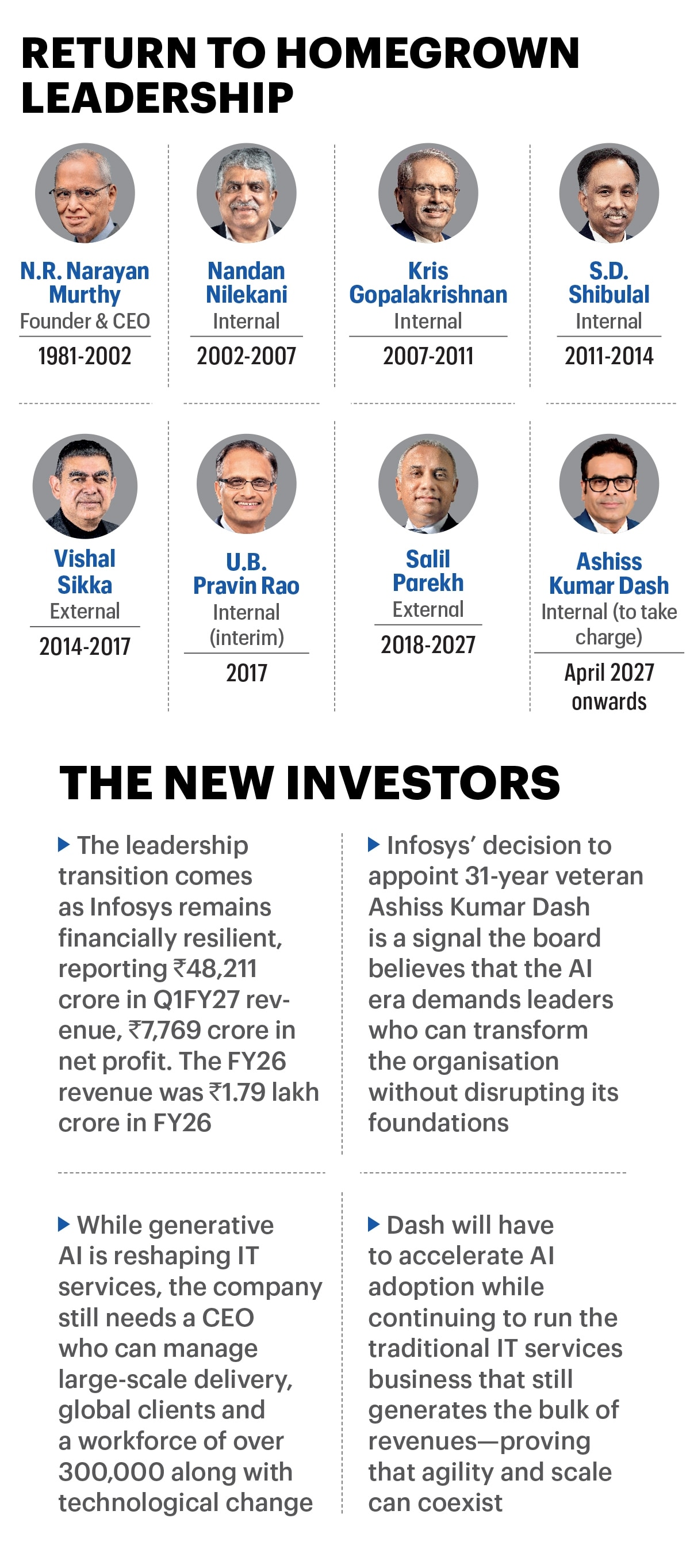

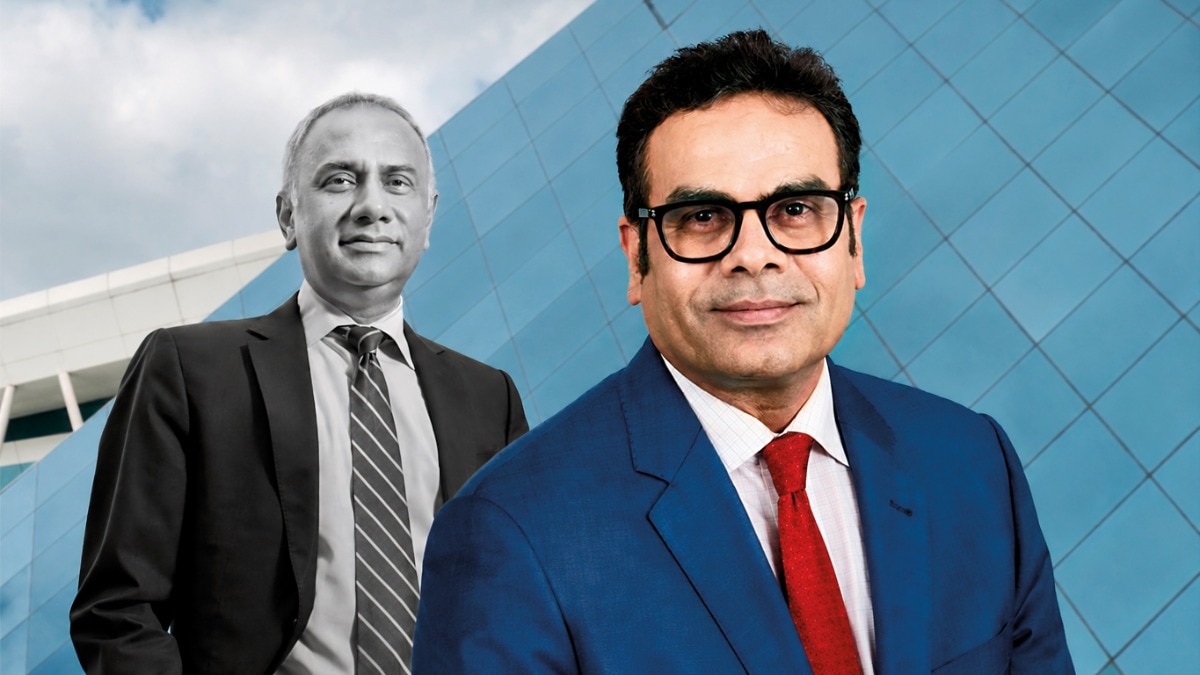
When Infosys announced that Ashiss Kumar Dash would succeed Salil Parekh as Chief Executive Officer (CEO) next April, the immediate reaction was to focus on the familiar. Three decades at the company, leadership across multiple businesses, deep client relationships and a long operational track record. However, the appointment raises a far more interesting question.
Artificial intelligence (AI) is forcing the global information and technology (IT) services industry to rethink how software is built, sold and delivered. Dash’s appointment provides a blueprint for what the Infosys board believes the next phase of leadership will require.
The announcement came alongside a strong first quarter performance that underscored the company’s position of stability. Infosys reported a 12% year-on-year increase in consolidated net profit to Rs 7,769 crore for the quarter ended June 30, while revenue from operations rose 14% to Rs 48,211 crore. The consolidated FY26 revenue was Rs 1.78 lakh crore.
In many industries, moments of disruption prompt companies to seek outsiders capable of rewriting the rules. Infosys has done that before. Salil Parekh, the current CEO, himself joined from outside the organisation in 2018, bringing global consulting experience at a time when the company was rebuilding after years of leadership churn.
Infosys today is not searching for stability after a crisis. It is preparing for transformation from a position of strength.
The challenge is no longer fixing governance or restoring growth. It is integrating AI into a company that serves thousands of enterprises across more than 50 countries without unsettling either customers or employees.
That changes what the board looks for in a CEO, according to experts. An insider who understands complexity.
Unlike digital-native technology companies, global IT services firms are extraordinarily complex organisations. They simultaneously manage hundreds of large client relationships, thousands of ongoing transformation programmes, delivery centres across continents and workforces that rival the population of small cities. Running such a business demands far more than technological vision. It requires institutional memory.
According to Anandorup Ghose, Partner and CHRO Programme Leader at Deloitte India, the appointment also reflects a characteristic often overlooked in Indian IT. “Some Indian companies have traditionally maintained a long bench of leaders waiting for the CEO role. Like several Indian IT services companies, it has consistently developed leaders internally because these organisations are built around deep knowledge of clients, delivery models and the company’s way of operating.”
That institutional continuity is particularly valuable during periods of technological transition.
At first glance, the AI era appears to favour leaders with cutting-edge product backgrounds or experience building frontier AI companies. But enterprise technology rarely changes as dramatically as headlines suggest.
While generative AI is rapidly altering software development and consulting, a substantial portion of global IT spending continues to be directed towards maintaining enterprise systems, integrating applications and running mission-critical infrastructure. The incoming CEO therefore inherits two businesses at once where one has to evolve rapidly, and the other isn’t allowed to fail.
Ghose argues that this balancing act explains why operational experience remains indispensable.
“You need someone who appreciates AI, but also someone capable of managing an organisation of this scale. A significant part of Indian IT services is still traditional implementation, integration and application management. The challenge is transforming the business without disrupting the engine that already exists.”
According to experts, for an IT company, the competitive advantage lies in helping large enterprises deploy AI securely, responsibly and at scale. That shifts the definition of innovation.
The next CEO must convince global clients that Infosys can modernise decades-old technology estates while simultaneously introducing AI into business processes without disrupting operations.
Infosys’ choice suggests the board believes the AI race will not simply be won by the boldest vision or the loudest narrative but by leaders capable of modernising a global enterprise without losing the trust of its clients, employees and investors.
@PalakAgarwal64


