












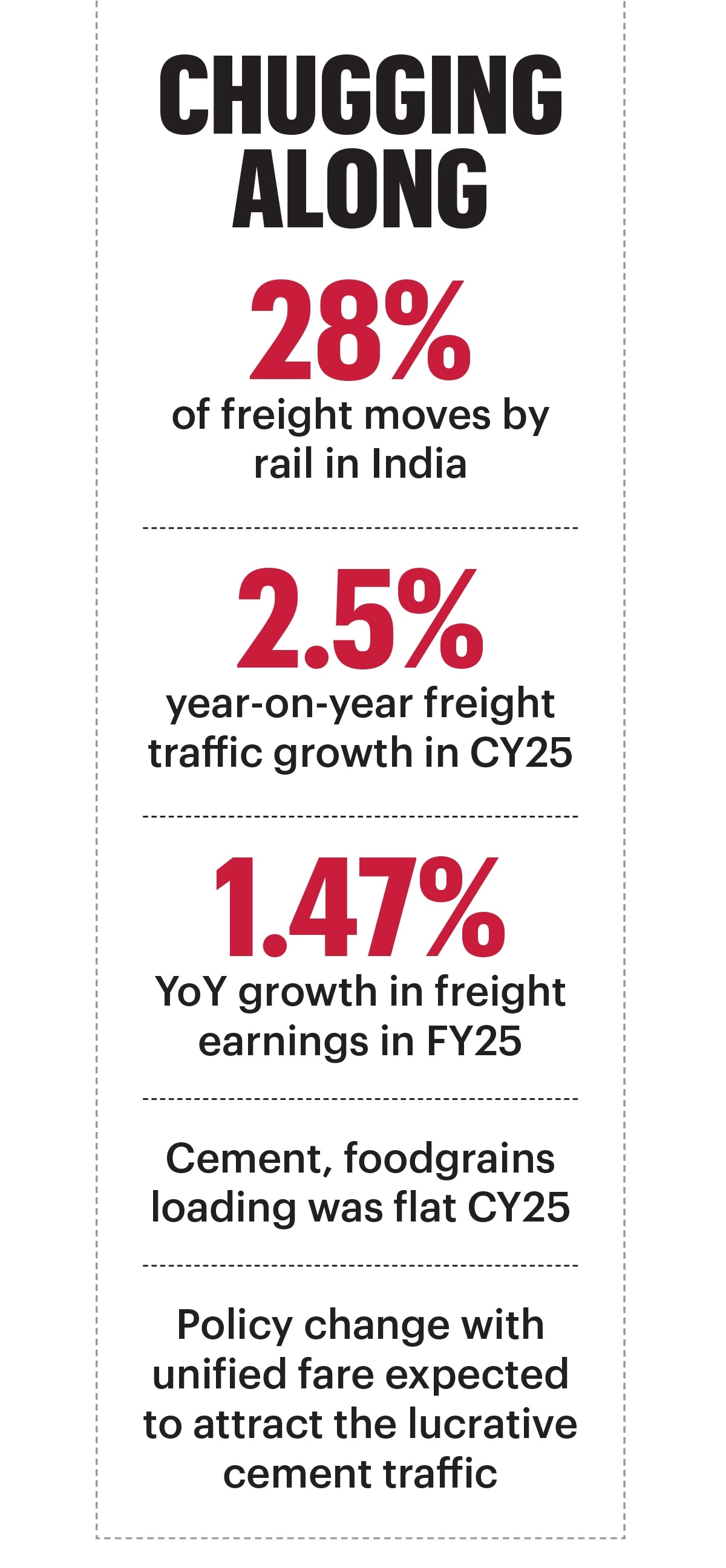

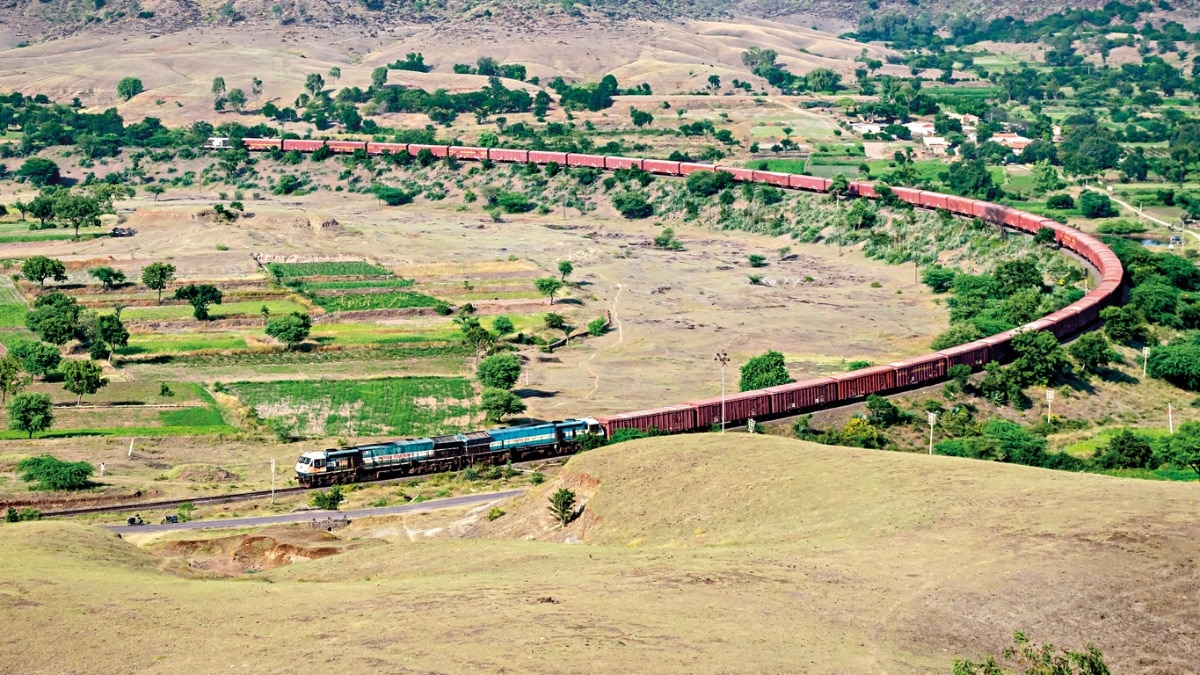
The Indian Railways is seeking to increase its share of freight moved in the country and earn more revenue after losing ground to a widening road network.
The state-owned transporter is focusing on its fare structure—dropping the cost of carrying freight and doing away with distance-based fare slabs—to win back customers who have deserted it for roads.
Last November, the Railways introduced a revised rate policy for the movement of bulk cement, ending a system of setting the freight rate based on distance travelled and weight carried. The rate averaged higher under the old system.
The new rate for bulk cement was set at Rs 0.90 per tonne per km. It was cut later to Rs 0.85 per tonne per km after concerns were raised by the cement industry that this would not be enough for them to switch to the Railways from roads.
Yet, even a Rs 0.05 per tonne per km cut is significant for long-haul customers, adding to their savings.
A plan to introduce a unified freight rate for other commodities moved by Railways is now under discussion in the Railway Board. Railway Minister Ashwini Vaishnaw has asked top officials to look at other commodities on which a fixed rate can be introduced.
Freight Traffic
Experts caution that ending telescopic slab freight rates—a pricing structure where the rate per unit of distance decreases as the total distance rises—could harm long-haul traffic moved by the Railways.
Sanjiv Garg, Secretary General of the Chartered Institute of Logistics & Transport (CILT), says the Railways has marginally reduced the cost by abolishing differential freight rates for cement.
“The Railways is not differentiating between short lead and long lead traffic, which is a regressive step. It has an inherent advantage in carrying long lead traffic as the unit cost of transportation falls when the distance moved increases,” he says.
Garg, a former Additional Member of the Railway Board, explains that the fall in unit cost of transportation over long distances was being partly shared with rail users as an incentive for them to offer long lead traffic to the Railways.

“Now the roads will start competing over long lead traffic too, as the unit rate per km is identical for all leads of cement traffic moving via rail,” he adds.
The actual impact of the policy is likely to be felt only in financial year 2026-27 (FY27) when numbers will be available for the entire fiscal year.
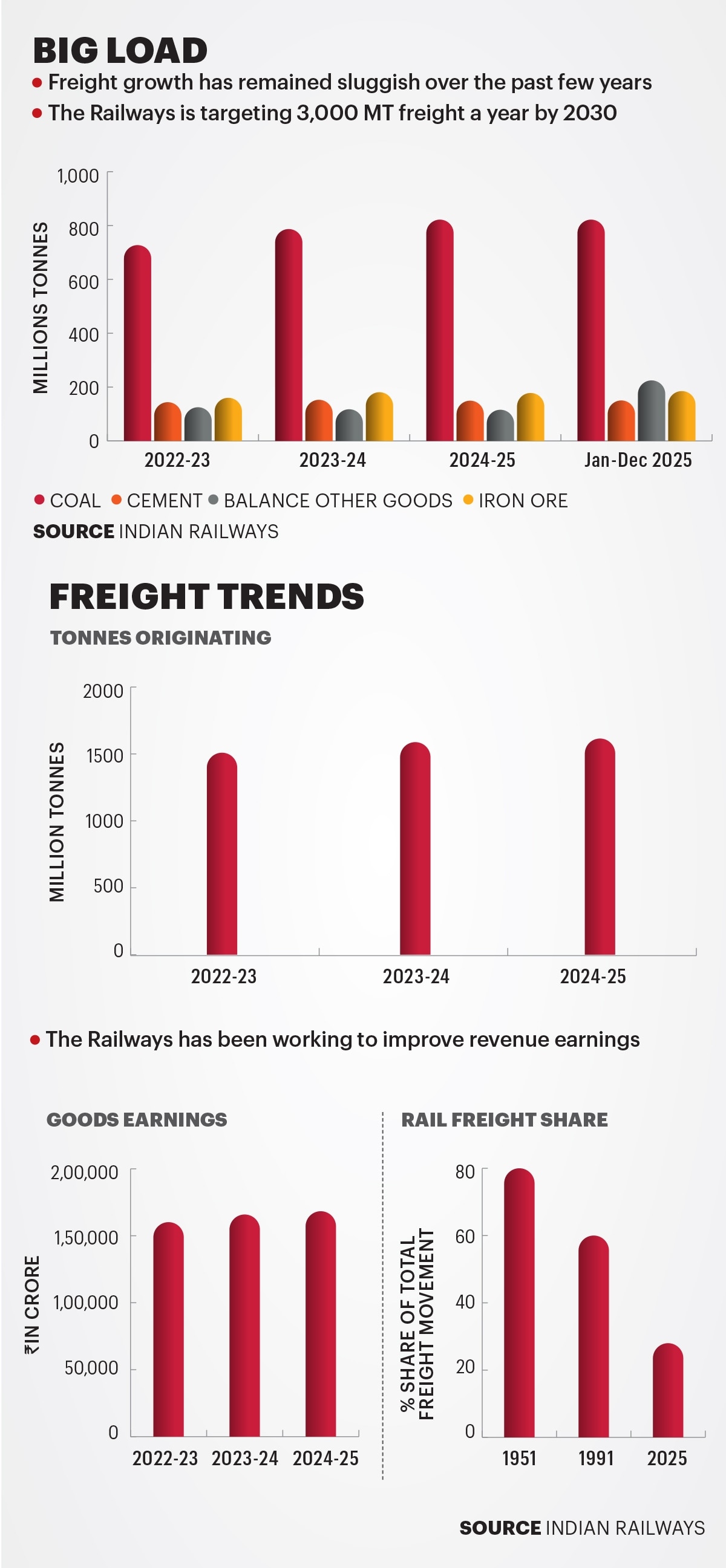
The Railways moved 1,656 million tonnes (MT) in calendar year 2025. It has plans to almost double freight traffic to 3,000 MT by 2030. Roads have grabbed a higher share of freight with faster and shorter connectivity between origin and destination points.
In 2025-26, freight revenue is estimated to be 5.1% lower than the budgeted target.
Rate Rationalisation
Declining revenue growth has been observed in the transport of cement and fertiliser by the Railways over the past few years. The introduction of the new policy was to make cement movement more competitive with that by roads.
As part of the Railways’ reforms for cement transportation, Vaishnaw unveiled the rationalisation of rates for bulk cement in containers. He said these reforms will bring down the cost of cement. Under the new policy, distance and weight slabs were removed, leading to a substantial reduction in cement transportation costs.
The policy enabled the movement of large volumes of cement in a single consignment and minimised packaging requirements while reducing material losses from spillage by using cleaner transportation by road.
Additionally, the policy ensured faster turnaround times through mechanised loading and unloading, enhancing overall efficiency in cement logistics.
Garg says the policy can be termed successful only if it leads to a substantive increase in cement transported by rail. “This policy is applicable to bulk cement traffic moving in tank containers only. But the dead weight of 20 tonnes of the empty BLSS wagon is now also chargeable along with the traffic carried, because the rate charged is now based on per GTKM basis rather than NTKM basis. Hence, we will have to see how the cement industry finally reacts,” he says.
BLSS is a specialised freight wagon designed to transport intermodal containers and trailers. Gross tonne km (GTKM) looks at the total weight of locomotives and vehicles. Net tonne km (NTKM) is the transportation of a tonne of goods for a km.
Other challenges are looming, too. “The biggest challenge for this policy is capex for infrastructure creation for silos to store bulk cement and empty movement of BLSS wagons on return (trips). In a country where rail tracks are already facing capacity constraints, running empty wagons is wasting your available infrastructure,” says Lalit Chandra Trivedi, former General Manager of the Railways.
He says the policy should have been designed after consulting industry players and any future extension of the unified freight rate to other commodities should take into account stakeholders’ concerns to make it workable.
Reforms
Despite rising input costs, the Railways has not revised freight rates since 2018. Under the National Railway Policy, freight charges were already considered high and that any further increase could have led to a decline in traffic.
The Railways has been pushing for reforms to revive freight traffic, keeping in mind that it accounts for over 60% of revenue.
Between FY18 and FY27, freight revenue has contributed an average of 68% to total internal revenue, making it the primary source of revenue for the Indian Railways.
In FY27, 99.7% of revenue is estimated to be raised from traffic operations, with 62% of traffic revenue estimated to come from freight (Rs 1.89 lakh crore), and 29% from passenger services. Revenue from freight and passenger services is estimated to increase by 5.8% and 9.1% over the previous year.
Economic Survey 2025-26 noted that high freight rates distorted competition with roads, inflated commodity and consumer prices and increased the cost of logistics.
It observed that rationalising freight rates could improve revenue buoyancy, incentivise a modal shift of freight from roads and increase market share. It would also help decongest road space and decarbonise the transport sector.
Perceived Skew
Another key concern is that the Railways’ freight revenue is skewed towards bulk commodities, which include goods such as coal, iron ore, cement, foodgrains, fertilisers, petroleum and limestone, contributing 84% of freight traffic.
The rest belongs to non-bulk goods such as container freight, vehicles, fast-moving consumer goods, pharmaceuticals and parcels. The contribution of container services, the closest proxy available for non-bulk goods, is estimated to increase from 4% of revenue in FY18 to 6% in FY27.
Rail freight charges are based on a minimum chargeable weight per wagon. The Draft National Railway Plan had observed that this makes rail transport less competitive for light cargo as charges are also linked to wagon capacity rather than the actual weight carried.
It noted that costs for first- and last-mile transportation, terminal handling and haulage made rail transportation of these goods costlier than by that by roads.
@richajourno


