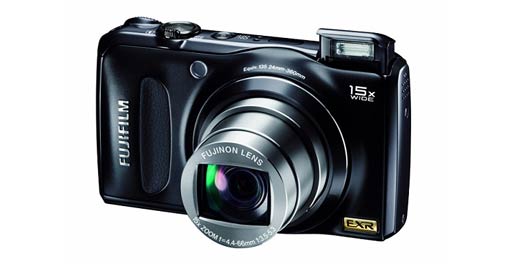
A major plus that a digital SLR (single-lens reflex)
camera has over the compact is its ability to use different lenses. Today's mirrorless compacts too can be fitted with lenses as required by the shooting but there are more options in
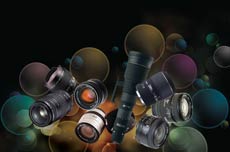
DSLRs. The lens-a photographer's third eye- is the single-most important factor in the picture-making abilities of a camera. All lenses comprise a system of optics that direct the image on to the sensor (in film cameras, on to the film plate). You can use a variety of lenses from zooms with shifting aperture to fixed focal-lengths for different photographic situations. One tip: When using zoom, restrict yourself to a 4X zoom, that is, if you are using, say, a 16-85 mm zoom, the best results will be between 16 mm and 65 mm.
Extreme Wide-Angle Lens or Fish-Eye LensThis is a special lens that can take a picture with a view of 170-180 degrees. Apparently, a fish eye has a similar field of view, thus the nomenclature. It creates exaggerated angles and distorted perceptions and should be used with care for special effects.
Telephoto LensAll lenses with focal lengths longer than 50 mm are called telephoto lenses, or tele for short. Lenses generally available in this category range from 50 mm to 600 mm. Tele lenses can come in the form of zoom lenses too, say like 70 mm-200 mm, 80 mm-200 mm or 100 mm-400mm. They can also be fixed focal length ones like a 70 mm lens, an 85 mm or a 200 mm. Fixed length lenses are usually more expensive and are used by professionals or very serious amateur photographers.
Normal LensA normal lens has a focal length of 50 mm. It is so called because it comes closest to what a normal human eye sees. A 50 mm lens can come with different aperture capacities-called f-stops, or the indicative diameter of the aperture (bigger the f number, smaller the pupil size). You will notice that your camera lens stops at around F3.5 or F4. This is often the basic capability of a normal lens. If you want you lens to have f numbers lower than that, you will end up paying more. F numbers of 2.8 or 1.4 would double the cost of the lens.
Short Zoom LensA lens with both wide and tele capabilities in a single body is called a short zoom lens. Using these involves a shift in aperture. For instance a lens rated at 28-105 mm F4, 5.6 means that at 28 mm focal length, the aperture is set at f4. When you zoom to 105 mm, the aperture shifts to f 5.6. Aperture can't be made bigger than f5.6.
Super Tele LensThis is a very high-power lens with focal lengths of 400 mm, 600 mm or even 1000 mm that you use for sports or wildlife photography. They can also come as zoom lenses. However, remember that fast super zoom lenses (400 mm F4 or 600 mm F5.6) cost a lot of money, perhaps as much as a mid-segment car.
Macro Lens (sometimes called Micro lens)This is a lens that is used for very close up work and provides a reproduction ratio of 1:1 or 1:2. This translates into the subject being captured on the sensor either life-size or half-sized. Macro lenses can approach the subject very closely without distortion, while a very narrow depth of field allows only the subject to be in high focus.
Wide Angle LensAll lenses with focal lengths below the normal 50 mm are categorised as wide angle lenses. They offer a wider field of view than the human eye. So your 28 mm or 22 mm lenses are wide angle. Usually you can get a wide-angle lens with focal length of up to 16 mm. These lenses are suitable for landscapes or when you want to capture a wider area from a fairly cramped position close to the subject. Using a wide-angle lens increases the depth of field, that is, images are sharper relative to the distance from the lens.
Fixed Aperture LensYou can get a zoom lens where the aperture does not shift. Because of the technology involved, such a lens is usually more expensive than a shifting aperture zoom lens. You could, for example, get a 24-70 mm F2.8 lens. This means that whether you are using wide-angle at 24 mm or tele at 70 mm, your available aperture remains constant at f2.8.