The story of Microsoft (Bill Gates, garage, world dominance) is too well known by now to bother repeating. But did you know that Microsoft was started during the 1973-75 recession in the US? Similarly, Walt Disney began during the 1923-24 recession and Hewlett Packard was conceived in the Great Depression. In India, Wipro BPO and MindTree are fruits of a slowdown. Inspiring, no doubt, but what prompted the founders of these companies to take the plunge at a time when the world around them was playing safe? Can you afford to do the same when you are risking your life's savings? If you are in line for a pink slip, isn't it safer to tighten your belt and wait till you get a new job?
If you have a good business idea and were just waiting for the right time to strike out on your own, a job loss might be all the impetus you need. Even if you haven't planned your business and are considering entrepreneurship because you don't have too many options, it's a good time. Experts say there are several reasons why you should start a business during a slowdown. Most importantly, you can acquire property and manpower cheaply. Also, the existing competition in the same field might be weak and ready to be toppled by a strong entrant. Once the recession ends, you will be in a far stronger position than the newcomers since you would have weathered the worst.
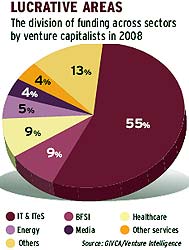
The biggest problem you are likely to face is finance, especially if you are thinking of roping in venture capitalists. There has been a steady fall in VC funding in India, from $876 million in 2007 to $740 million in 2008. The figure is expected to be lower in 2009. Which is why it's important to look for a 'recession-proof' business. Of course, there isn't any such thing, but there are sectors that will see demand regardless of the state of the economy. We take a look at some of these areas and small enterprises that can be profitably started in each sector.
Education
It's the one sector that can be called recession-proof, especially in India, where education is considered important. It's also a sector that venture capitalists are interested in; VCs struck nine deals worth $53 million in this sector in 2008. It is estimated that the education sector is worth $40 billion, with a potential growth of 16% a year over the next five years. "We are quite bullish on education, as the sector is fairly resilient to slowdown. In bad times, education is the last thing to be compromised on," says Akhil Shahani, V-P, marketing, Kaizen Holdings, a venture fund focused on the education sector.
Besides the fact that it has potential, this sector is still largely untapped. "This space is mostly under-penetrated. The private sector spend in this sphere is negligible," says Ashish Gupta, VC, Helion Ventures. Strangely, even as elearning gathers momentum, experts believe that there is good potential in conventional schools— play schools, vocational institutions and the like.
Investors are also looking at schools, ranging from kindergarten to grade 12 (K-12). Says Shahani: "K-12 schools hold good business potential as once the child enters the school, he becomes your client for the next 12 years."
Vocational institutions are also attracting a lot of investments. "There is always a demand for certain skill-sets. Moreover, given the job losses in the current situation, people are looking to upgrade their skills," adds Shahani.
Energy
This seems like a sector for the big-league players, but it is not really so. The emphasis is primarily on alternate energy. Mohanjit Jolly, executive director, Draper Fisher Jurvetson, India, says, "Within the energy sector, there is tremendous potential across various sources of energy— wind, solar, hydro and also for storage devices and distribution. There is a huge demand-supply gap that needs to be bridged."
While setting up businesses that provide alternate energy or valueadded services is possible, remember that most of these businesses will call for large amounts of capital. This is why attracting venture capitalists is so important. The good news is that the VCS are interested and eager to explore opportunities in this field. In 2008, the sector saw 5% of the total VC deals, mainly in companies that focused on solar-based products and renewable energy. Bengalurubased Soham Renewable Energy raised $15 million from DE Shaw and $8 million from Ikya Human Capital last year. Indo-US start-up Deeya Energy also attracted a similar amount from New Enterprise Associates.
"The existing sources of energy are drying up, which is driving the demand for alternate energy sources such as wind and sun. Also, consumers are becoming conscious about using eco-friendly sources of energy. So there is good potential in this sector, which VCs would like to tap," says Arun Natarajan, CEO, Venture Intelligence.
Mobile Value-Added Services
The value-added services for mobile phones is expected to be worth $3 billion by 2012. That's a lot of money—and a lot of potential. Despite the overall gloom, VCs are looking to invest in this area. In just 10 months of 2008, seven deals worth $91 million were finalised. Most of the interest is now in niche areas. Caller tunes and ringtones are old news; voice messaging and games are the hot areas.
"As of now, the penetration in the mobile telephony space is low and there is a tremendous growth potential in this area. With more customers, more telecom operators would like to add a larger number of services. This will enhance the scope of the value-added services market," says Sanjeev Aggarwal, VC, Helion Ventures.
Consumer Internet and specialised retail are two other areas that VCs are increasingly becoming interested in. Aggarwal cites Helion's investment in travel portal, makemytrip.com. "It is growing at a rapid rate even though the travel industry has experienced negative growth. The Internet provides outstanding customer experience and convenience at a lower cost. Currently, there are only 40 million Internet users in India. Any more additions would mean more transactions online," he says.
Study the market and you might find more such areas where funding might be easy. And who knows, you might have another Microsoft on your hands.
Hot sectors in 2009