Prime Mminister Manmohan Singh has finally reserved his place in history by getting the approval of the Nuclear Suppliers Group (NSG) for India-specific exemptions from restrictions on nuclear trade—there is still the small formality of a US Congressional nod that now looks like becoming a fight against the calendar, given the US’s own political exigencies and the looming Presidential elections. But then, seeing how the US went out of the way to secure the NSG waiver for India, there’s a fair chance of an encore before the US Congress adjourns by the end of this month. Be that as it may, New Delhi already knows that the trump card—the NSG and IAEA waivers—lies with it rather than with Washington, for if the deal fails to muster support in the US Congress, South Block has the option of shopping elsewhere—and the “nuclear malls” in Paris and Moscow are more than eager to hawk their wares to India.
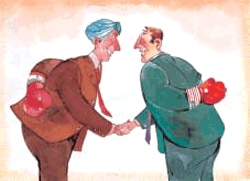
Lets tango: India and the US are allies, but are they also friends?
Russia, in fact, also has a strategic interest in nuclear trade with India as this country’s deepening romance with Washington has neither been digested by Kremlin, nor washed down by the gallons of vodka that is available aplenty there—given the historical context of India-Russia relations. And that, interestingly, could be a valuable lesson in progress for the stodgy mandarins in the Foreign Office whose predilection to stick to the tried and the tested is dumbingly legendary. Today’s foreign policy is not conducted on the basis of ideology but more on strategic interests—recall Bush’s visit to India in 2006 when he repeated ad nauseam that India and the US were strategic partners. After all, let’s not forget in the current bonhomie of the nuclear deal that both countries are bitterly opposed to each other in the Doha Round of the WTO on the issue of farmer subsidies and Washington still hems and haws on supporting New Delhi’s candidature for a permanent seat at the UN Security Council.
Even with Russia, despite the Friendship Treaty, both countries have walked their own paths since the last decade of the 20th century. Both still need each other—Moscow for a big customer for its military hardware and New Delhi for oil and military supplies. But the two countries still have strong differences over the pricing of the Admiral Gorshkov aircraft carrier and the quality of military spares that Russia supplies. Also, Russia doesn’t offer a thimble of a discount on the oil it retails to India. The Russian example, in fact, should be an eye-opener for our diplomatic corps— especially the way it charted out a strong foreign policy under Prime Minister Vladimir Putin in his earlier avatar as President—putting Russia’s selfish geo-political interests above everything else.
Countries don’t have friends, they have interests, and what earlier Indian governments forgot was that foreign policy is the tool to further those interests. It is heartening that India is at last coming to terms with this reality, though, ironically, two of the earliest strategic documents on foreign policy originated in this country. Kautilya’s Arthashastra and the Mahabharat, in a chapter called Shanti Parva, set out in detail how relations with other kingdoms should be governed—not by the personal preferences of the king, but by a hardnosed assessment of his kingdom’s needs.
This newfound pragmatism in the MEA, however, needs to be institutionalised. It requires innovation and boldness—pusillanimity in global geo-politics and foreign policy conducted by rote will not get India very far. New Delhi’s foreign affairs mandarins need to realise that modern diplomatic relations between nations are like modern-day marriages— where the spouses spar during the day, but share the same bed at night. India’s foreign policy, long targeted at winning applause from the Leftwing intelligentsia who so debilitated the country in the first few decades after Independence, is coming of age at last.
Yes, there will be flashpoints in our alliance with the US; there will be issues on which the two countries will be in opposing camps. But that is a part of modern-day diplomacy. By keeping the bigger picture in mind and by ignoring the WTO fiasco, Manmohan Singh, the architect of economic reforms, has completely snapped the remnants of the umbilical cord that still tied India to its socialist past.














