
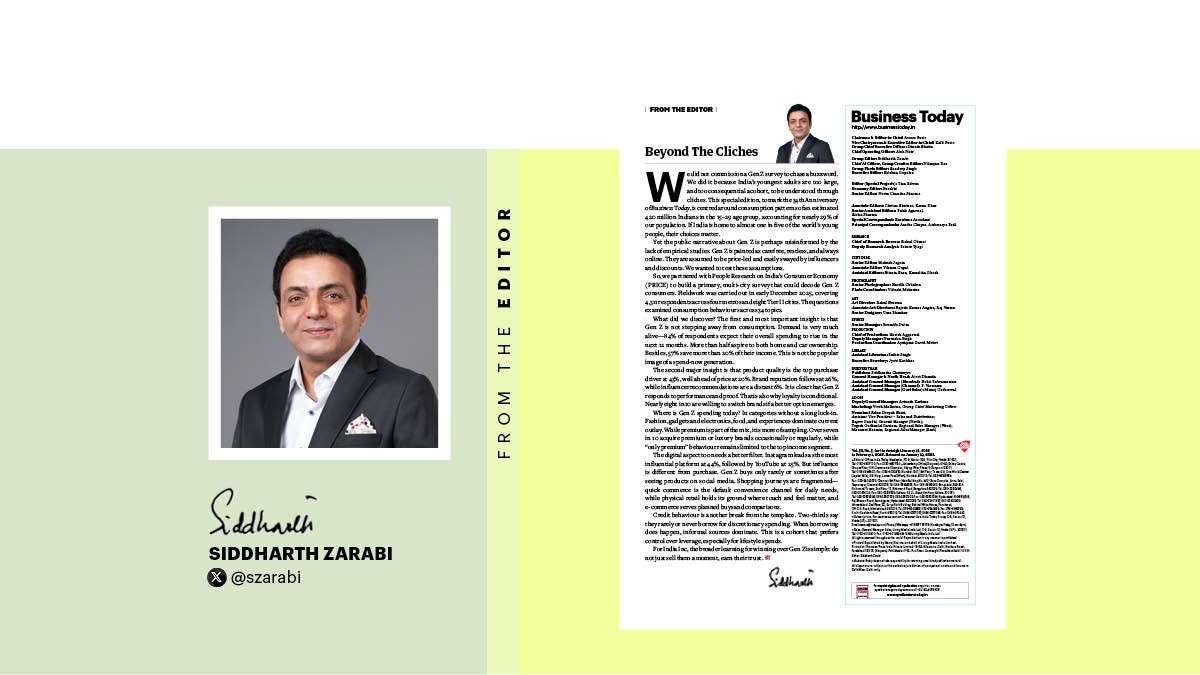
We did not commission a Gen Z survey to chase a buzzword. We did it because India’s youngest adults are too large, and too consequential a cohort, to be understood through cliches. This special edition, to mark the 34th Anniversary of Business Today, is centred around consumption patterns of an estimated 420 million Indians in the 15–29 age group, accounting for nearly 29% of our population. If India is home to almost one in five of the world’s young people, their choices matter.
Yet the public narrative about Gen Z is perhaps misinformed by the lack of empirical studies. Gen Z is painted as carefree, restless, and always online. They are assumed to be price-led and easily swayed by influencers and discounts. We wanted to test these assumptions.
So, we partnered with People Research on India’s Consumer Economy (PRICE) to build a primary, multi-city survey that could decode Gen Z consumers. Fieldwork was carried out in early December 2025, covering 4,311 respondents across four metros and eight Tier II cities. The questions examined consumption behaviours across 34 topics.
What did we discover? The first and most important insight is that Gen Z is not stepping away from consumption. Demand is very much alive—84% of respondents expect their overall spending to rise in the next 12 months. More than half aspire to both home and car ownership. Besides, 57% save more than 20% of their income. This is not the popular image of a spend-now generation.
The second major insight is that product quality is the top purchase driver at 43%, well ahead of price at 20%. Brand reputation follows at 26%, while influencer recommendations are a distant 6%. It is clear that Gen Z responds to performance and proof. That is also why loyalty is conditional. Nearly eight in 10 are willing to switch brands if a better option emerges.
Where is Gen Z spending today? In categories without a long lock-in. Fashion, gadgets and electronics, food, and experiences dominate current outlay. While premium is part of the mix, it is more of sampling. Over seven in 10 acquire premium or luxury brands occasionally or regularly, while “only premium” behaviour remains limited to the top income segment.
The digital aspect too needs a better filter. Instagram leads as the most influential platform at 44%, followed by YouTube at 25%. But influence is different from purchase. Gen Z buys only rarely or sometimes after seeing products on social media. Shopping journeys are fragmented—quick commerce is the default convenience channel for daily needs, while physical retail holds its ground where touch and feel matter, and e-commerce serves planned buys and comparisons.
Credit behaviour is another break from the template. Two-thirds say they rarely or never borrow for discretionary spending. When borrowing does happen, informal sources dominate. This is a cohort that prefers control over leverage, especially for lifestyle spends.
For India Inc, the broader learning for winning over Gen Z is simple: do not just sell them a moment, earn their trust.









