
A Credit Suisse report is even more bullish: “India is likely to be on a highly reflationary policy drive in the coming weeks, unlike most others in the emerging world.” No matter how much the finance minister makes you richer—or poorer—on 29 February, there is something he has already done to make you a more intelligent investor.
Three years ago, by restructuring Section 80C of the Income Tax Act, he moved away from an era of government-dictated tax investing to need-driven investing. Freedom, be it of economy or investing, can be made most of only if you do your homework well.
Sensex and budget
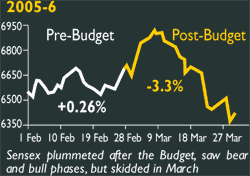
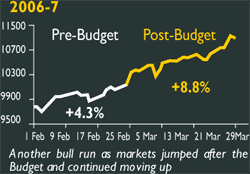
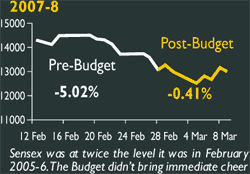
Crash, boom, bang...That seems to be the response of the key market indices after every Budget speech. Investor sentiment veers wildly immediately after the Budget, usually pushing the indices down. And this generally has little to do with the provisions of the year’s most important financial statement.
In fact, the only one of P Chidambaram’s Budgets (during his second stint) that caused the Sensex to nosedive was his most people-friendly one (2005-6). Obviously, the market is least interested in whether tax slabs are simplified or not, or what taxsavings are offered. Index gyrations in the run-up to, and immediately preceding the Budget speech, are largely because of market expectations and kneejerk interpretations.
But, as the graphs on the right show, the indices generally bounce back in the days following the Budget, proving eventually that it is fundamentals and not sentiment that drives the markets.
The big picture | |||
FACTORS | PERFORMANCE | PROSPECTS | |
| GDP growth | Global | Strong; 4.2% in past five years | Expected to slow down |
| Domestic | Strong; 8% in past five years | Moderately lower compared to past | |
| CORPORATE EARNINGS | Revenues | Growing in excess of 20% year-on-year | Moderately lower |
| Profits | Growing in excess of 25% year-on-year | Moderately lower | |
| INCOME LEVEL | Savings | Growing | Likely to grow |
| Spending | High | Expected to moderate | |
| INDUSTRY | Demand | High | Will continue to be high |
| Supply | Low compared to demand | Narrowing the gap with demand | |
| Costs | Increasing | Will go up | |
| Margins | Stable or growing | Will come under pressure | |
| TRADE | Imports | Rising | Continued growth likely |
| Exports | Rising | Continued growth likely | |
| LIQUIDITY | Money supply | Growing | Should continue to grow |
| Capital flows | Growing | Uncertain | |
| Prices and inflation | Stable | Risk of increase | |
| REGULATORY | Political situation | Stable | Uncertain |
| Taxation | Stable | Stable | |
| Policy | Stable | Stable | |
| Source: Bhavesh Shah, vice-president (research), Asit C Mehta Investments | |||













