Day order
This order is valid only for the day on which it is placed. If the order cannot be executed by the end of the trading session, it is automatically cancelled. In the example below, the shares of Reliance Industries opened for trading at Rs 1,033. A day order to buy 25 shares at Rs 1,020 would have been executed had the share price of the company drifted down to Rs 1,020 during the day. But the share price stayed above Rs 1,020 till the end of the day, and the system cancelled the order.
Good till cancelled
Unlike the day order, a good till cancelled (GTC) order remains valid for a specified number of days till it is cancelled by the trader. The validity period is specified by the exchanges. GTC orders help investors to trade at a specified price without monitoring its movement.
IOC order
The immediate or cancel (IOC) order, as the name suggests, is for buying or selling the security as soon as the order is placed. If there is no buyer or seller for the security at the specified price, the order is cancelled immediately. Sometimes, an IOC order is executed partially. An IOC order was placed at 12.45 p.m. for 100 shares of Reliance Industries when the price plunged to Rs 1,025. However, only 25 shares could be bought at this price before it bounced back. The system executed the transaction and cancelled the order for the remaining 75 shares.
Market order
A market order is for buying or selling a security at the prevailing market price. It is executed immediately, irrespective of the market price. The problem is that the investor finds out the price at which he bought or sold the securities only after the order has been executed. If a market order had been placed for 100 shares of Reliance Industries at 12.45 p.m., the buyer would have got 25 shares at Rs 1,025 and the remaining 75 shares at the price at which they were available after it bounced back.
Stop losses (SL) and how to use them
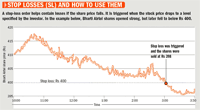
A stop-loss order helps contain losses if the share price falls. It is triggered when the stock price drops to a level specified by the investor. In the example below, Bharti Airtel shares opened strong, but later fell to below Rs 400.
SL market order
In the market order, the stop loss is activated as soon as the price reaches the trigger and is executed at the prevailing market price. The investor has no control over the price at which the order is executed after it is triggered. In the above example, the shares were sold at Rs 398 though the trigger was Rs 400.
SL limit order
A limit order specifies the price at which the shares are to be sold after the stop loss is triggered. This way the investor is sure of getting a specified price for his shares. However, in case the price falls very rapidly below the limit price, there may be no buyers for his shares and the purpose could be defeated.
What experts say
Experts advise that in volatile markets, the trigger should not be too close to the market price. The share price could fall in the morning and trigger the stop loss only to bounce back later in the day. Stop losses can also be used while short-selling. You will have to set a buy order if the price rises beyond a certain level.
Market price protection
What happens if you place an order for shares at Rs 100, but by the time it is received by the system the price has risen to Rs 106? If it is a market order, you will be sold shares at Rs 106, but if you opt for market price protection (MPP), the order will not be executed. MPP limits the execution price as a percentage of the last traded price. If you set a protection of 2 per cent and place the order at Rs 100, then the order will not be executed if the price of the security rises above Rs 102. This is particularly useful if the security is volatile.
Index-based market circuits
These are the trading barriers set up by exchanges to prevent excessive speculation and panic selling. The circuits are activated when the market moves by over 10 per cent and trading halts across equity and derivative markets throughout the country. The circuits are currently applicable to two benchmark indices—the BSE Sensex and the S&P CNX Nifty.