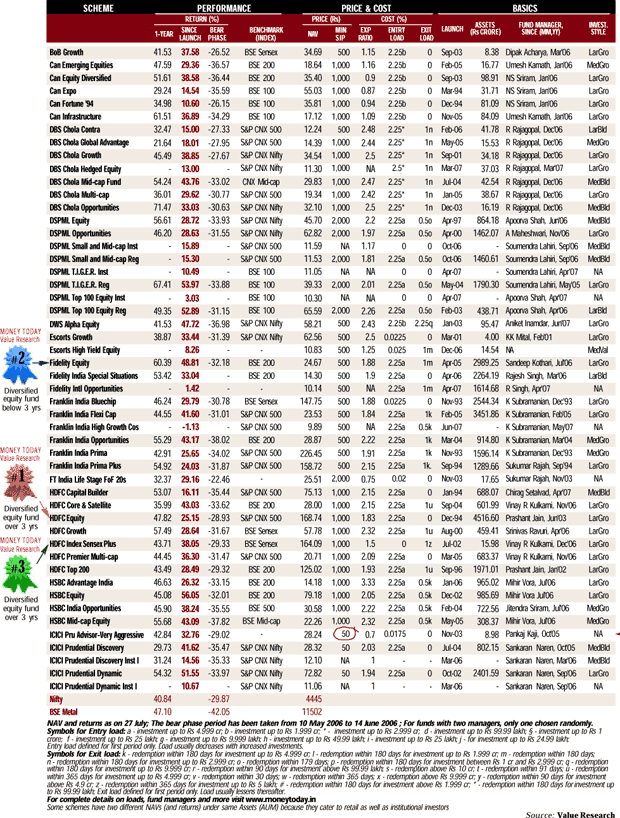
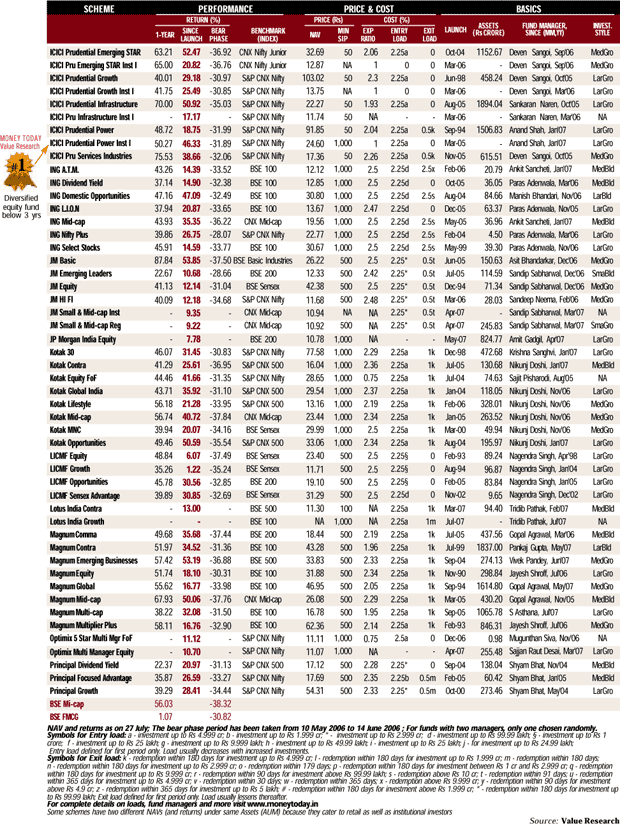
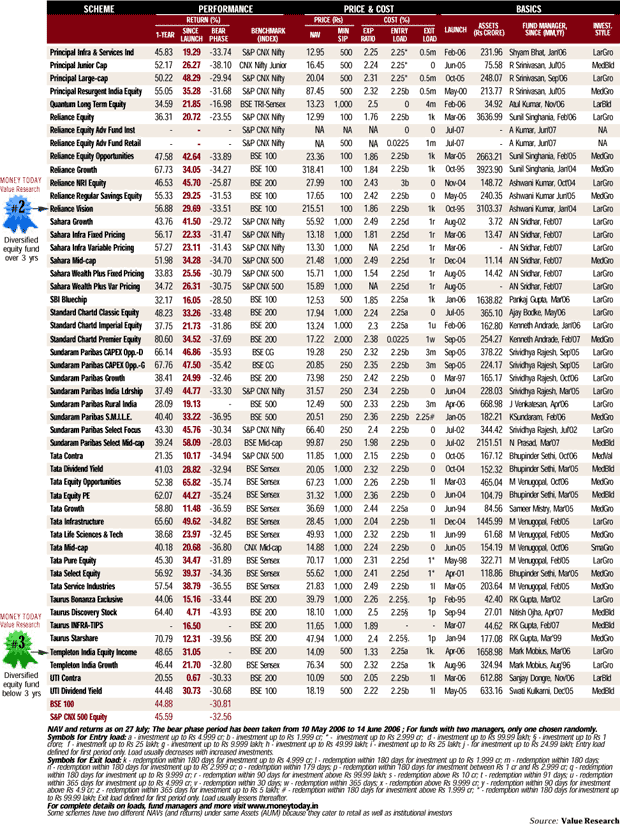
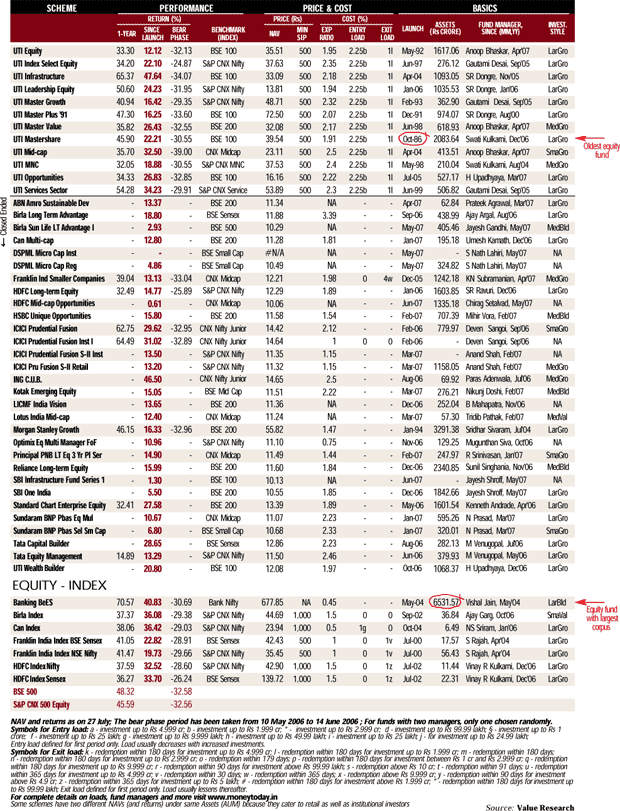
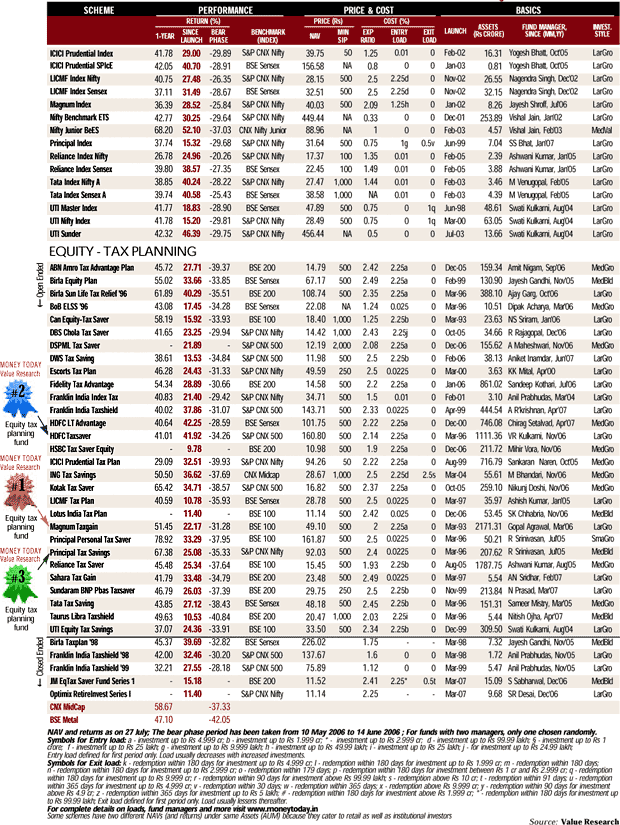
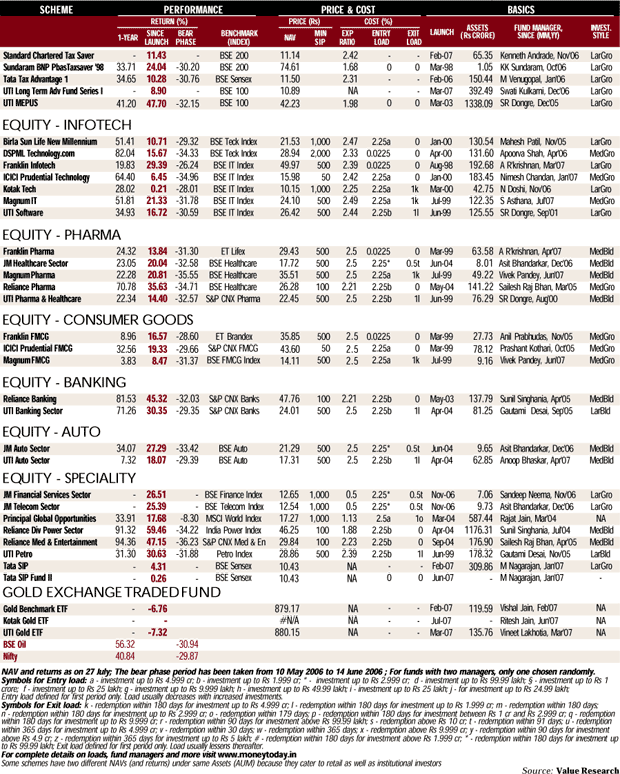
Whether you want to buy mutual funds or are just eager to see how the funds you own compare with other schemes, you’ve come to the right place. In the tables we analyse 733 funds across 14 most relevant parameters of evaluation.
The only schemes out of our radar are those catering exclusively to institutional buyers (mostly debt funds) and those launched after May 2007. Here’s what each parameter (column of the tables) means.
FUND SCHEME: Fund schemes are listed in alphabetical order, under three broad categories —equity, balanced and debt. Look up the name of your fund scheme to compare its returns, costs, et al with other schemes. For easy distinction, tables of different categories appear in different colours. To ensure you don’t end up comparing apples with oranges, these three categories of fund schemes have been further classified into specific sub-categories. For instance, equity funds have been divided into equity diversified, equity tax planning, equity index and equity sectors.
PERFORMANCE: Returns on investment is the most significant indicator of a fund’s performance. But returns vary over time and should be judged in relation to investment schemes with similar objectives. The tables show the following measures of returns:
1-year return: Change in value in the past one year, as on 27 July 2007.
Return since launch: Some funds are three months old, some 15 years and more. This column shows annualised return since their launch. Compare this to know stability of returns, but do this only for funds that are at least three years old.
Bear-phase return: When stock markets go in for correction, equity funds could lose value. Usually, well-managed funds lose less than the average market index. We chose the period of 10 May to 14 June 2006 (when the Sensex fell by 29%) to judge the bear phase return.
Benchmark index: This is the index the scheme uses to gauge its performance. The returns on this index should ideally be compared with the returns on the fund scheme to judge its performance.
PRICE AND COST: A fund with above average return could also be the one with above average costs, which would affect the net return. The parameters here are:
NAV (Net Asset Value): This is the value (price) of one unit of the fund scheme and is calculated by dividing total assets of a fund (AUM) by the total number of units. A higher NAV doesn’t mean that the fund is more expensive or that its returns will be lower.
Minimum SIP: Is the minimum amount you can invest in a fund under the systematic investment plan. A lower SIP makes the fund more accessible to small investors.
Expense ratio: Represents the percentage of funds assets deducted annually to pay for management fee and other expenses. The higher the ratio, the costlier is the fund.
Entry load: The sales fee you pay at the time of investing. This varies across fund schemes.
Exit load: The redemption fee charged when you sell units. This too varies hugely across funds and usually reduces as the period and amount of investment increases.
BASICS: Apart from returns and cost, the four fundamentals to keep in mind are:
Launch: The month and year of the launch
Assets: Total AUM of the scheme as on 30 June. This usually has no bearing on returns.
Fund manager, since: Shows the tenure of the manager. Generally, the longer the tenure, the more relevant the performance numbers.
Investment style: Describes the kind of companies the funds invest most heavily in. Companies are divided into large (with huge market capitalisation), mid-size and small and also as the ones with growth or value stocks, or a blend of the two. Nine investment styles are thus arrived at. A similar grid was followed to capture the investment style of debt funds.
The key issues here are the quality of holdings and their sensitivity to interest rate fluctuations. The investment styles move from low quality-low sensitivity (LQLS) to high quality-high sensitivity (HQ-HS).