Investors find it easy to pick a mutual fund based on its past performance. However, a better way to evaluate a fund is to consider its returns vis-à-vis the expected returns. If the returns generated are higher than those expected, it is considered a superior fund. Yet, relying on this indicator alone may not be useful as it ignores the risks associated with a fund. For, in an effort to generate higher returns, fund managers tend to take greater risks than they should, thereby impacting the performance of the fund. Given a choice between two funds offering similar returns, investors are likely to pick one that is less risky. So, often, what matters is the quality of past returns rather than the magnitude.

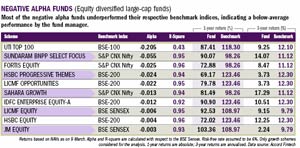
Hence, it is essential to consider the fund manager's performance. The statistical tool used to assess this performance is known as alpha or Jensen's alpha. It measures the difference between the actual return and the expected return. A positive alpha value signifies superior performance by the manager as the fund generates returns in accordance with the risk taken, while a negative value signifies underperformance as the fund fails to compensate for the risks assumed. The higher the alpha, the better the fund.
Valued information
The expected return of a fund is defined as the sum of the risk-free rate and beta times the market risk premium (the additional return generated over the risk-free rate). The beta coefficient, measures the sensitivity of a fund with respect to its benchmark index (see Account for Risk, October 2009). The higher the beta, the more will be the expected return. Usually, the government bond yield is used as a proxy for the risk-free rate. There are two types of risks faced by a mutual fund. These are companyspecific and
marketspecific. While the fund aims at eliminating company-specific risks through diversification, the market risk cannot be removed. This method of estimating expected returns is known as capital asset pricing model or CAPM. If the return is less than that estimated by CAPM, it's considered inadequate. Alpha values are available on Websites such as
valueresearchonline.com and
myplexus.com.
The limitations
Considering alpha on a standalone basis could be misleading if the reliability of beta coefficient is questionable. Therefore, it should always be considered along with r-square, also known as the coefficient of determination. R-square measures the degree of variations in a fund that is attributable to variations in the market, which is defined by the benchmark index. Its value varies between 0 and 1. The closer the value of r-square to 1, the higher will be the reliability of beta and alpha. As alpha is derived from expected returns, which, in turn, is calculated using the beta coefficient, any instability in beta will make the alpha useless.
Moreover, alpha is suitable for well-diversified funds as it considers only the market risk. However, it fails to evaluate the performance of less-diversified funds as they are also prone to company-specific risks. Another factor that affects alpha is the fund's expenses. Alpha could be negative due to the expenses involved in the fund's return.