
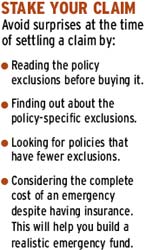
For years, policy-holders have complained of delays and difficulty in the settlement of general insurance claims. Many of these problems can be mitigated if you read the exclusion clauses of the policy—health, automobile or house—before buying it. There can, of course, be complications or exceptions. So, an insurer can use the insurable interest clause and refuse to pay if he feels the policyholder was careless in safeguarding the insured article. Similarly, for motor insurance, especially where third-party claims are settled by courts, the insurer pays depending on the court’s ruling and the extent of the cover. In the normal course, however, a simple perusal of the exclusions can save you much heartache at the time of claim settlement.
For a personal accident cover that offers protection against mishaps resulting in partial, total or temporary disability, there are sub-clauses and you cannot make a claim under more than one sub-category. Besides, accidents caused under the influence of liquor or drugs, breach of law, etc, are excluded.
Health insurance has one of the highest cases of claim rejections, which is why it is essential to consider its exclusions. Not all hospital bills qualify for reimbursement as the policy comes into effect only if the policyholder is hospitalised for at least 24 hours. Also, the first claim cannot be made within 30 days of buying the policy. Most health plans don’t cover diseases or injuries existing at the time of taking the cover, so diabetes and hypertension patients will find it difficult to settle a claim related to heart ailments. Neither do they cover non-allopathic medication, congenital diseases and cosmetic/aesthetic or related treatment.
In the case of motor insurance, third-party liability cover insures against death or injury (caused by your vehicle) to pedestrians, occupants of other vehicles and outsiders other than passengers, for a limited amount, capped at Rs 7.5 lakh. However, this compensation is fixed by a court and could be higher, leaving you to arrange for the rest of the compensation. Even a comprehensive motor insurance does not cover damage to tyres (unless the vehicle too is damaged), wear and tear, and mechanical breakdown. The claim can be rejected if the person driving the vehicle at the time of accident does not have a valid driving licence or is drunk, or if the premium has not been paid beyond the grace period.
In the cover protecting your home, only the contents mentioned in the policy are covered, excluding loss or damage to livestock and pets. For an allrisk cover on jewellery and valuables, the claim is rejected if the damage is due to cracking, scratching or breakage of parts. Similarly, the cover for breakdown of appliances excludes damage to external fittings. So remember, insurance is as good as its fine print.













