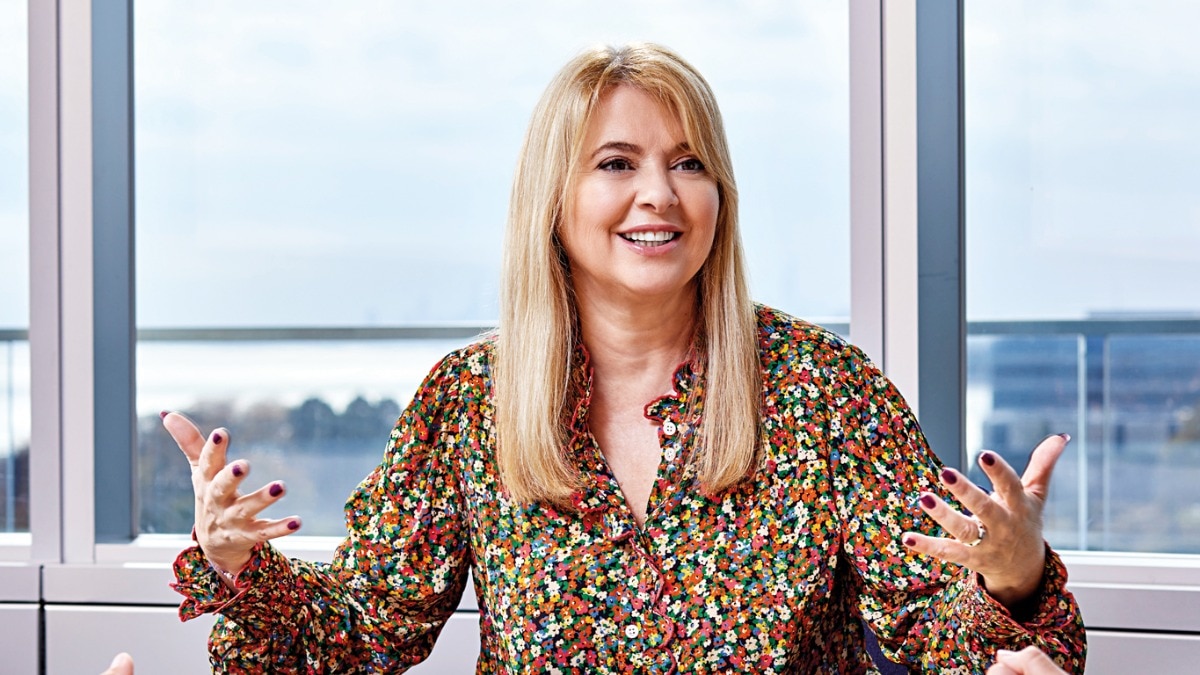
Francesca Cornelli is the Dean of Northwestern University’s Kellogg School of Management as well as a professor of finance and holds the Donald P. Jacobs Chair of Finance. Since joining Kellogg in 2019, Cornelli has crystalised the school’s mission to shape empathetic leaders who can think globally, unite diverse perspectives, and lead through rapid change and complexity. A global educator, Cornelli has vast international experience and has taught at some of the top schools in the world. In an interview with Business Today, she speaks about how leaders of tomorrow can navigate today’s challenges. Edited excerpts:
Today we have at least three major forces of geopolitics, geoeconomics and tariffs, and AI impacting global businesses. Is this a pivotal moment for companies, and if so, how should they respond to these changes?
This is something I have been reflecting on a lot. In the last six years of my Deanship here, I have seen all these forces playing out. And there’s no doubt that today, for leaders in business, the situation is much more complex than before. So, companies and business leaders cannot look at the situation only from their lens, of say, strategy or profits. But they have to consider the interest of all other stakeholders like employees and customers too.
In such a world, business schools are important in preparing aspirational leaders who can navigate the environment. It is clearly a world of incredible uncertainty and will remain so for a while. At the same time, we should not overreact to the present but always keep an eye on the north star because these students who will become tomorrow’s leaders will have to take difficult decisions. Therefore, tomorrow’s leaders need to have both Intelligence Quotient (IQ) and Emotional Quotient (EQ).
Apart from the above, in this time of great uncertainty, what else should business leaders be doing?
In this environment, leaders need to have an open mind because not only is there economic and political conflict but also a misperception that the values between various stakeholders have in common are much less than what it actually is.
Kellogg recently launched the Litowitz Center for Enlightened Disagreement that prepares companies and leaders to converse with people even when they disagree about a point of view. Thoughtful and respectful disagreement can fuel understanding, innovation, and progress—offering a powerful antidote to today’s polarised discourse. One group should not demonise the other because each group has different priorities and comes from a different background.
There are many concerns about the advent of AI in the business world. Are they valid?
People need to be comfortable with human-machine partnerships. The efficiencies brought by AI don’t necessarily mean a loss of jobs. Using AI for quantitative needs allows people to focus on creativity and innovation. At Kellogg, we prepare students to use AI as a tool that provides the information and space to deliver innovative ideas and leadership.
You have studied and taught in various parts of the world like Europe, Russia, India, United States, and perhaps more. How is management education different in each of these geographies and what was your personal experience?
It’s interesting to me, because this goes back to the aspect of culture that I briefly spoke about as well as the economic system of that country or region.
I think it’s very humbling sometimes that coming from another country, one takes certain things for granted, because that’s how one does it in your country. And they assume that everybody is doing it that way. This understanding that each region’s economy is different has been very important in my formation as an economist.
So, while students come to Kellogg with their daily experiences and assumptions, it is actually crucial for them to realise that their assumptions are not always right and that it is important to see the entire context. Let me give you an example of how this is done in Kellogg in the field of healthcare, which is a very popular area of focus among students and therefore very important for us. We teach the entire ecosystem of healthcare, that even though a company might want to invest in biotech, you need to understand the entire healthcare system all the way to how a hospital does procurement. Recently, one of our faculty members started a course in Shanghai to study the Chinese healthcare system. This way students form a better appreciation for how healthcare is managed differently in a particular economy. I am hoping to start do something like this about Indian healthcare market.
Kellogg has a partnership with Indian School of Business (ISB), Hyderabad. Do you have collaborations with any other Indian business schools? Or are you looking for more?
We do not have any other partnerships in India so far, apart from the one with ISB. But I will very be open. While ISB is close to us, it would be great to form more relationships with other Indian institutions. That is very important to us.













