
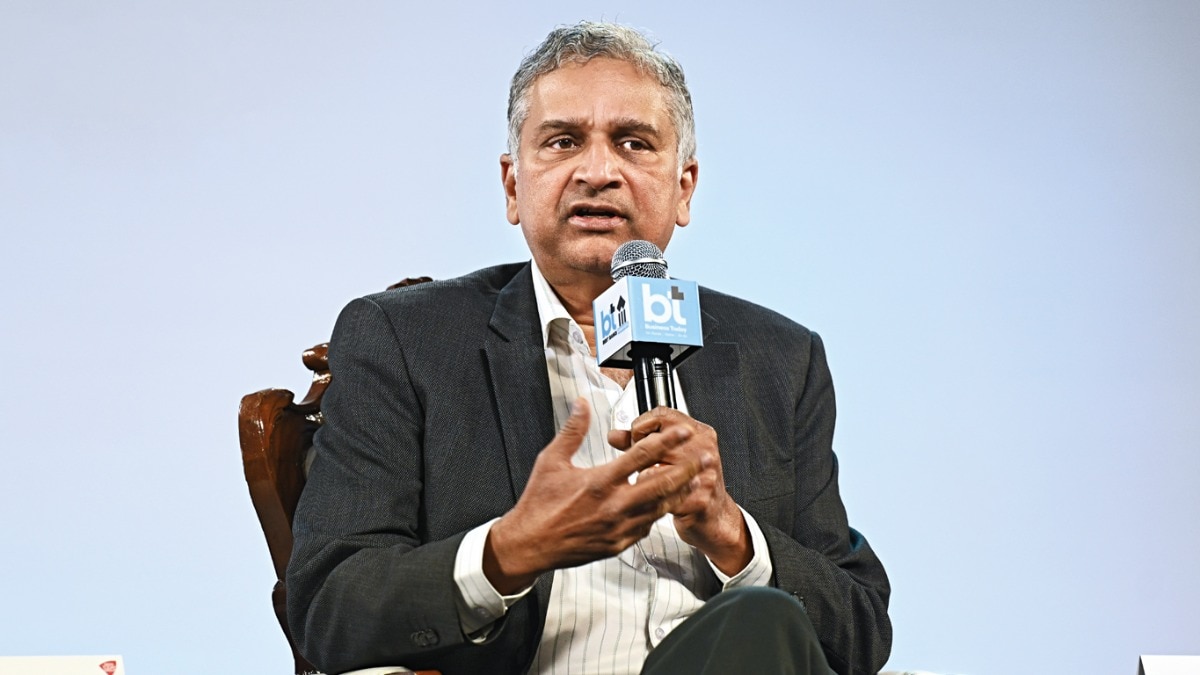
In an interaction with Business Today, Madan Sabnavis, Chief Economist, Bank of Baroda, talks about the factors behind India Inc’s performance and why forex volatility is a persistent concern for Indian companies, especially since Donald Trump became the US President. Edited excerpts:
How do you assess the overall financial health of India Inc?
The financial health of India Inc has improved significantly in recent years. One of the key indicators of this is the interest coverage ratio, which has remained steady at six-seven times. That’s a strong signal that corporates are comfortably meeting their interest obligations, despite operating in a high-interest rate environment, especially with the repo rate being at elevated levels over the last couple of years.
While corporate profitability hasn’t been uniformly strong—owing to sector-specific demand challenges—the overall improvement in the interest coverage ratio reflects financial resilience.
This trend is further supported by the low levels of non-performing assets (NPAs) in the banking system, which indicates that the repayment capacity has remained robust.
Are Indian companies better equipped to handle global shocks?
When we talk about global tensions, one of the biggest challenges for Indian corporates is the volatility in foreign exchange rates. While global commodity prices—barring crude oil—have largely been stable and are even trending downward in 2025, forex volatility remains a persistent concern, especially since the time of the Trump administration.
The cost of hedging has become a critical issue, and many Indian companies don’t maintain fully hedged positions, which leaves them exposed to currency fluctuations. While Indian industry is predominantly domestic-focused and somewhat insulated from global trade shocks, certain export-oriented sectors—like pharmaceuticals, gems and jewellery, readymade garments, and to some extent electronics—could still face the impact of global tariff barriers or demand shifts.
While India Inc. is relatively insulated, the risks are real and sector specific.
Employee costs grew by 7% in FY25, the lowest in four years, compared to 13-16% growth in the previous three years. What explains this slowdown?
There has been a lot of concentration in terms of controlling overall costs. This includes employee costs also. We have not seen companies normally giving double-digit increments. That is something that has slowed down.
Second, if you look in terms of overall hiring at various levels, it also shows a mixed pattern. Not all companies are hiring. For example, several IT companies are opting for layoffs. When you have a layoff, people who earn a higher salary tend to get laid off. All these factors have actually combined to bring about slower growth in terms of wage or salary bill.
Do you think the Reserve Bank of India’s (RBI’s) rate cuts will finally push corporate profitability and investment plans in the ongoing fiscal year?
The impact of rate cuts will depend largely on demand environment across specific industries. In infrastructure-linked sectors—such as steel, cement, chemicals, and capital goods—where demand remains strong, we can expect a pickup in investment activity. These sectors are already witnessing robust demand, and lower interest rates could further support their capex plans.
However, when it comes to consumer-oriented industries, the story is different. Over the past couple of years, inflation has dented urban consumption, and many of these companies are still operating with surplus capacity. So, for them, a cut in interest rates alone may not be sufficient to trigger fresh investments unless demand picks up meaningfully.
Why has sales growth slowed over the past two years, and what kind of topline and bottom line performance do you expect from India Inc in FY26?
The slowdown in sales over the past two years is largely a result of the post-Covid adjustment. Initially, there was a strong pent-up demand in manufacturing, but that eventually peaked and began to taper off, led by high inflation. Later, we witnessed a surge in demand for services like travel and tourism, which continues to some extent even now.
This uneven recovery has created phases where topline growth was strong but profit margins were under pressure, and later, when profits improved, topline growth became subdued.
Looking ahead to FY26, with inflation expected to decline—possibly to 3.7–3.8%—the pricing pressures should ease. This, coupled with a gradual revival in consumption, could support revenue growth for companies.
@iamrahuloberoi













