












Gujarat has long been at the heart of India’s industrial story. Now, as India seeks to accelerate manufacturing and become a developed economy by 2047, the state is looking to extend that advantage into a new generation of industries.
Business Today’s India@100 research ranks Gujarat as India’s top manufacturing state. Its manufacturing gross value added (GVA) has risen from nearly `2 lakh crore to more than `4.4 lakh crore in 10 years. The state has built on traditional strengths such as chemicals, pharmaceuticals, textiles, engineering, gems and jewellery and ceramics, while expanding its focus to semiconductors, electronics, electric mobility, green hydrogen and other emerging sectors.
Gujarat is also seeking to leverage the reconfiguration of global supply chains while strengthening its MSME ecosystem and preparing workers for technology-intensive manufacturing. Its latest policy push includes the Viksit Gujarat Industrial Policy 2026 and the Viksit Gujarat Data Centre Policy 2026-29, which seek to marry advanced manufacturing with digital infrastructure.
In an interview with, Gujarat Chief Minister Bhupendra Patel explains what has driven the state’s manufacturing leadership, why execution and governance matter in the competition for investment, and how Gujarat sees its role in the Viksit Bharat@2047 journey. Edited excerpts:
Q: Business Today’s research has ranked Gujarat as India’s top manufacturing state. What are the policy decisions that helped the state achieve leadership?
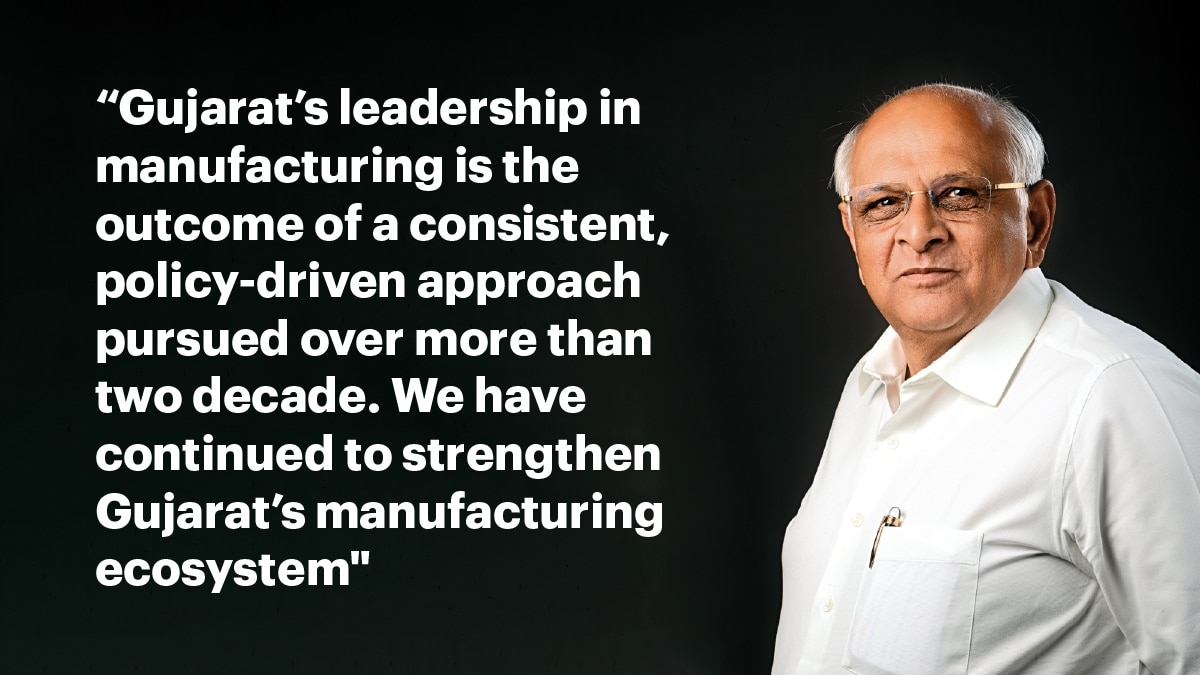
A: Gujarat’s leadership in manufacturing is the outcome of a consistent, policy-driven approach pursued over more than two decades. Building on the strong foundation laid by Prime Minister Shri Narendra Modi, we have continued to strengthen Gujarat’s manufacturing ecosystem through progressive policies and sustained reforms.
A key driver has been the Gujarat Industrial Policy 2020, complemented by sector-specific policies for high-growth industries such as semiconductors, electronics, biotechnology, space technology, renewable energy, green hydrogen, IT/ITeS, GCCs, textiles, shipbuilding and tourism.
We have also strengthened ease of doing business through single-window clearance mechanisms, simplified regulatory processes and decriminalised more than 500 provisions under the Gujarat Jan Vishwas (Amendment of Provisions) Act, 2025. Sector-specific industrial parks through GIDC, early adoption of public-private partnerships for ports and infrastructure, and reliable power supply have further enhanced the state’s competitiveness.
Initiatives such as the Vibrant Gujarat Global Summit have created a platform for global investment and collaboration. Going forward, the Viksit Gujarat Industrial Policy 2026, aligned with Viksit Bharat@2047, will further accelerate industrial growth, promote innovation and generate employment.
Q: Our research shows Gujarat’s manufacturing GVA has grown from nearly `2 lakh crore to over `4.4 lakh crore. What has driven this remarkable growth?
A: This is the result of a long-term strategy built on three key pillars: industrial diversification, large-scale investments and cluster-based development.
First, we have diversified beyond traditional strengths such as chemicals, pharmaceuticals, textiles, engineering, gems & jewellery and ceramics. We are now supporting emerging sectors such as semiconductors, electric vehicles, green hydrogen, electronics, aerospace and defence.
Second, Gujarat has attracted transformative investments across these sectors, creating new manufacturing capacities, strengthening supply chains and encouraging ancillary industries.
Third, our cluster-based approach has facilitated specialised industrial ecosystems across the state, improving productivity, encouraging innovation and integrating MSMEs into domestic and global value chains.
This has been supported by policy stability, world-class infrastructure, efficient logistics and ease of doing business, giving investors the confidence to establish and expand their operations in Gujarat.
Q: Gujarat has also emerged as India’s largest manufacturing investment destination. What differentiates it from other states competing for industrial investments?
A: Gujarat’s competitive advantage lies in policy stability, swift decision-making and a large, well-integrated industrial ecosystem. Investors choose Gujarat for its efficient administration, skilled workforce and integrated industrial ecosystem. It offers structural advantages, including India’s longest coastline of about 2,340 km, a robust port network, industrial clusters, reliable power supply, strong road and rail connectivity, high renewable energy potential and a proactive single-window clearance system.
Between January 2000 and March 2026, the state attracted cumulative FDI worth $74.6 billion. It is ranked top in NITI Aayog's Investment Friendliness Index 2026 and contributed nearly 25% of India’s merchandise exports.
Q: The state is also India’s export champion. How much of this success do you attribute to Gujarat’s ports, logistics infrastructure and industrial corridors?
A: Gujarat’s position as India’s leading export hub is anchored in its ports, logistics infrastructure and integrated industrial corridors. Today, 39% of the country’s cargo is handled through Gujarat.
This advantage is reinforced by Dedicated Freight Corridors, expressways, inland container depots and multimodal connectivity, enabling faster cargo movement, lower logistics costs and greater supply-chain efficiency. Gujarat has also developed manufacturing ecosystems through Special Investment Regions such as Dholera and Mandal-Becharaji, the PCPIR, Special Economic Zones, logistics parks and sector-specific industrial clusters.
Q: As global companies look to diversify supply chains beyond China, how is Gujarat positioning itself to capture a larger share of global manufacturing?
A: As companies increasingly adopt the China+1 strategy, they are looking for destinations that offer resilience, reliability, scalability and policy certainty. Gujarat is well positioned to meet these expectations.
Our strategy is to develop globally competitive manufacturing ecosystems rather than standalone industrial projects. Through initiatives such as Dholera Special Investment Region, the Delhi-Mumbai Industrial Corridor, plug-and-play industrial infrastructure, integrated multimodal logistics and smart industrial townships, we are creating an ecosystem that enables global manufacturers to establish and expand operations with confidence.
At the same time, Gujarat is emerging in future-ready sectors such as semiconductors, electronics, electric mobility, advanced materials, renewable energy and green hydrogen. With ready industrial land, reliable power, efficient logistics, skilled talent and streamlined regulatory processes, it offers global investors what matters most: speed, scale and certainty.
Our vision is clear: Gujarat is not only a manufacturing destination for India but a preferred manufacturing destination for the world.
Q: The next wave of manufacturing will be driven by sectors like semiconductors, electronics, EVs, batteries, green hydrogen and aerospace. Which sectors do you believe will define Gujarat over the next decade?
A: Gujarat’s next phase of industrial growth will be anchored in scale, technology, sustainability and inclusion. While it will continue to lead in chemicals and petrochemicals, pharmaceuticals, engineering, textiles, ceramics, gems and jewellery, and agro and food processing, the next decade will be defined by strong growth in semiconductors and electronics, aerospace and defence, advanced manufacturing, AI and data centres, biotechnology, medical devices, and the green energy and electric mobility ecosystem.
Gujarat is well positioned to emerge as a global hub for technology-driven manufacturing and contribute meaningfully to Viksit Bharat@2047.
Q: MSMEs form the backbone of manufacturing. What is the government's strategy to help MSMEs become globally competitive?
A: MSMEs are the foundation of Gujarat’s industrial growth. With more than 4.2 million MSMEs, our strategy centres on improving access to technology, finance, quality certification, market linkages, exports and digital transformation, while promoting Industry 4.0 and AI adoption.
Through initiatives such as Udyami Mela, capacity-building workshops, AI demonstrations and Reverse Buyer Seller Meets, MSMEs have gained greater technology exposure and direct access to global markets. More than 10,800 B2B meetings generated export business enquiries worth over `1,680 crore.
The Viksit Gujarat Industrial Policy 2026 further strengthens this ecosystem through targeted support for MSMEs, start-ups, women entrepreneurs and first-generation industrialists.
Q: India has set an ambitious goal of becoming a developed nation by 2047. What role do you see Gujarat playing in achieving that vision?
A: Gujarat is a committed partner in India’s journey towards Viksit Bharat@2047. States will be the real engines of India’s economic transformation, as land, infrastructure, skilling, local governance and investor facilitation are largely driven at the state level.
Gujarat aims to contribute through leadership in manufacturing, exports, ports and logistics, financial services, renewable energy, innovation and inclusive regional development.
Q: Several states are now offering incentives to attract industries. Does Gujarat still believe incentives are the biggest differentiator, or has governance become the real advantage?
A: Financial incentives may attract initial interest, but governance is what ultimately drives investment decisions. Today, investors place equal, if not greater, importance on policy stability, regulatory transparency, speed of approvals, quality infrastructure, land availability and post-investment support. Gujarat’s experience has consistently shown that responsive and predictable governance creates a far stronger competitive advantage than incentives alone.
This is reflected in our single-window clearance system, time-bound approvals, efficient project monitoring and strong inter-departmental coordination. By developing plug-and-play industrial infrastructure, sector-specific industrial parks and ready utility networks, we have significantly reduced project implementation timelines.
Our track record speaks for itself. The Micron semiconductor project progressed from the signing of the Memorandum of Understanding to groundbreaking within just three months. Going forward, we will further strengthen this ecosystem through data-driven decision-making, AI-enabled project monitoring and deeper industry engagement.
Q: Gujarat has recently launched the Viksit Gujarat Industrial Policy 2026 and the Viksit Gujarat Data Centre Policy. How do you see these helping the state maintain its current position?
A: These will strengthen Gujarat’s leadership while positioning the state as a global destination for advanced manufacturing, innovation and the digital economy. Together, they mark the next phase of Gujarat’s growth journey—from India’s manufacturing leader to a global hub for the industries of the future.
The Industrial Policy introduces a more flexible and industry-centric approach. Through the “Choose Your Incentive” framework, industries can opt for a customised combination of capital subsidy, interest subsidy or power tariff reimbursement based on their business requirements. The policy focuses on 21 thrust sectors while promoting R&D, innovation, value addition and high-quality employment. It also supports women entrepreneurs and first-generation industrialists through targeted incentives, skill development and enhanced support mechanisms. Complementing this, the Data Centre Policy targets investments of up to `6 lakh crore and 7.5 GW of data centre capacity.
@bhutanichetan


