
IIM Ahmedabad has again secured the top position in BT-MDRA Best B-schools Survey 2026-27, extending a legacy of excellence built over six decades. But staying at the top year after year demands continuous adaptation as competition intensifies and the landscape of management education evolves.
As artificial intelligence reshapes industries and redefines the skills future leaders need, how is India’s most respected business school preparing for the next era of management education?
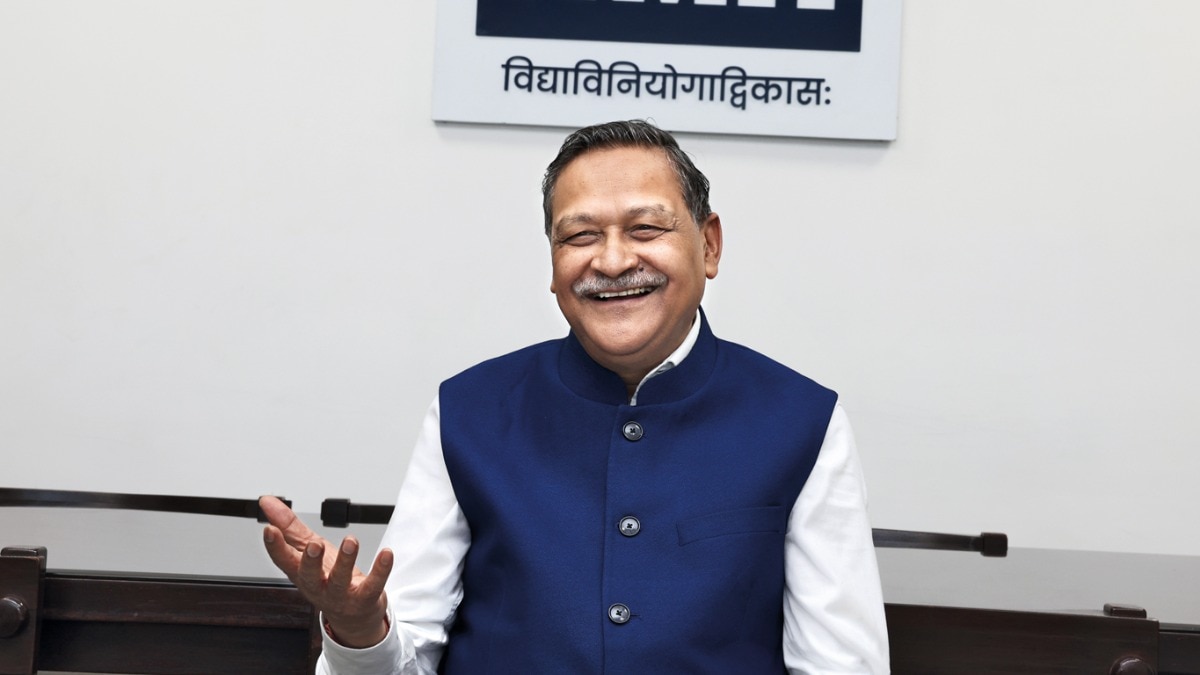
Leading this transformation is Professor Bharat Bhasker, Director of IIM Ahmedabad. An information technology leader with nearly three decades of experience across industry, research, teaching and consulting in India and globally, he took charge of the institute in March 2023.
In this conversation with Business Today, he discusses how IIM Ahmedabad is preparing students for the future, why judgement will become a defining leadership skill in the AI era, and how Indian business schools can shape global management thinking. Edited excerpts:
Q: What does it really take to stay at the top year after year, given the competitive dynamics in management education?
Thank you. It is gratifying to know that we are maintaining our course. There will always be challenges, but our focus remains on our main goal: creating leaders for the corporate sector in India. That requires attention to three or four key areas.
The first is investing in faculty and keeping them motivated, because ultimately an institution is nothing but a group of faculty members. The second is that research impact must be significant—the aim is that our research is referenced by industry, rather than papers being published for their own sake. The third is our alumni network. We are also occupied with the question of what management education will look like in the next 10 to 20 years, what transformations are occurring in industry, and the likely impact on management education. We continue to reinvent the MBA before it needs reinventing—this has been one of the fundamental aspects of our approach. We prepare management graduates for 10 years down the line, so in 2026, we are educating them for 2036. That mindset is probably what distinguishes us from many other management schools and makes us a unique institution in the country.
Lastly, there is our international focus. Over the past five decades, our output was oriented toward the Indian marketplace, but our graduates have also performed exceptionally well globally.
Q: Given the conflict in West Asia, has there been any impact on the goals of your first foray into that region?
Yes, it has had an impact, mainly due to the uncertainty in February and March. We have had to bring our batch back from Dubai to India, and for two months they studied here because we were unsure which way the situation would unfold. In April, they returned to Dubai, and it took us another month or so to settle back in.
Our faculty continue to teach there happily, and students are finding jobs in that market—placements have been quite good. I would not like to give exact numbers, as releasing them is the placement chairperson’s prerogative, but I can say the salaries and roles our students are securing are very competitive.
Our foray is still on track. We are launching a two-year weekend MBA programme, because we found that many people in that market are immigrants from various countries who cannot leave their jobs to join a full-time, one-year MBA programme.
Q: Our survey suggests that overall admissions to business schools, including some IIMs, have been a little muted this year. What factors are at play here?
The factors at play mainly concern the top 30 or 40 management institutes—the ones producing genuine corporate leaders, out of roughly 50 or 60 institutes overall contributing to management education in the country. Among the top 20, I would not say there is significantly less interest. Overall, the CAT-taking population has decreased, and this has much to do with an overall shift from management towards technology.
We have already responded by introducing an MBA in business analytics and AI, which has drawn a great deal of interest. Many technically inclined candidates are now seeking an MBA that combines people management, financial management and leadership training with a strong grounding in technology, and are gravitating toward such techno-oriented or AI-oriented MBA programmes rather than a conventional one. So, the earlier mad rush towards MBA education is easing, while those genuinely inclined towards and suited to management education remain in the pool.
Q: You spoke about the relevance of management education. Is the MBA relevant, and will it continue to be so?
The MBA will always be relevant, though its content will keep changing. Compare the content of an MBA in the 1970s with one from 2000-2010, or with today’s—they are vastly different. Earlier curricula were dominated by manufacturing, distribution and logistics in a traditional sense. With the arrival of e-commerce, the business environment absorbed it, incorporating data and technologies such as RFID into supply chains, and a great deal of technology became embedded in MBA education. Without much fanfare, the post-2000 MBA reinvented itself.
Today, we must plan for leadership in an AI-enabled environment, and today’s MBA curriculum has to adapt and shift its focus accordingly. This transformation is somewhat steeper than the previous one, because in the earlier shift, information was abundant and a good manager’s skill lay in extracting knowledge from it. Today, knowledge itself is becoming abundant, so the managerial capability that matters most is judgement.
So, MBA education must shift from being about acquiring knowledge to developing judgement.
I would also add that a common response to AI in management education today is simply to add a course—‘AI for managers’ or ‘AI for marketing’. I do not believe that is how AI will transform management education. The shift needs to be more fundamental: shifting the domain entirely towards problem-solving, with AI as an enabling technology that provides more knowledge and helps solve the problem as a whole, rather than producing merely “AI-aware” managers through add-on courses. Institutions need this fundamental shift in management education for it to remain relevant, otherwise managers and AI-technology heads will end up competing for the same leadership positions, with equal opportunity to win them.
Q: Our survey reveals that among the top 25 business schools, the student mix has changed. The number of engineering graduates has fallen while non-engineers have risen. What kind of results is this shift delivering?
I will answer this in two parts: IIM Ahmedabad, and the rest of management education in India. We have always focused on a class mix that was not dominated by any single sector. Historically, our mix has been around 60% engineers and at least 40% from commerce, chartered accountancy, law, medicine, and other professions. Solutions and thinking improve when case discussions include people from varied backgrounds.
The second factor is that other management institutes have recognised that IIM Ahmedabad’s classroom mix is central to why it continues to produce more corporate leaders than most, and many are now adopting their own diversity mechanisms to bring in more non-engineers. This process began roughly 10 to 15 years ago, around 2010, and its results are increasingly visible.
Q: Indian B-schools have produced globally successful leaders and CEOs. But beyond leadership talent, how are they contributing to global management thinking through original research and thought leadership? What more ideas are needed for Indian B-schools to have a stronger global influence?
This is a very apt question. For the first 40 years, Indian management education focused on creating and grooming managers to solve local, Indian industry problems, but without documenting that work to the extent Western schools have documented and built frameworks.
Only about 20 years ago did Indian management schools take this turn, recognising a responsibility to also contribute to and document their work, rather than remain followers who simply learned from others’ frameworks. This is what we today call research and publishing, and it was really seeded only around 20 years ago. We are beginning to see the impact: frameworks emerging from Indian research are increasingly being used within India, even if the Western world has not readily adopted them yet.
I believe that if we stay on this path, it will take another 15-20 years for the world to begin recognising this work more widely, as our economy grows and our solutions are adopted globally rather than the reverse. It is not that Indian management schools are not doing the research, our priorities were not aligned with documentation and publication. We started this documentation process quite late and are now working on it, and within another decade, we should begin to see Indian management thinking penetrating and being adopted globally.
@szarabi
Read full interview on BT.in













