
As this special edition highlights, India’s manufacturing story is no longer defined by scale alone. It is increasingly being shaped by the ambition of companies, large and small, to build products across sectors, not only for India but for markets around the world.
The Business Today-Deloitte India study that forms the foundation of this company-focused edition captures this transformation in detail. Drawing on an analysis of more than 5,000 listed and unlisted firms, it ranks nearly 700 manufacturers and provides a comprehensive view of how India’s manufacturing landscape has evolved over the past decade.
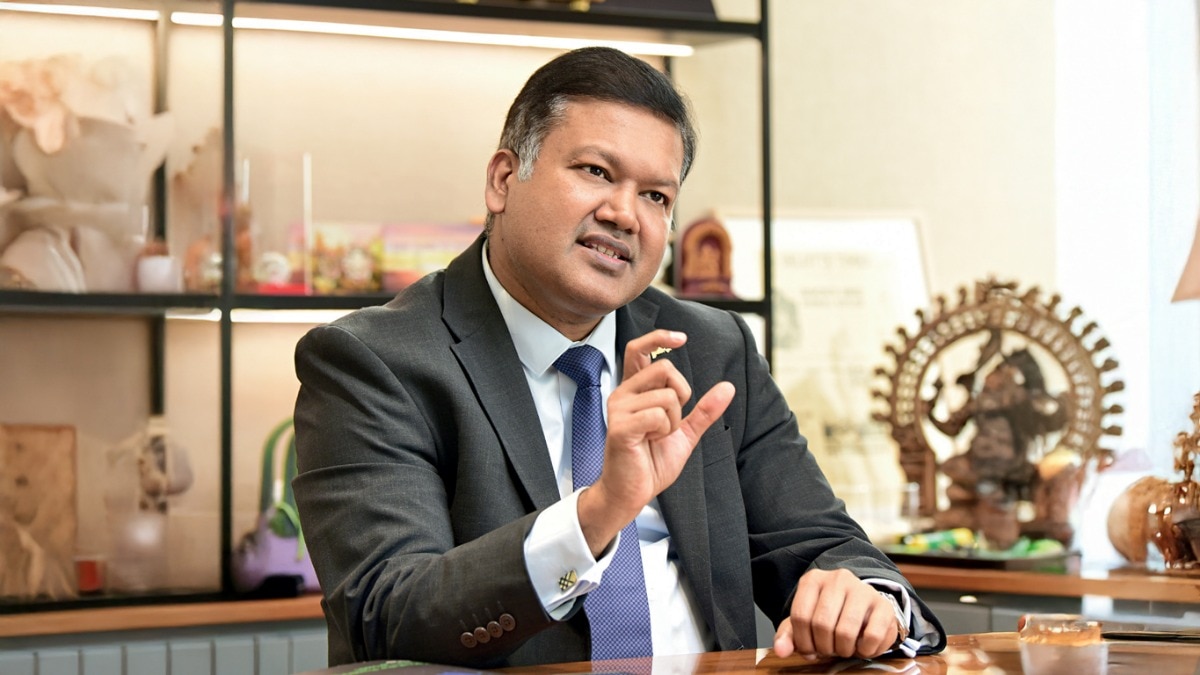
Against this backdrop, Siddharth Zarabi spoke with Romal Shetty, CEO of Deloitte South Asia and a member of Deloitte’s Global Executive Committee, to put these trends and numbers into perspective. Bringing insights from Indian boardrooms as well as global markets, Shetty discusses the next phase of India’s manufacturing journey and what it will take to translate the country’s growing momentum into sustained global leadership. Edited excerpts:
Having looked at this universe of companies, what does the data tell you?
What the study really does is point to the scale, profitability and financial discipline of the companies surveyed. The best manufacturers are not just growing bigger; they are growing in a way that funds their next phase of growth.
Three drivers stand out in this study. One is scale with purpose, which means building market position, not just volume. Then there is profitable growth—converting revenue into healthy margins and returns. And finally, financial discipline—generating cash, keeping debt under control, and reinvesting in capacity and innovation.
This is especially visible in sectors like electronics, automobiles and capital goods, where leading companies have created a virtuous cycle of growth, cash generation and investment.
And the interesting thing about the study is what it tells us about smaller and emerging manufacturers. The lesson there is: do not chase scale before building financial resilience.
So, strong balance sheets, disciplined cash management and investment in technology are what will enable these companies to compete globally.
Is Indian manufacturing at a genuine inflection point?
India has expanded its manufacturing capacity, investment and exports. The story over the last decade is one of meaningful structural progress, but there is some unfinished transformation. We have expanded capacity, attracted a lot of investment and built globally competitive industries. The next phase should focus on deeper value creation rather than volume alone.
The sectors where the transformation is real are technology-led manufacturing—whether it is electronics, semiconductors, automobiles, pharma or defence. These have evolved into strategic sectors and have been supported by advanced manufacturing, automation and digital technologies. India is increasingly positioned as a credible alternative in our global supply chains, with manufacturing exports becoming more diverse and globally competitive.
Then there is financial quality—our strongest manufacturers, and that can be seen in the study as well, are not just growing revenues but delivering higher returns, healthier balance sheets and stronger cash generation, reflecting good operational discipline.
And finally, there is a Global South opportunity, where India can become an engine of demand for manufacturing and innovation, supplying affordable products and industrial capabilities.
Where the ambition remains unfinished is domestic value addition. Much of the growth has come from assembly and capacity creation, but deeper localisation of components, materials and supply ecosystems is still evolving. Apart from this, the manufacturing sector’s contribution to GVA has broadly remained flat—17.2% in FY14 and 17.5% in FY24. So, in 10 years, there has not really been the kind of expansion at the scale that was originally envisaged.
Third is the value unlock. The next decade will be defined less by creating more factories and more by unlocking productivity through R&D, design, intellectual property and higher-value manufacturing.
The opportunity now is to move from being a competitive production base to becoming a globally significant, value-creating economy.
What needs to change to move from an assembly-led model to a deeper self-sustained manufacturing ecosystem in India?
A couple of things. India needs to have greater domestic value addition to build its own deeper manufacturing ecosystem. The encouraging sign is that productivity is improving. The companies analysed in the study show that earnings have grown faster than sales and assets, suggesting that manufacturers are becoming more efficient, more profitable and better at deploying capital. But value addition remains uneven. Even in sectors like electronics, which is a remarkable success, domestic value addition is still estimated at 18-20%. This highlights that a sizable portion of the value chain, from components and materials to design and intellectual property, continues to sit outside India.
Another key element is strategic autonomy. It is important that we have areas where we are completely independent, build everything, and certain areas where we are strategic and have collaborations with countries with resilient supply chains.
Both are needed because you cannot change things overnight. It is a long journey, and no one country has all the components.
To move towards a deeper manufacturing ecosystem requires a shift on four fronts. First is building complete industrial value chains by localising components, materials and the supplier ecosystem rather than only final assembly.
The second is competing through technology, with greater investment in research and development to do more in advanced engineering, automation, tooling and intellectual property.
Third is the need to strengthen smaller manufacturers so that they also become globally competitive suppliers.
And finally, position India as a Global South manufacturing hub, creating products and industrial solutions designed not only for developed markets but also for the fast-growing economies of Asia, Africa and West Asia.
These are the four things that would be a good change to move away from this assembly-led model to a deeper manufacturing ecosystem.
Will geopolitics continue to be a key driver and function as an impetus to broaden and deepen India’s manufacturing base?
Absolutely. There are a host of things that companies must contend with today that they did not over the past three to four decades. Supply chains are constrained today. Wars are going on, and that means there is a risk that supplies could stop immediately. Therefore, for companies, geopolitics has become one of the top two or three concerns to consider and be mindful of.
That is why strategic autonomy is important. We know that everything cannot be designed, developed, sourced or produced in India. Earlier, the idea was—I would source it from anywhere in the world. The world is my playground. But today that is not the case.
What should medium and small companies do in such a situation?
A combination of things, really. For instance, mapping the entire component value chain and asking where this comes from. Companies need to broaden their horizons and ask whether we have multiple options. This is especially important.
They also need to put their hand up and do some localisation and not depend on everything being sourced from elsewhere.
They should undertake backward and forward integration to see which parts of the value chain they can produce on their own.
Scaling up also makes a difference.
So, if they can do some of these things, smaller companies can manage the crises brought about by geopolitical issues or tariffs, among other things.
Do you think companies will continue to remain competitive once the production-linked incentive (PLI) schemes reach the end of life?
The PLI schemes have helped in several sectors. There is no doubt about that.
Incentives, as you know, create the initial scale. But long-term competitiveness really depends on costs, technology, domestic value addition and export demand. These are particularly important.
What the PLI has done is accelerate capacity. By March this year, the schemes had attracted more than Rs 2.4 lakh crore investment across 14 sectors. That is satisfactory.
But now it must become self-sustaining. Companies need to be competitive on unit costs, have reliable quality and sufficient capacity utilisation without depending on incentives.
The real transition is also moving from assembling products to controlling components, processes, technology and customer relationships.
Companies should use AI and, where relevant, even digital twins, especially in manufacturing, to improve product design, production yields, quality and capacity utilisation. This helps reduce costs.
If the PLI support is being used as a subsidy, it will be a big challenge when it ends.
But if a company has built some of the things that I mentioned and reached a particular scale, it will be okay.
What is required to further increase ease of doing business to boost manufacturing?
There are some states that do it well. Today, to open a manufacturing hub, you need multiple approvals from multiple departments, ministries and others. Some states have brought all of that together in one place, and there is one coordination officer who facilitates the entire thing. Nobody needs to run around to 15-20 ministries to figure things out. This is a small but important example.
Second, if there are subsidies and incentives, sometimes it is difficult to get those incentives because the number of forms you must fill, the number of returns you must file—all that takes a lot of time.
So, simplifying this is important. Two committees are there for further easing and removing regulations. This should be put on an even faster track.
The experience should be that you enter the country, you enter a state, and everything is completely managed as a one-stop shop. More approvals should be given digitally—if you meet the policy requirements, the process should be done, with no human interaction at all.
Which sectors will create next generation global companies from the manufacturing space?
Among the promising sectors is electronics. Defence and aerospace offer a tremendous market opportunity—for domestic consumption as well as exports. And then, industries like pharma, automobiles and electric vehicles, industrial machinery, specialty chemicals and clean energy equipment are really where I see promise. Importantly, these companies need to build right, and again, as our study indicates, there needs to be proprietary technology, product engineering, reliable global networks and global quality standards.
And of course, from a financial point of view, all the expansion should be supported by returns, manageable debt and operating cash, and not just scale alone.
Compared with China or other countries, do we have it in us to become a sizable manufacturing player?
Obviously, a comparison with any other country, including China, is difficult today. But from a pure entrepreneurship spirit and capability perspective, in some areas like aerospace or medtech, we manufacture real deep technology. So, it is not that we cannot manufacture. Secondly, India does have domestic demand as well.
So, if you look at entrepreneurship, domestic demand and frugal innovation, there is some serious talent in the younger generation. This is of a different generation. I am optimistic that India can become a large global manufacturing economy.
@szarabi













