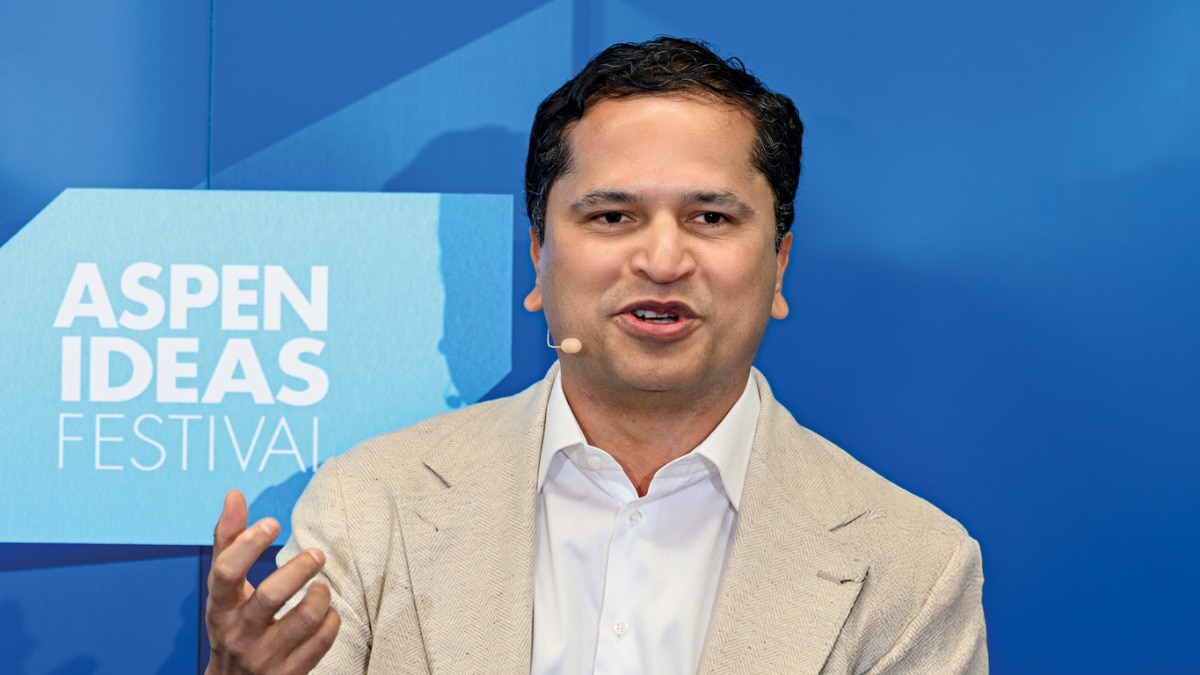
Asutosh Padhi, an IIT and IIM graduate, is the Chicago-based Senior Partner and Global Leader for Firm Strategy at McKinsey & Company. In an interview with BT, he talks about how companies can navigate the many disruptions they face at this moment. Edited excerpts:
With the global economy in a state of flux, what are you hearing from CEOs of global companies about their concerns?
The I have been spending a lot of time with CEOs around the world, and I would say that two topics are consistently on their minds. The first one is geopolitics, given all the uncertainty around tariffs and trade. The second is Artificial Intelligence (AI) and its disruptive impact. We are at the very beginning of what we are going to witness with AI. It’s going to be one of the most important forces of our lifetime.
Regarding geopolitics, what we’re telling CEOs is, one, to have a perspective around what is the implication for your particular institution. We call
This a value creation thesis. What does it imply in terms of your strategy, your customer footprint, your supply chain, and your operating footprint.
Our view is that the fastest learners will win. So, what are the things CEOs and institutions need to do to start realising the real benefits from AI? And do so in a very practical approach as opposed to a long-term multi-horizon planning.
I assume that Indian companies are not as evolved as some global companies. Is that correct and what are you hearing from the Indian business leaders?
Let me start with the adoption of AI globally. Globally, just about 10% companies are starting to see real business outcomes from AI, meaning top line revenue growth, margin improvement, cash flow improvement, customer satisfaction, employee satisfaction, etc. Some of those companies are definitely from India.
In my conversations with CEOs I realise that the best companies are starting to frame AI not as a technology opportunity, but as a business opportunity. So, they’re asking the business unit leaders to come back and say, “What are the applications of AI and how do you start to see this?”
You and your colleagues have pioneered the concept of the ‘Titanium economy’. What is its relevance for Indian business groups?
I think the titanium economy concept is actually very relevant to India. We started to look at which companies fundamentally drive innovation in the US. There is a lot of focus around the technology companies. What we noticed was that there was another segment where real innovation happened. These are about 6,000 companies and 80% of them are privately owned. And these are typically much smaller. But they work on products that are really important.
We call them titanium companies because they are durable, resistant, around us, and yet you don’t see them. They drive about 60% of R&D and about two-thirds of the exports from US from a manufacturing standpoint.
Now, why is this concept relevant to India? Because these are companies that typically are focused around specific areas with deep specialisations. These are not the most capital-intensive industries.
But they are companies that start to build distinctive brands, products, and technologies, and that is why I think this idea about focusing on an area to drive world-class levels of productivity and competitiveness is good. I think it would be terrific for both India and the world if the country was to have a thriving titanium economy.
What are the major challenges McKinsey has faced in the last 100 years?
There are very few institutions, and especially professional services institutions, which turn 100. We feel incredibly fortunate and privileged to be part of such an institution. Let me start with what doesn’t change: our mission. It is around how do we continue to help clients make substantial improvements in their performance, and second, how do we continue to attract the best talent.
When I joined McKinsey, we were largely an institution with private sector clients. Fast forward 30 years and we now serve the private, social and public sectors.
Our global footprint has expanded. Our range of capabilities has expanded from strategy to operations, technology and transformation. Going forward, there are two or three things that we’re working on right now.
One is distinctiveness, which is how does McKinsey continue to be stand for pre-eminence, always solving the toughest problems with the world’s best talent. The second is repositioning ourselves for the age of AI and saying, how do we really make that the next big chapter for us. And the third one is continuing to evolve and work on our talent model.













