The performance of most diversified
Indian equity funds has been poor compared to returns that the international markets have given since last year. Between July 27, 2010, and July 27, 2011, funds focusing on international markets have returned 15% on an average compared to the 2% return given by Indian large- and mid-cap equity diversified funds as well as the Bombay Stock Exchange Sensex.
Harshendu Bindal, president, Franklin Templeton Investments (India), says developed markets have done well in the last one year due to attractive valuations and hope of faster economic growth. "The Indian market has underperformed due to tepid foreign institutional investor inflows on the back of strong headwinds (inflation, corporate scams, high interest rates and policy inaction)," he says. The US market, for instance, has given 12% returns between August 2010 and August 2011. Hong Kong, Korea and Taiwan have returned 9.2%, 14.2% and 8.5%, respectively.
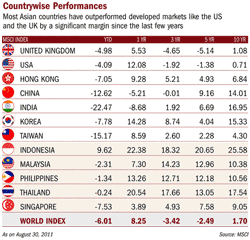
Countrywise Performance
What is notable is the performance by countries in the Association of South East Asian Nations, or Asean, region, which led in returns. For example, Indonesia has returned 22% in the last one year, while Thailand has returned 20%.
(See Countrywise Performances)MUST READ:
Research before investing in policies THE PROPELLANTAs the global economy faced turmoil, emerging markets, especially those in Asia, showed resilience and posted large gains. Bindal says higher economic growth and healthy banking systems in most Asian countries should help them capture a higher share of global output. "The economies of the region are better placed due to lower leverage, high savings and rising consumption," he says.
However, not all Asian funds have done well. One reason is the underperformance by China and India. Take Franklin Asian Equity Fund, which has returned 8% between July 27, 2010, and July 27, 2011. This is far below the 20% return given by DSPBR World Gold Fund, DSPBR Energy Fund and ING Optimix Global Commodities Fund.
ASEAN ADVANTAGEArindam Ghosh, head, retail sales, J.P. Morgan Asset Management, says the Asean region is in a sweet spot as apart from being rich in natural resources, the countries there have low debt. Besides, their fast population growth will fuel consumption. They are also increasing spending on infrastructure.
"The Asean region is in a sweet spot as apart from being rich in natural resources, the countries there have low debt."
Arindam Ghosh
Head, Retail Sales, J.P. Morgan Asset Management
|
For instance, Indonesia is among the top 5 countries in mining potential, has the world's fourth-largest gold reserves and is the world's largest thermal coal exporter. Singapore is a large financial services hub with a lot of liquidity and a thriving tourism industry. The region is likely to become a powerful economic bloc by 2025, when it is expected to be the 6th largest in terms of gross domestic product.
"From the Asia Pacific growth standpoint, the Asean region will be next to India and China, with a big overlap with India in terms of young population and consumption," says Ghosh. Like India, the region-especially the Philippines and Thailand-offers cheap labour, which makes it strong in outsourcing.
Tushar Pradhan, CIO, HSBC Asset Management (India), says the region is big in manufacturing, with the West being the main consumer. It got a huge impetus after the global financial crisis in 2008 when central banks around the world gave incentives to boost consumption. "This fuelled economic growth, which spurred manufacturing in the Asean region," says Pradhan.
However, with financial stimulus ending, consumers in the West may not have the same ability to spend, especially with an unemployment rate above 9%. So, the question is whether the growth in the region can be sustained? The silver lining, says Pradhan, is that these countries have large economies and are increasingly trading among themselves.
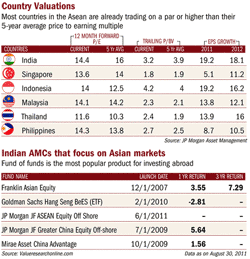
Country Valuations
The markets in the Asean region have risen significantly in recent months and seem to be close to their fair valuations
(See box on Country Valuations). Indonesia, Malaysia and Thailand are close to or above their average 5-year price to earning, or P/E, multiple.
Ghosh says one must invest in these markets not for valuations alone but also look at the expected corporate earnings growth of 15-16%. The Institutional Brokers Estimate System-a service which gives data on corporate earnings- expects that the region is set for a fair degree of upgrades. In contrast, corporate earnings growth in India, which was 22-23% a few quarters ago, has moderated to 17-18%, with chances of further downgrades, says Ghosh. In China, too, the growth in corporate earnings has been just 15-16% in the last few quarters.
At present, the only way Indian investors can take part in the Asean growth story is through JPMorgan JF ASEAN Equity Off-shore Fund. It buys units of JF ASEAN Fund, which primarily invests in companies of countries that are members of the Asean. As on April 2011, the fund saw a compounded annual growth rate of 19% based on a five-year record of
investing in the Asean region.
ASIAN CANVASAlthough the region offers attractive opportunities, Bindal says investors must focus on long-term trends and fundamentals of companies rather than the overall economic growth. He says from a medium- to long-term perspective, funds offering overall Asia exposure instead of just focusing on Asean have the potential to deliver better risk-adjusted returns.
Further, one could look at China, where valuations are among the lowest. The country is trading at 11 times earnings compared to its long-term average of 14 times. Stocks of real estate companies in China have been beaten down to 50% of their net asset value, while banks are trading at 9x forward earnings. With fears of the economy worsening overstated, low valuations and expected earnings growth of 15-16%, China is a great investment for the short to medium term, says Ghosh.
"The economies of the Asian region are better placed due to lower leverage, high savings and rising consumption."
Harshendu Bindal
President, Franklin Templeton Investments (India)
|
There are various China dedicated funds on offer. These include Mirae's China Advantage Fund and JF China Equity Off-shore Fund. Investors can also put money in Hang Seng Bees, an Exchange-Traded Fund offered by Benchmark Asset Management which invests in Hang Seng constituents (Hong Kong Stock Exchange).
"Further, if we look at the performance of indices of various countries over long periods, say last 10-12 years, no single country has been the best or worst performer in any 2 consecutive years", says Ghosh.
This highlights the fact that various countries offer different growth opportunities in different ways at different points in time, making it imperative to diversify across countries and regions. "All investors should have a majority of their exposure to core, diversified funds that offer regional or global exposure and then move to country-specific or thematic funds," says Bindal.