1. Watching from the sidelines may cost you
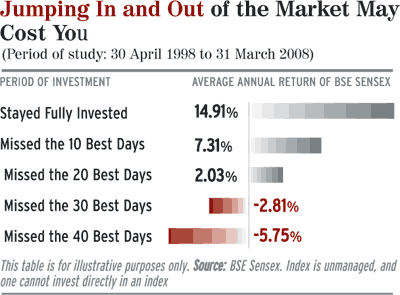
When markets become volatile, a lot of people try to guess when they will bottom out. In the meantime, they often park their investments in cash. But just as it is difficult to spot a declining market, many also fail to see an upward trend in the market until after they have missed opportunities for gains. Missing out on these opportunities can take a big bite out of your returns.
The graph above is a hypothetical illustration showing the risk of trying to time the market. By missing just a few of the stock market’s best single-day advances, your overall potential returns could reduce dramatically. India’s economic fundamentals remain strong and many global analysts expect India to emerge as one of the largest economies over the coming decades.This means that investments in wellmanaged companies are likely to deliver superior risk-adjusted returns over the long term.
2. Systematic Investing Makes It Easier to Cope with VolatilityMost people are quick to agree that volatile markets present buying opportunities for investors with a long-term horizon. But mustering the discipline to make purchases during a volatile market can be difficult.You can’t help wondering, “Is this really the right time to buy?”
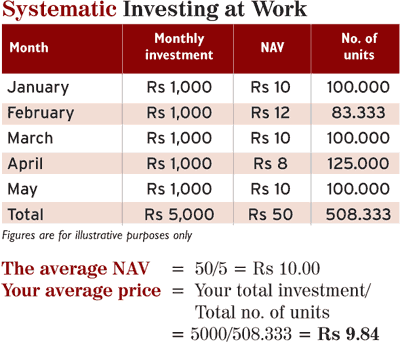
Systematic investing can help reduce anxiety about the investment process. Simply put, systematic investment plans using rupee-cost averaging, means committing a fixed amount of money at regular intervals to an investment.You buy more units when prices are low and fewer units when prices are high, and over time, your average cost per unit is likely to be less than the average price per unit. What you see from Table I is the fascinating aspect of systematic investing. It makes you buy fewer units when the price is high and more units when the price is low, thereby averaging out your cost, giving you the same discipline as investment professionals.While systematic investing does not assure you of a profit, it is known to have worked well for millions of investors throughout the world.
3. Tune Out the Noise and Gain a Longer-Term PerspectiveThe strong growth in the Indian economy and markets has resulted in plethora of information available through various media outlets, dedicated to reporting market news.While this helps investors in keeping abreast of market developments, following market movements on a day-today basis could result in a very short-term outlook. To put your own investment plan in a longerterm perspective and bolster your confidence, you may want to look at how different types of portfolios have performed over time.
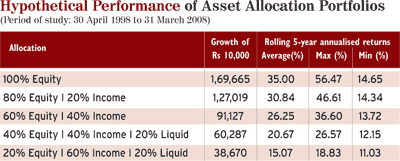
As you can see in Table II, while stocks may be more volatile, they have still outperformed other asset classes over longer time periods.The hypothetical asset allocation portfolios shown above are for illustrative purposes only. They do not represent the past or future portfolio composition or performance of any Franklin Templeton fund and are not intended as investment advice. Equity is represented by Franklin India Prima Plus, Income is represented by Templeton India Income Builder Account and Liquid is represented by Templeton India Treasury Management Account—Regular Plan.
Having a clear long-term asset allocation plan in line with your investment objective and risk profile is far more important than chasing yesterday’s winners and focusing on short-term trends.
4. Now May Be a Great Time for a Portfolio CheckupIs your portfolio as diversified as you think it is? Meet your financial adviser to find out. Your portfolio’s weightings in different asset classes may shift over time as one investment performs better or worse than another.Together with your adviser, you should re-examine your portfolio to see if you are properly diversified.You can also determine whether your current portfolio mix is still a suitable match with your goals and risk tolerance.
5. Realistic ExpectationsWe do not have control over market movements, but we can control our expectations. Equities have the potential to deliver reasonable rates of 12% over the next 5-10 years. Historically, equity markets have delivered relatively better inflationadjusted returns, but you need to keep in mind that volatility is an inherent characteristic of markets. While sentiment might impact the short-term direction of the markets, fundamentals have always prevailed over the longer term.
Sukumar Rajah is chief investment officer (equities) at Franklin Templeton Investments