
Just a fortnight ago, we told you not to let the volatility in the markets get to you (Keep Smiling, 15 November 2007). Keep investing, we said. If you haven’t started yet, this is as good a time as any, we added. Since the markets have been going up ever since, more and more investors are looking to invest directly in equities. Which is only good news for stock brokers.
CHECKLIST FOR SELECTION |
| Track record: Avoid firms that have been entangled in legal or regulatory problems in the past. Seek referrals from acquaintances |
| Accessibility: Getting through to the trading division should not be difficult. Check if there are enough phone lines and trade executors |
| Low costs: Compare brokerage charges of other firms. Opt for a plan that suits your trading style |
| Wider reach: The broker should trade on both NSE and BSE to ensure that you get the best prices |
| Online security: Make sure your online brokerage uses advanced encryption technology to prevent hacking |
It all sounds very good, no doubt, but is all this really for you? Should you stick with your broker simply because you pay a low brokerage fee? And if you’re a newbie, should you select a broker because you are offered free research reports? We cut through the clutter and examine the basic services that a broker ought to provide and what the value-additions are.
If you already have a broker, examine the services and charges offered. If they are not satisfactory, ask if you can get a better deal; otherwise, consider moving to a different broker. If you’re new to the markets, remember that selecting a stockbroker is as crucial as choosing the right doctor. Honesty, trustworthiness and competence are vital. Otherwise, it may prove injurious to your financial health.
THE SERVICES
Decide on your requirements before signing up. “We offer four different trading accounts, based on individual needs,” says Vinay Agrawal, vice-president, e-broking, Angel Broking. Brokerage firms today offer a bouquet of products and services, including trading in equities, commodities, derivatives, IPOs and mutual funds through both offline and online models. Some also offer financial planning and advisory services.
You can trade online, standing in front of a trader’s terminal, or on the phone through either voice or SMS. So, what channel should you use? An online platform offers many tools but it is important to understand these to avoid blunders. For example, you can set “at market” orders, limit orders, and stop losses. But a mis-click could cost a fortune. “Computer literacy plays an important role, since one needs to be Net-savvy,” says Agrawal. If you are not tech-savvy but know where to invest, start small with an online account. Once you are familiar with the system, you can raise the volume of trade.
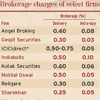 |
| Click to view the brokerage charges of select firms. |
Many brokerages also allow online clients to call and place orders. This is useful if, for some reason, the Internet is inaccessible. “We do not differentiate between our online and offline customers; they can use both trading modes and the services remain the same,” says Agrawal.
If you are a seasoned player and like day-trading, you might prefer trading at an outlet where you can directly place orders to the trader. That’s because online trading closes 15 minutes before end of session so an online day-trader can miss crucial last-minute moves.
In terms of value-addition, most brokerages provide research reports to their clients. Most broking houses offer research reports on over 100 stocks to its online clients while others give customers access to research by different brokerages. “At the end of the day, it is the customer who has to make an informed decision” says Anil Kaul, director and CEO (retail), ICICIdirect. However, adds Agrawal, “Many people prefer to do their own research and invest online. It’s more convenient.”
THE COSTS
Arora shifted to a new broking house because it charged a lower brokerage. Earlier, he used to pay almost 2% on every transaction, which ate into his profits. The new firm charges a flat fee of Rs 500 for trades up to Rs 5 lakh which is 0.1%. But while the brokerage is lower, the service of the new broker is not as good and Arora misses the personalised attention of the previous firm. |
Until 2000, when Geojit Securities launched the first Indian online trading service, investors had no way of confirming the price at which shares were bought or sold. And for this, they had to pay brokers between 1.5% and 2.5% on a trade. But with the advent of online trading and with more investors getting wise to the ways of brokerages, transparency regarding charges and costs has increased.
Fees have reduced substantially. Brokerage charges are now determined by the volume of trade, not a rigid percentage since the effort to execute a trade of 100 shares or 1,000 shares is the same.
The percentage charged as commission decreases as the trade value increases. The brokerage is determined by the model, value and volume of trade. Some broking houses insist on a minimum investment, though most do not.
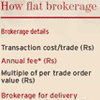 |
| Click to view how flat brokerage works. |
If you are a small investor, however, the flat structure will prove more expensive. “The flat fee model is suitable for traders who buy and sell in large volumes. For long-term investors, with only three-four trades a year, the savings may not be substantial,” says financial planner Gaurav Mashruwala.
An innovative scheme introduced by Reliance Money charges a flat Rs 500 for delivery-based trades up to a value of Rs 5 lakh per year. That works out to a very low rate of 0.10% for delivery-based trades.
For an increase in value to Rs 10 lakh, the investor is charged Rs 500 for two months. “We want to bring in more investors by offering them reasonable rates. For day traders, the power to trade through this route increases manifold,” says Sudip Bandyopadhyay, director and CEO, Reliance Money.













 Gaurav Arora, Chartered Accountant, Delhi